Collectible Artifact Comparison Tips: Expert Guide to Authentication and Valuation
Mastering the art of comparing collectible artifacts is essential for collectors, investors, and historians who want to avoid costly mistakes. Whether you are evaluating ancient coins, vintage furniture, archaeological relics, or historical documents, systematic comparison techniques reveal authenticity, condition, and fair market value. This comprehensive guide provides actionable tips for side-by-side artifact assessment, helping you make informed acquisition and disposal decisions.
Table of Contents
| Section | Topic |
|---|---|
| 1 | The Fundamentals of Artifact Comparison |
| 2 | Key Comparison Metrics for Different Artifact Types |
| 3 | Authentication Markers vs Red Flags |
| 4 | Using Reference Collections and Provenance |
| 5 | Tools and Techniques for Precise Comparison |
| 6 | Frequently Asked Questions |
1. The Fundamentals of Artifact Comparison
Collectible artifact comparison is the systematic process of evaluating two or more items against established benchmarks to determine authenticity, relative condition, and market value. Unlike casual observation, professional comparison relies on documented criteria, measurement standards, and knowledge of period-specific manufacturing techniques.
The core principle is simple but critical: every artifact tells a story through its materials, construction methods, wear patterns, and modifications over time. Learning to read these stories requires comparing not just similar items but also understanding how genuine artifacts differ from reproductions, forgeries, and restored pieces.
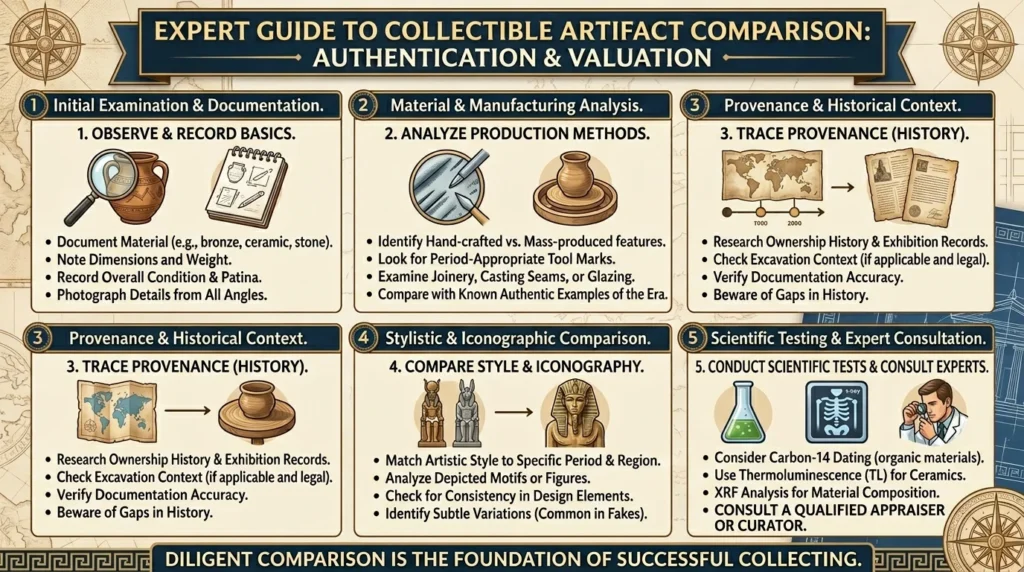
Why Comparison Matters
A collector who cannot compare effectively risks paying premium prices for common items, purchasing sophisticated forgeries, or selling undervalued treasures. The difference between an authentic 18th-century Chippendale chair worth 15,000anda20th−centuryreproductionworth300 often lies in subtle comparison details visible only to trained eyes.
The Three-Tier Comparison Framework
Professional collectors use a hierarchical approach starting with macro-features, moving to micro-details, and finally examining intangible characteristics. This structured method prevents premature conclusions based on surface impressions.
2. Key Comparison Metrics for Different Artifact Types
Different artifact categories require different comparison criteria. Understanding category-specific metrics dramatically improves evaluation accuracy.
Ancient Coins and Medals
When comparing ancient coins, examine these critical elements in order of importance:
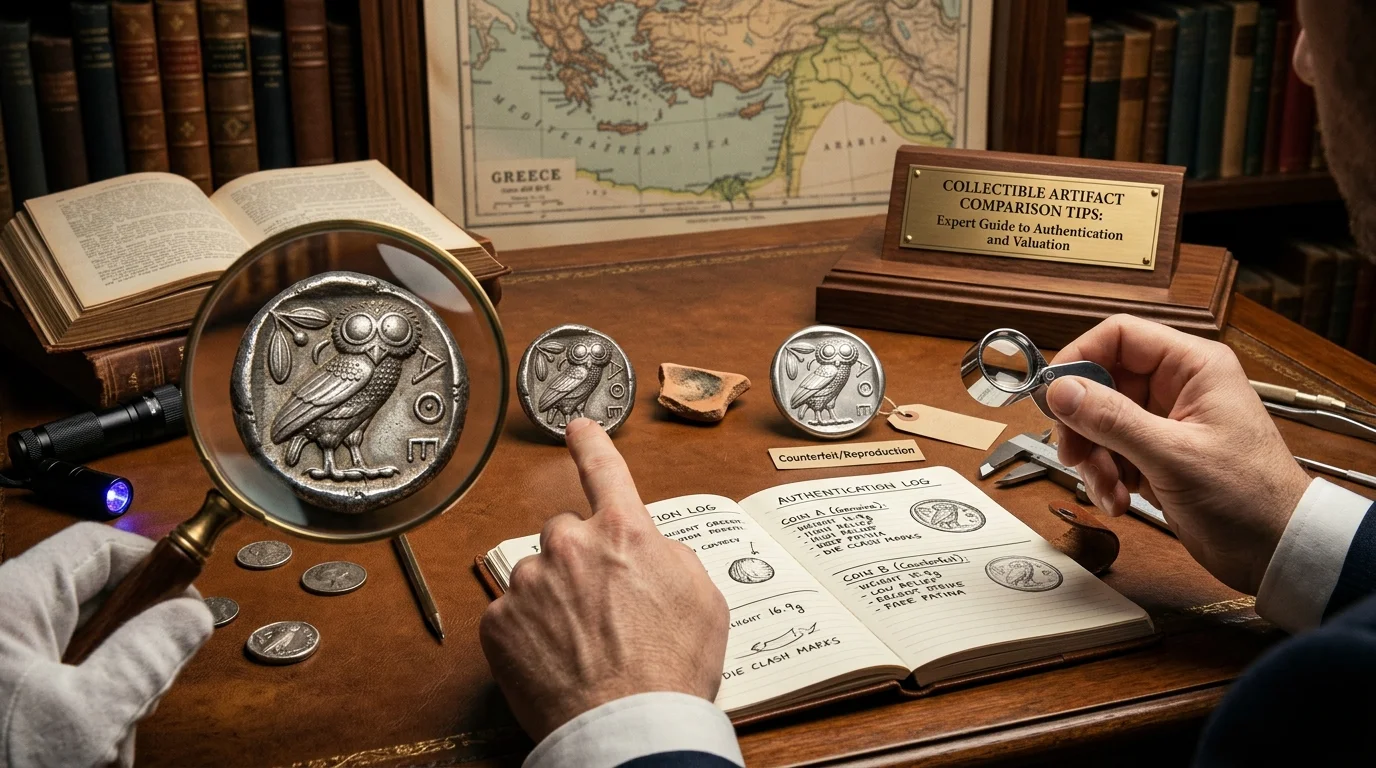
Die matching represents the gold standard for authentication. Two coins struck from identical dies will share microscopic alignment marks, flow lines, and die cracks. Reproductions cannot replicate these random characteristics.
Edge construction reveals age immediately. Cast reproductions often show seam marks, while struck coins exhibit metal flow patterns. Hammered coins display irregular edges, whereas milled coins have consistent rims.
Patina comparison requires careful attention. Genuine ancient patinas integrate with the metal surface. Artificial patinas sit on top and often dissolve in acetone or reveal bright metal underneath.
Weight and diameter measurements expose many forgeries. Ancient coins rarely meet theoretical ideal weights exactly due to circulation wear and ancient striking variations. Reproductions often hit perfect theoretical weights suspiciously.
Antique Furniture
Period furniture comparison focuses on construction techniques rather than appearance alone:
Joinery tells the truth. Hand-cut dovetails from the 18th century feature uneven pins and tails with saw marks. Machine-cut dovetails with perfectly uniform spacing indicate post-1860 manufacture at the earliest, and usually much later.
Wood oxidation comparison reveals age secrets. Exposed wood surfaces darken naturally over centuries. Interiors and hidden surfaces remain lighter. A piece showing uniform color inside and out suggests intentional aging or modern production.
Hardware comparison often exposes replacements or reproductions. Original 18th-century brass handles were hand-filed with slight irregularities. Machine-stamped hardware with perfect symmetry indicates 20th-century manufacture.
Archaeological Artifacts
Stone tools, pottery shards, and metal artifacts from archaeological contexts require specialized comparison protocols:
Wear pattern analysis distinguishes ancient use from modern manufacture. Genuine arrowheads show microscopic edge rounding from use. Freshly knapped reproductions display sharp, unworn edges.
Residue comparison can confirm authenticity. Ancient tools sometimes retain blood residues, plant phytoliths, or adhesive traces under magnification. Modern reproductions lack these environmental markers.
Break patination reveals age truthfully. Ancient breaks develop patina matching the surrounding surface over decades or centuries. Fresh breaks expose bright, unpatinated material.
Historical Documents and Paper Artifacts
Paper comparison requires understanding both material and content:
Chain and laid line patterns identify paper age. Handmade papers before 1800 show irregular chain lines. Machine-made papers after 1800 display consistent, parallel lines.
Ink chemistry comparison exposes modern additions. Iron gall ink from earlier centuries interacts with paper differently than modern synthetic inks. Ultraviolet light reveals these differences clearly.
3. Authentication Markers vs Red Flags
Creating a mental checklist of positive authentication markers and negative red flags streamlines the comparison process.
Positive Authentication Markers
Consistent wear distribution across all surfaces indicates genuine age. An antique chair showing heavy arm wear but pristine seat edges suggests selective aging. Genuine wear patterns look illogical but natural.
Tool marks that follow period-appropriate methods provide strong evidence. Eighteenth-century surfaces carry plane blade irregularities. Sandpaper scratches indicate post-1840 work.
Material availability matching the claimed origin confirms authenticity. A Hawaiian artifact made from non-native wood species cannot predate European contact regardless of appearance.
Red Flags Requiring Investigation
Identical wear on multiple supposedly unrelated items signals reproduction. Forgers often tumble modern pieces together to create artificial wear that appears suspiciously uniform.
Over-cleaned surfaces accompanied by aggressive aging marks should raise immediate concerns. Forgers clean pieces thoroughly to remove modern tool marks then add artificial wear.
Missing provenance combined with pristine condition creates suspicion. Rare artifacts surviving centuries without documentation or condition issues require exceptional verification before purchase.
Screws before 1850 indicate fraud in most contexts unless the artifact’s history specifically includes later repairs. Machine-made screws with consistent threads date to the mid-19th century at the earliest.
4. Using Reference Collections and Provenance
No collector can memorize every authentic detail. Reference collections and provenance documentation provide essential comparison benchmarks.
Building Reference Knowledge
Visiting museum collections with study access allows direct comparison with authenticated examples. Note that museum artifacts are not necessarily typical condition examples, as institutions often retain the finest specimens.
Published catalogs raisonnés provide authoritative comparison data for specific artifact categories. These resources document known genuine examples with measurements, materials, and distinguishing characteristics.
Online databases increasingly offer high-resolution images searchable by multiple criteria. The British Museum’s online collection and the Metropolitan Museum of Art’s Open Access program provide free reference images.
Provenance Comparison
Provenance documentation should form a complete chain from discovery or creation to present ownership. Gaps in this chain require additional verification.
Compare documented condition descriptions against current condition. Significant changes without explanation require investigation. A coin documented as having edge damage that suddenly appears undamaged should be rejected.
Compare ownership history against known collection catalogs. Many forgeries enter the market with invented provenances referencing legitimate collections. Verify each claimed previous owner through published records when possible.
5. Tools and Techniques for Precise Comparison
Professional-level comparison requires appropriate tools and systematic techniques.
Essential Comparison Tools
A 10x triplet loupe with built-in scale allows magnified examination of surface details. Avoid cheap plastic loupes that distort edges and reduce color accuracy.
Digital calipers measuring to 0.01mm provide precise dimension comparison. Record measurements in a standardized logbook for each artifact examined.
Ultraviolet light sources reveal retouching, modern adhesives, and certain restoration materials. Different materials fluoresce characteristically under long-wave and short-wave UV.
A gemologist’s scale accurate to 0.01 grams enables weight comparison. Temperature and humidity affect weight measurements, so control environmental conditions during comparison.
Side-by-Side Arrangement
Position artifacts on a neutral gray background with consistent lighting from a 45-degree angle. Overhead lighting creates shadows obscuring surface details. Multiple light sources eliminate confusing shadows but reduce texture visibility.
Photograph comparison items together in the same frame using identical camera settings. Reference scales and color charts in each image enable accurate remote comparison.
Documentation Protocol
Create standardized comparison sheets recording each metric examined. Include date, lighting conditions, tools used, and examiner qualifications. This documentation supports future reassessments and provides evidence for insurance or legal purposes.
Photograph comparison points at maximum magnification with scale visible. Digital images should be stored unmodified alongside RAW originals to preserve evidentiary value.
6. Frequently Asked Questions
Q1: Can two genuine artifacts of the same type appear completely different?
Yes, significantly. Individual variation is expected in handmade artifacts. Craftsman skill differences, material variations, and usage patterns create authentic diversity. Only machine production creates identical specimens.
Q2: How can I compare artifacts when I only have access to photographs?
Photographic comparison is limited but useful. Request images taken under natural daylight without filters. Ask for scale references, edge views, and magnified detail shots. Compare measurements and weights when provided.
Q3: What is die matching in coin comparison?
Die matching examines the specific metal stamps used to strike coins. Two coins struck from the same die will share microscopic die flaws, alignment marks, and metal flow patterns. Die matching is a definitive authentication method when demonstrable.
Q4: How does patina help in comparison?
Patina forms through chemical reactions between artifact materials and the environment over time. Comparing patina color, thickness, adhesion, and distribution helps distinguish ancient objects from modern reproductions. Artificial patinas behave differently under magnification and chemical testing.
Q5: Is it safe to handle artifacts directly during comparison?
Direct handling risks damage from skin oils, moisture, and physical pressure. Wear cotton or nitrile gloves. Support artifacts on padded surfaces. Never force stuck components. If dismantling is necessary for comparison, consult a professional conservator.
Q6: Can restoration affect comparison results?
Yes, restoration can significantly alter comparison metrics. Replaced components may not match original materials. Surface cleaning can remove patina evidence. Repairs can obscure original construction details. Always compare restored artifacts against documentation of pre-restoration condition.
Q7: What is the most reliable single comparison metric?
No single metric proves authenticity. Forged artifacts often succeed on one metric while failing on others. Reliable comparison requires multiple independent metrics pointing to the same conclusion. Convergence of evidence matters more than any individual measurement.
Q8: How do I compare artifacts from unknown cultures?
Research comparative examples from archaeological reports and museum databases. Focus on manufacturing techniques, which are culturally specific. Avoid comparing purely aesthetic features, which may coincidentally resemble artifacts from unrelated cultures.
Q9: What is provenance comparison?
Provenance comparison verifies that an artifact‘s documented ownership history aligns with its physical characteristics, condition, and known examples from that collection. It involves checking publication records, exhibition histories, and collection marks against physical evidence.
Q10: Can machine learning help with artifact comparison?
Emerging AI systems show promise for certain comparison tasks, particularly pattern recognition in coins, pottery decoration, and tool typologies. However, current systems require extensive training datasets and cannot replace expert visual comparison for authentication decisions.
collectibleartifactcomparison artifactauthenticationtips compareantiques artifactvaluation reliccomparisonguide antiquecoincomparison furnitureauthentication archaeologicalartifacttips collectioncomparison forgerydetection artifactprovenance patinacomparison diecoinnatching antiquecollectortips comparisonmetrics