Complete Collectible Relic Storage Guide: Professional Preservation Methods for Home Collectors
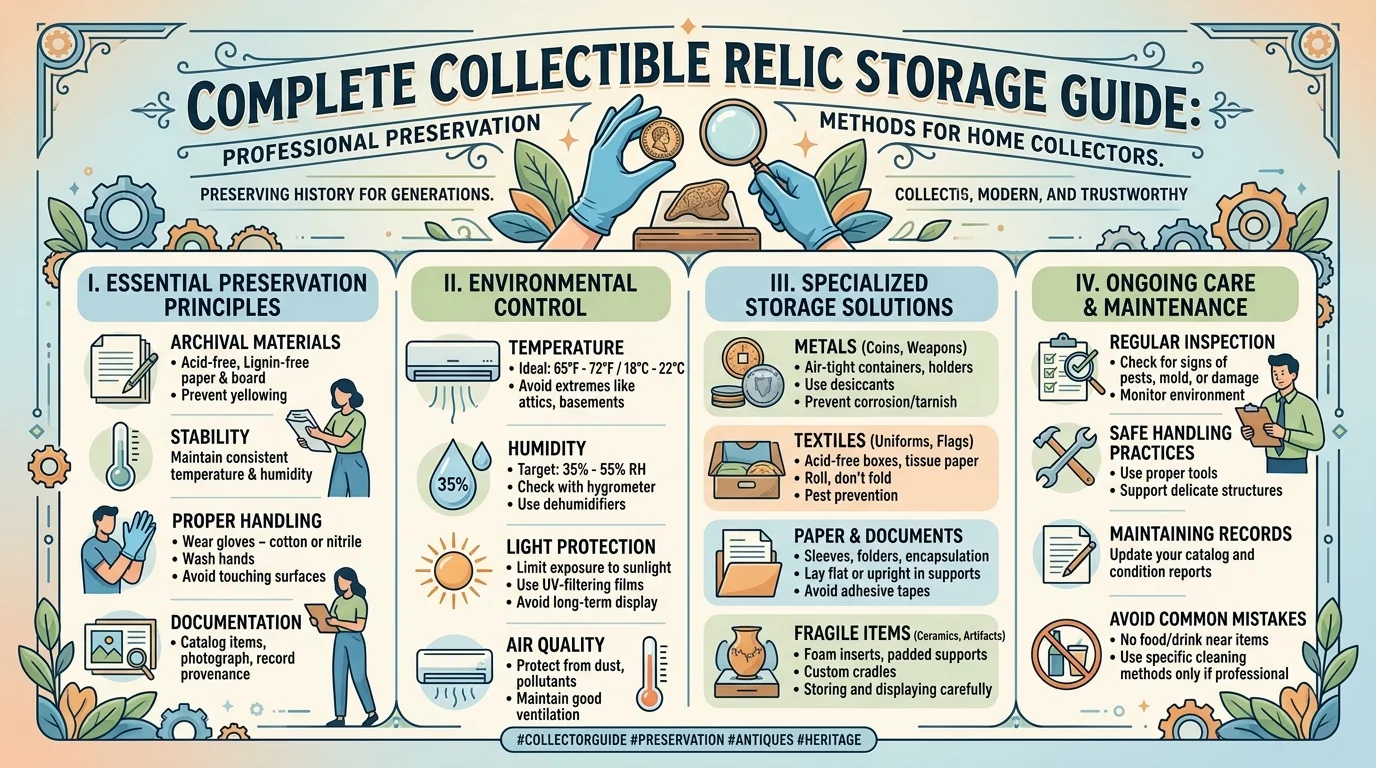
Preserving valuable collectibles and historical relics requires more than just finding a shelf or a box. Whether you collect ancient artifacts, vintage textiles, rare documents, or mineral specimens, proper storage is the single most important factor in maintaining condition and value. This comprehensive guide draws on museum conservation standards to help home collectors implement professional-grade storage solutions that protect treasures from deterioration, damage, and loss.
Table of Contents
| Storage Component | Key Requirement | Risk If Ignored |
|---|---|---|
| Temperature | 15-20°C (59-68°F) stable | Cracking, embrittlement |
| Relative Humidity | 45-55% stable | Mold, corrosion, shrinkage |
| Light Exposure | No direct sunlight, UV filtering | Fading, chemical degradation |
| Storage Materials | Archival-quality, acid-free | Acid migration, staining |
| Pest Control | Regular inspection, exclusion | Physical damage, infestation |
| Documentation | Detailed catalog with photos | Loss of provenance, insurance issues |
| Security | Locked storage, access control | Theft, unauthorized handling |
| Disaster Preparedness | Smoke detectors, off-site backups | Total loss |
Understanding the Agents of Deterioration
Before implementing any storage solution, collectors must understand what threatens their treasures. Museum conservation identifies ten primary agents of deterioration, but for home storage, four factors require the most attention .
Temperature and Relative Humidity
Temperature and humidity work together as the most critical environmental factors affecting collectible relics. Inorganic materials like stone, ceramics, and most metals are relatively stable but will still be affected by adverse conditions . Organic materials—including wood, leather, textiles, paper, and bone—are particularly vulnerable to environmental fluctuations .
Professional storage facilities target a temperature of 15°C (59°F) and relative humidity of 55% year-round . For home collectors, the goal is stability rather than specific numbers. Avoid attics (temperature extremes), basements (humidity and flood risk), and exterior walls (temperature fluctuations).
Light Exposure
Direct sunlight is destructive to almost all collectible materials. Ultraviolet radiation fades pigments, weakens fibers, and accelerates chemical deterioration. The Western Australian Museum emphasizes: “Exclude direct sunlight from storage and display areas” . If you must display light-sensitive items, use UV-filtering glass or acrylic and rotate display periods to limit cumulative exposure.
Biological Pests
Insects, rodents, and mold can destroy a collection rapidly. The National Building Museum’s collections team notes that proper housekeeping and building maintenance are essential to reducing biological pest effects . Regular inspections, clean storage areas, and immediate attention to any signs of infestation are critical preventive measures.
Material-Specific Storage Guidelines
Different materials require different storage approaches. Understanding the specific needs of your collectibles is essential.
Textiles and Costumes
Cooper Hewitt, Smithsonian Design Museum houses over 26,000 textiles spanning twenty-four centuries. Each textile “is stored in a specially designed archival container that facilitates safe access for research and evaluation, as well as ensures the collection’s preservation for future generations” .
The museum’s storage system, designed by conservator Lucy Commoner, uses six standard-size modular boxes constructed of archival materials chosen for their chemically stable quality. Cotton twill tape, linen thread, and hand-stitched embossed labels secure and identify the textiles .
For home collectors:
- Store flat, never folded when possible
- Use acid-free tissue paper between folds if folding is necessary
- Avoid wooden drawers unless sealed (wood emits acidic vapors)
- Use padded hangers for hanging garments
- Wrap in unbleached cotton muslin for dust protection
Paper Documents and Photographs
Paper is highly susceptible to acid degradation, light damage, and improper handling.
The National Building Museum’s preservation team demonstrates best practices with a 1939 color pencil rendering that had been taped to high-acid fiberboard. After 80 years, the tape had dried out significantly. Using a very thin bone folder, they carefully removed the tape without harming the drawing, then scanned it and placed it in a new archival folder .
Key practices for paper storage:
- Remove all metal fasteners (staples, paperclips) which oxidize and stain paper
- Store in acid-free folders and boxes
- Use Mylar encapsulation for frequently handled items
- Keep flat, never rolled
- Maintain moderate humidity (prevents brittleness)
Metal Artifacts
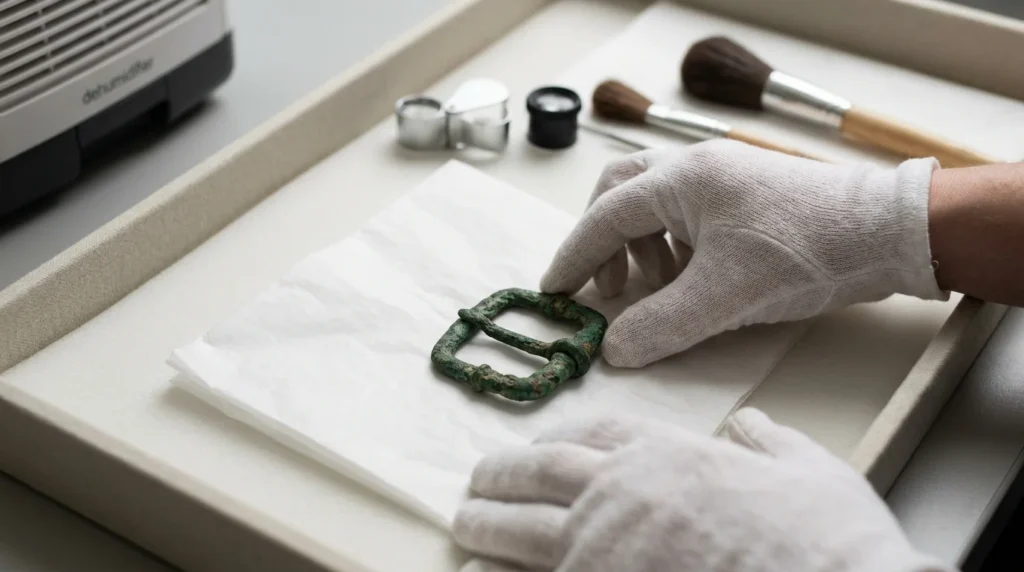
Metals require protection from humidity, which causes corrosion. The National Building Museum’s conservation of a Woolworth Building elevator surround demonstrates proper metal care. The piece had been painted and repainted for over a century before arriving at the museum. Conservators cleaned the surface, removed excess paint layers, retouched worn areas, and applied a protective gold gilt wax .
For home collectors:
- Maintain low, stable humidity (below 55%)
- Use silica gel in enclosed storage for humidity control
- Avoid handling with bare hands (skin oils cause corrosion)
- Store silver in acid-free tissue or specially treated cloth
- Never clean patina unless professionally advised
Stone, Mineral, and Fossil Specimens
Rock and mineral collections have unique storage requirements. Documentation is particularly important for geological specimens. “If self-collected, record the locality and date of collection. If purchased, record when, where, from whom, and the price paid. ‘Provenance’ is important in the collecting world and adds value” .
Storage practices for specimens:
- Most store well at room temperature
- Some specimens are sensitive to humidity or light
- Use compartmentalized trays or drawers to prevent contact damage
- Label each specimen individually, not just the container
- Store high-value items in locked safes or safe deposit boxes
The Virtual Vault: Digital Documentation
Physical storage is only half the equation. Documentation protects your collection’s value and ensures proper insurance coverage.
The WorthPoint Vault provides a virtual storage service for collectors to keep documentation, photos, and price information on their valuables. CEO Will Seippel created this solution after losing his Florida home to Hurricane Ian in 2022. Despite his extensive background in antiques, Seippel did not have an inventory of his possessions, making the insurance claim process arduous .
Seippel explains: “Nobody knows what’s in your house better than you—not the bank, the insurance company, or anyone else. The Vault is a way for anyone to safely back up the information, value, and history of anything they own. It’s safe, secure, and available should the worst happen” .
Essential documentation elements:
- High-quality photographs from multiple angles
- Provenance records (ownership history)
- Purchase price and date
- Appraised value (updated every 3-5 years)
- Insurance policy information
- Storage location within your home
Store this documentation off-site—cloud storage, a safe deposit box, or with a trusted family member.
Insurance and Appraisal
Proper storage must be complemented by adequate insurance coverage. Standard homeowner’s policies typically have very low limits for collectibles.
For rock and mineral collections, experts recommend seeking specialized “collectibles insurance” rather than relying on homeowner’s policies. One collector spends 120annuallyfora200−piececollectionworth17,000 through a specialized insurer .
Before obtaining insurance:
- Have the collection appraised by qualified professionals
- Look for appraisers certified by the Appraisers Association of America, American Society of Appraisers, or International Society of Appraisers
- Avoid appraisers who offer to buy items they appraise (conflict of interest)
- Seek policies covering theft, accidental breakage, fire/water damage, and natural disasters
Home Storage vs. Professional Facilities
While professional museum-level storage is difficult to replicate at home, it is not impossible. Millions of collectors successfully maintain valuable collections in their homes .
To organize secure antique storage at home:
- Select a room with no direct light and no open vents
- Maintain strict temperature and humidity control
- Use humidifiers or dehumidifiers as needed
- Use acid-free materials for all containers and wrapping
- Clean and inspect items regularly based on their material type
For extremely valuable collections or when home conditions are inadequate, professional storage facilities offer solutions. DeepStore, the entrusted storage provider for The National Archives, operates 150 meters below the surface in a rock salt mine, providing naturally stable temperature of 15°C and 55% relative humidity year-round, free from UV light, flooding, pests, and even bomb threats .
The Role of Digital Replicas
For items too fragile for regular handling or display, digital restoration and reproduction offer an excellent solution. The Conservation Center’s Digital Restoration department uses overhead scanners that never touch the object’s surface, allowing safe duplication of delicate photographs, documents, and books .
This approach allows collectors to:
- Display high-quality reproductions while originals remain in secure storage
- Share collection items with researchers without risk
- Provide access to family members while protecting heirlooms
- Create backup copies in case of disaster
Transition Planning for Collections
One of the most overlooked aspects of collectible storage is planning for the collection’s future after the collector’s lifetime.
As Rock & Gem Magazine notes: “All too often, collections get broken up and sold for pennies on the dollar after the death of the collector. Worst case, they end up in a landfill because kids can’t be bothered” .
To prevent this outcome:
- Spell out collection wishes in a will or trust
- Discuss intentions with heirs during your lifetime
- Consider donating to museums (accompany with cash endowment for upkeep)
- Liquidate during your lifetime if heirs have no interest
Checklist for Collectible Relic Storage
| Task | Frequency | Priority |
|---|---|---|
| Inspect stored items for damage | Monthly | High |
| Check humidity and temperature levels | Weekly | High |
| Clean storage areas | Quarterly | Medium |
| Update documentation with new acquisitions | As acquired | High |
| Review insurance coverage | Annually | High |
| Update appraisals | Every 3-5 years | Medium |
| Test smoke detectors | Monthly | Critical |
| Backup digital documentation | Quarterly | High |
FAQ
What temperature and humidity are best for storing collectible relics?
Professional facilities target 15°C (59°F) and 55% relative humidity. For home collectors, stability is more important than specific numbers. Avoid attics, basements, and exterior walls. Inorganic materials are more stable than organic materials but will still be affected by adverse conditions .
Can I store antiques and collectibles in my home?
Yes. While museum-level conditions are difficult to replicate, millions of collectors successfully store valuable collections at home. Select a room with no direct light and no open vents, maintain strict temperature and humidity control, and use acid-free storage materials .
What is the best way to document my collection?
Create an electronic catalog with photographs, provenance records, purchase information, and appraised values. Store this documentation off-site using cloud storage or a safe deposit box. The WorthPoint Vault offers a secure virtual storage service for this purpose .
How should I store textiles and vintage clothing?
Store flat when possible, using acid-free tissue paper between folds. Avoid wooden drawers unless sealed. Use padded hangers for hanging garments. Wrap in unbleached cotton muslin for dust protection. Cooper Hewitt Museum’s textile storage system uses archival boxes with cotton twill tape and linen thread for securing items .
Do I need insurance for my collection?
Yes, especially for collections with significant monetary or historical value. Standard homeowner’s policies typically have low limits for collectibles. Specialized collectibles insurance is often affordable—one collector pays 120annuallyfor17,000 worth of coverage .
How do I handle fragile paper documents?
Remove all metal fasteners like staples and paperclips, which oxidize and stain paper. Store in acid-free folders and boxes. Consider Mylar encapsulation for frequently handled items. For heavily damaged items, professional digital restoration can create usable reproductions while preserving originals .
What should I do with my collection when I travel or move?
For short-term absences, ensure environmental controls remain operational. For moves, use professional art movers with experience in fragile items. For extreme situations (military deployment, long-term travel), consider professional storage facilities like DeepStore, which provides BS EN 16893:2018 compliant storage .
What planning should I do for my collection’s future?
Document your wishes in a will or trust. Discuss intentions with heirs. Consider donating to museums (potentially with a cash endowment). If heirs have no interest, consider liquidating during your lifetime. Proper documentation ensures your collection’s value and stories are preserved .