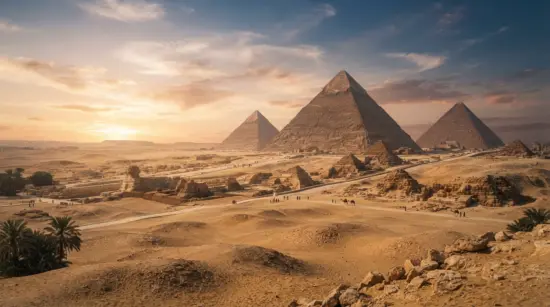
Standing on the dusty horizon of the Giza Plateau, the Great Pyramids cut a striking silhouette against the desert sky. For thousands of years, these colossal stone structures have captured human imagination, inspiring awe, artistic wonder, and intense scientific debate. Built during an era long before modern cranes, heavy machinery, or advanced surveying computers, the pyramids represent one of the greatest engineering feats in human history.
Yet, despite centuries of excavation, historical study, and technological analysis, the Egyptian pyramids refuse to give up all their secrets. Behind those massive blocks of granite and limestone lie hidden chambers, unexplained acoustic phenomena, astronomical alignments of uncanny precision, and architectural mysteries that continue to stump top engineers today. In this deep dive, we will explore the mind-blowing secrets, hidden rooms, and fascinating facts that make the Egyptian pyramids an eternal enigma.
1. The Construction Paradox: How Were They Really Built?
When you stand at the base of the Great Pyramid of Giza, built for the Pharaoh Khufu around 2560 BCE, the sheer scale is overwhelming. It is composed of roughly 2.3 million stone blocks, each weighing between 2.5 and 80 tons. To complete the monument within Khufu’s roughly 20-to-27-year reign, workers would have had to cut, transport, lift, and place a block roughly every two minutes, working 10 hours a day, every day of the year.
Moving Massive Stones Across Desert Sands
For decades, scholars debated how ancient builders moved such tremendous weights across shifting desert terrain without modern engines. A long-held popular theory suggested crude wooden rollers, but recent discoveries revealed a far simpler, brilliant technique. Ancient tomb paintings show massive statues being pulled on sledges while a worker pours water on the sand directly ahead of the runners.
Physicists tested this method and confirmed that dampening sand reduces friction by roughly 50 percent. If the sand is too dry, it piles up in front of the sledge; if it is too wet, it bogs down. By achieving the precise ratio of water to sand, a relatively small team of workers could pull multi-ton sledges with surprising speed and efficiency.
The Mysterious Mortar That Outlasted Millennia
While the stone blocks themselves are famous, the mortar holding them together is equally miraculous. Ancient Egyptians used an estimated 500,000 tons of mortar during the construction of the Great Pyramid. Analysis reveals that this plaster-based mortar is significantly stronger and more water-resistant than modern cement.
Intriguingly, while scientists know the chemical composition—primarily gypsum that was superheated and mixed with additives—modern material scientists still cannot fully replicate its precise bonding strength. It has held the heavy stone casing in place through millennia of earthquakes, extreme heat, and seasonal shifts.
2. Hidden Voids and Unexplored Chambers
For centuries, explorers believed they had mapped every corridor within the Great Pyramid. The known internal network includes the Subterranean Chamber carved into the bedrock, the Queen’s Chamber, the Grand Gallery, and the King’s Chamber at the center. However, modern particle physics has revealed that the ancient monument still holds uncharted territory.
The Cosmic Ray Discovery: The Big Void
In 2017, an international team of researchers operating under the ScanPyramids project published a groundbreaking study. Using non-invasive cosmic-ray muon radiography—a technique similar to an X-ray that measures subatomic particles passing through solid rock—they discovered a massive hidden void above the Grand Gallery.
This space, dubbed the “Big Void,” is estimated to be at least 98 feet (30 meters) long and similar in cross-section to the Grand Gallery. In 2023, further high-definition ultrasound and endoscopic imaging confirmed a corridor-like space near the main entrance on the north face. Archeologists are still debating its true function:
- Structural Weight-Relieving Space: A deliberate void engineered to relieve stress from the immense weight of stone above the Grand Gallery.
- A Hidden Burial Chamber: An untouched room designed to preserve royal treasure far away from ancient grave robbers.
- Construction Ramp Pathway: An internal void used to guide internal counterweights during the building process.
3. Mind-Blowing Astronomical and Geographical Precision
The geometric precision of the Great Pyramid of Giza seems almost impossible for a bronze-age civilization. The base of the Great Pyramid covers over 13 acres and is level to within less than an inch across the entire perimeter. Even more astonishing is its cardinal alignment.
Targeting True North
The Great Pyramid is aligned to True North with an error margin of just four-sixtieths of a single degree. This alignment is far more accurate than the Royal Observatory in Greenwich, London, which missed absolute true north by a wider margin. Because the magnetic poles shift over time, achieving alignment with True North required detailed long-term observations of circumpolar stars, such as Thuban, which served as the Pole Star in ancient times.
The Orion Correlation Theory
One of the most captivating theories surrounding the Giza layout is the Orion Correlation. Proposed by author Robert Bauval, this hypothesis notes that the three main pyramids on the Giza plateau—Khufu, Khafre, and Menkaure—are arranged in an exact spatial configuration matching the three stars of Orion’s Belt (Alnitak, Alnilam, and Mintaka).
Furthermore, the size of each pyramid corresponds to the relative brightness of each star, and the nearby Nile River mirrors the placement of the Milky Way galaxy. In ancient Egyptian cosmology, Orion was intimately tied to Osiris, the god of rebirth and the underworld. While some mainstream archaeologists view this correlation as coincidental, the geometric relationship between the sites remains an intriguing subject of study.
4. Acoustic Reverberation and Thermal Anomalies
Beyond what we can see with the naked eye, the interior of the Great Pyramid behaves strangely in terms of sound, light, and heat.
Resonance in the King’s Chamber
Step inside the King’s Chamber, built entirely of dark red granite blocks brought from Aswan, and you will notice an eerie acoustic property. Acoustic engineers have measured that the room acts as a powerful resonant cavity, capable of amplifying specific sound frequencies. The natural resonant frequency of the chamber centers around 438 to 440 Hz—very close to the standard tuning tone for modern musical instruments.
When low-frequency sounds or chants are produced inside the chamber, the solid granite vibrates, creating an intense, immersive reverberation that can produce deep psychological and physiological sensations. Some researchers suggest this acoustic resonance was intentionally engineered into the room to enhance sacred rituals performed for the deceased pharaoh.
Thermal Variations Behind Stone Walls
In 2015, thermal imaging surveys conducted during different times of the day revealed unusual temperature anomalies across the Giza structures. Most notably, along the lower eastern base of the Great Pyramid, researchers discovered a row of adjacent stones that showed a temperature difference of up to 6 degrees Celsius compared to neighboring rocks.
Such thermal spikes usually indicate empty spaces, air currents, or distinct building materials hidden directly behind the exterior stones. While research remains ongoing, these thermal patterns provide compelling evidence that there are still hollow internal spaces waiting to be uncovered.
5. Surprising Facts Most People Don’t Know
Popular media often portrays the pyramids as dusty, yellow-brown monuments standing alone in an empty desert filled with cursed tombs. The historical reality is far richer and more colorful.
They Once Gleamed Like Polished Diamonds
When the pyramids were originally completed, they did not look like the weathered stone stacks we see today. They were coated in a smooth, gleaming outer layer of highly polished Tura limestone. These white casing stones were cut with remarkable precision so that the joints were nearly invisible.
Under the hot Egyptian sun, the monuments reflected light so intensely that they could be seen from miles away, earning them the ancient name “Ikhet,” meaning the “Glorious Light.” In 1301 CE, a massive earthquake loosened much of the casing, after which local builders stripped the fallen limestone to build palaces, mosques, and fortresses in nearby Cairo.
An Ancient “Air Conditioning” System
Despite the blazing heat of the Sahara Desert, where temperatures routinely exceed 100°F (38°C), the internal temperature of the Great Pyramid remains constant at exactly 20°C (68°F)—the average ambient temperature of the Earth at that latitude. This climate stability was achieved through precise stone thickness, strategic air shafts, and insulating mortar design.
The Pyramids Were Not Built by Slaves
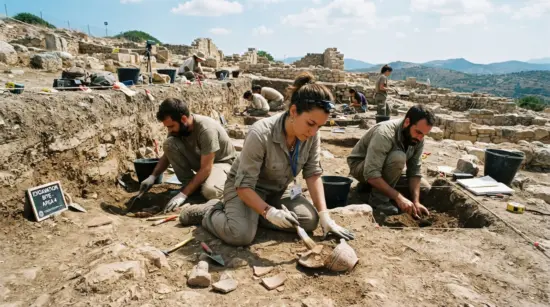
Hollywood movies often show thousands of mistreated slaves building the pyramids under the whip. However, modern archaeological excavations near the Giza site proved this narrative wrong. In the 1990s, archaeologists unearthed the Lost City of the Pyramid Builders.
Findings show that the workforce consisted of tens of thousands of skilled, well-paid laborers who worked in seasonal shifts. Examination of animal bones shows they ate high-quality meat (beef and mutton), had access to medical care for broken bones, and were buried with honor in tombs near the royal pyramids when they died—a privilege never granted to slaves.
No Royal Mummies Were Found in the Giza Pyramids
Although pyramids served primarily as monumental funerary sites, no royal mummy was ever discovered inside the Great Pyramid of Giza. When early Arabic explorers broke into the King’s Chamber in the 9th century, they found the carved granite sarcophagus completely empty, missing its lid and containing no gold, jewelry, or human remains. While tomb robbers likely looted the treasures during antiquity, the total absence of funerary inscriptions inside the chamber leaves room for continued debate.
6. Key Pyramids Beyond Giza
While Giza gets most of the global spotlight, Egypt is home to over 118 identified pyramids, showcasing an evolution of architectural experimentation over centuries.
The Step Pyramid of Djoser (Saqqara)
Built around 2670 BCE by the legendary architect Imhotep, the Step Pyramid is considered the world’s oldest large-scale cut-stone structure. Instead of smooth sides, it features six stacked stone layers (mastabas) rising like a giant staircase into the sky.
The Bent Pyramid of Dahshur
Built under Pharaoh Sneferu, this monument is famous for its unique silhouette. The lower section rises at a steep 54-degree angle, but halfway up, the builders abruptly adjusted the slope to 43 degrees. Architects realized the initial angle was structurally unstable and causing internal structural cracks, leading to a quick mid-construction fix that gives the pyramid its famous “bent” look.
The Red Pyramid
Learning from the structural errors of the Bent Pyramid, Sneferu successfully constructed the Red Pyramid nearby. Rising at a constant 43-degree angle, it became the world’s first successful smooth-sided pyramid, serving as the direct architectural blueprint for the Great Pyramid at Giza.
7. Frequently Asked Questions (FAQ)
Why were the Egyptian pyramids built?
The pyramids were primarily built as grand funerary monuments and resurrection machines for the pharaohs. Ancient Egyptians believed that when a king died, part of his spirit (the Ka) remained with his body. The pyramid protected the royal body, showcased the king’s divine authority, contained grave goods for the afterlife, and served as a symbolic launchpad for his soul to join the gods in the heavens.
How long did it take to build the Great Pyramid of Giza?
Historical estimates and archaeological evidence suggest it took approximately 20 to 27 years to build the Great Pyramid of Giza. This required an organized workforce of thousands of skilled builders, quarrymen, stone masons, transport crews, and support staff living in nearby temporary cities.
Are there still undiscovered rooms inside the Great Pyramid?
Yes. Recent non-invasive research projects, such as ScanPyramids using cosmic