For roughly ninety-nine percent of human history, our ancestors lived on the move. Small, tightly knit bands of hunter-gatherers tracked game across vast distances, gathered wild plants, and adapted constantly to the shifting moods of nature. Their world was vast, but their permanent footprints on the landscape were light. Then, in a relatively brief period on the geological clock—between 10,000 BCE and 3,000 BCE—human society underwent a radical transformation.
Across several distinct regions of the globe, people stopped wandering. They cleared fields, built permanent homes, stored harvests, and organized complex social structures. This shift laid the groundwork for the world’s first civilizations. But how exactly did humans transition from small foraging groups to massive, organized empires with standing armies, monumental architecture, and written legal codes? The answer lies in a fascinating combination of climate shifts, agricultural breakthroughs, geographic luck, and human ingenuity.
The Spark of Progress: The Agricultural Revolution
To understand the rise of complex societies, you have to start with food. For tens of thousands of years, obtaining enough calories to survive was a full-time, collective effort. Humans consumed what was readily available in their immediate environment, moving when resources thinned out.
Around 10,000 BCE, as the last ice age receded, temperatures warmed and weather patterns became more predictable. In various parts of the world, humans began noticing that seeds dropped in fertile soil yielded harvestable crops months later. Rather than searching for food, they could produce it.
This transition, known as the Neolithic Revolution, altered everything. The intentional cultivation of cereal grains like wheat, barley, millet, and rice—combined with the domestication of animals like goats, sheep, cattle, and pigs—created something entirely new: food surpluses.
A food surplus meant that not every individual needed to farm to keep the community alive. For the first time, societies could support specialized roles. Some people became full-time builders, weavers, blacksmiths, and potters. Others stepped into roles as priests, administrators, and soldiers. Settlements expanded from temporary encampments into permanent villages, which gradually grew into dense, thriving cities.
Mesopotamia: The Cradle in the Fertile Crescent
If you trace the origins of urban life, your journey inevitably leads to Mesopotamia—a region nestled between the Tigris and Euphrates rivers in modern-day Iraq, Syria, and Turkey. The word Mesopotamia literally translates to “the land between rivers,” and those waters were the lifeblood of human settlement.
The climate of southern Mesopotamia was arid and received little rainfall, making dry farming impossible. However, the twin rivers flooded annually, leaving behind rich, nutrient-dense silt. To harness this resource, local communities had to coordinate on a massive scale. They built complex irrigation networks, dig canals, construct levees, and manage water distribution during droughts.
This required organized leadership, which laid the foundation for the world’s first true city-states around 4000–3500 BCE, dominated by a culture known as the Sumerians.
The Rise of Sumerian City-States
Cities like Uruk, Ur, Eridu, and Lagash emerged as vibrant regional centers. Uruk, at its peak around 3000 BCE, was home to an estimated 50,000 to 80,000 residents—an unprecedented concentration of human beings. Towering over these mud-brick cities were ziggurats, massive terraced step pyramids that served as religious centers and administrative hubs run by powerful priesthoods.
The Sumerians were tireless innovators. To keep track of grain storage, livestock counts, and trade agreements, they invented one of the earliest known writing systems: cuneiform. Starting as simple pictorial tokens pressed into wet clay tablets using a reed stylus, cuneiform evolved over centuries into a sophisticated script capable of recording complex literature, legal codes, and historical events.
Sumerian innovations did not end with writing. They popularized the wheel for transportation and pottery production, developed advanced mathematics based on the number 60 (which gives us our 60-minute hour and 360-degree circle), and crafted intricate metallurgy. In time, competing city-states were unified under broad empires, most notably by Sargon of Akkad, who created one of history’s earliest recorded multi-ethnic empires.
Ancient Egypt: Life Along the Gift of the Nile
While Sumer was establishing its city-states, another monumental civilization was taking shape along the banks of the Nile River in northeastern Africa. The Greek historian Herodotus famously called Egypt “the gift of the Nile,” and the description remains spot-on.
Unlike the wild, unpredictable flooding of the Tigris and Euphrates, the Nile flooded with astonishing regularity every summer. As the floodwaters receded, they left behind a rich, dark mud known as kemet (the black land), which offered incredibly fertile soil for crops. Surrounding this thin ribbon of green was harsh, impassable desert (the red land), which served as a natural barrier against foreign invasion.
Unification, Divine Kingship, and Eternity
Around 3100 BCE, King Narmer (sometimes identified as Menes) unified Upper and Lower Egypt, wearing the double crown to symbolize a single, centralized state. This marked the start of a political structure that would endure for millennia under the rule of Pharaohs—monarchs who were viewed not just as human rulers, but as earthly manifestations of divine power.
The Egyptian state was heavily centralized. A sprawling bureaucracy controlled agricultural distribution, collected taxes, organized massive labor forces, and managed vast trade networks stretching into Nubia, the Levant, and the Mediterranean.
To preserve administrative order and religious ritual, the Egyptians developed hieroglyphics, a visual writing system combining logographic, syllabic, and alphabetic elements. Written on papyrus scrolls, carved into temple walls, and painted inside tombs, hieroglyphs documented everything from economic inventories to divine prayers.
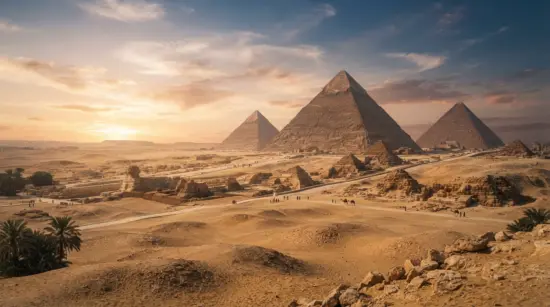
Egyptian culture was profoundly shaped by a belief in maat—the cosmic order, truth, and balance of the universe. The Pharaoh’s chief duty was to maintain maat. This deep concern with spiritual balance and the afterlife drove their iconic architectural legacy. During the Old Kingdom period (c. 2686–2181 BCE), Egypt constructed the Great Pyramids at Giza, engineering marvels built through precise mathematical planning and extraordinary human labor.
The Indus Valley: Urban Planning and Unsolved Mysteries
Thousands of miles to the east, along the basin of the Indus River in modern-day Pakistan and northwest India, another major civilization flourished contemporaneously with Mesopotamia and Egypt. Known today as the Indus Valley Civilization (or Harappan culture), this society reached its mature peak between 2600 BCE and 1900 BCE.
Spanning an area larger than ancient Egypt and Mesopotamia combined, the Indus Valley featured major urban centers like Harappa, Mohenjo-Daro, and Dholavira. What sets this civilization apart from its peers is its astonishing degree of city planning and technological standardization.
Masters of Infrastructure
Walking through the ruins of Mohenjo-Daro, modern archaeologists found cities laid out on precise grid systems. Houses were built using uniform, kiln-baked mud bricks that matched exact dimensional ratios across hundreds of miles of territory.
Perhaps most impressive was their sophisticated infrastructure:
- Advanced Drainage Systems: Almost every home was connected to a covered municipal drainage system, featuring private bathing rooms and flushable toilets—a level of public sanitation unmatched anywhere else in the world until the Roman Empire thousands of years later.
- Public Facilities: Instead of towering royal palaces or grand temples, the largest structures in Indus cities were public amenities, such as the “Great Bath” at Mohenjo-Daro, which likely served ceremonial or civic hygiene purposes.
- Standardized Weights and Measures: Trade was tightly regulated using uniform chert weights, indicating a high level of economic organization.
Despite their incredible achievements, the Indus Valley culture remains shrouded in mystery. Their script, found on thousands of carved steatite seals, has never been deciphered. Furthermore, unlike Mesopotamia or Egypt, archaeologists have found little evidence of grand monuments glorifying kings, massive weaponry, or military fortification, leading some scholars to suggest that their social hierarchy was surprisingly egalitarian.
China’s Yellow River Valley: The Dragon Awakens
In East Asia, human civilization forged its own independent path along the banks of the Yellow River (Huang He) and the Yangtze River. The yellow-colored, windblown soil known as loess washed into the Yellow River, creating immensely fertile floodplains perfect for cultivating dry crops like millet, while the warmer Yangtze region favored rice farming.
Early agricultural villages eventually coalesced into regional chiefdoms, setting the stage for China’s early dynasties. While legendary accounts speak of the Xia Dynasty, the first historically documented Chinese state was the Shang Dynasty, which rose to power around