Mysterious Relic Discoveries: Unexplained Artifacts That Challenge History and Science
Table of Contents
- What Are Mysterious Relic Discoveries?
- Classification of Unexplained Relics
- Famous Mysterious Relic Discoveries Across History
- Detailed Table of Unsolved Artifact Finds
- How Mysterious Relics Are Authenticated
- Scientific Methods Used to Study Enigmatic Artifacts
- Hoaxes vs. Genuine Mysteries: How to Differentiate
- Preservation and Display Challenges
- Frequently Asked Questions (FAQs)
- Ethical Framework for Handling Mysterious Relics
1. What Are Mysterious Relic Discoveries?
Mysterious relic discoveries are archaeological or accidental finds that resist conventional explanation due to anomalous age, impossible materials, unknown origin, or seemingly advanced technology for their presumed era. Unlike standard historical artifacts, these relics create more questions than answers.
Key characteristics include: out-of-place manufacture, unknown script or symbols, inexplicable metal composition, or discovery in a geologically impossible stratum. These objects attract both serious researchers and sensationalist media, making careful documentation essential.
2. Classification of Unexplained Relics
| Category | Definition | Example |
|---|---|---|
| OOPArts (Out-Of-Place Artifacts) | Objects found in geological layers predating their known invention | London Hammer (embedded in Cretaceous rock) |
| Anomalous Metallurgy | Metal objects with impossible alloy compositions or purity | Iron pillar of Delhi (rust-resistant since 400 CE) |
| Unknown Script Relics | Writing systems that cannot be deciphered despite extensive study | Voynich Manuscript, Phaistos Disc |
| High-Precision Ancient Work | Objects requiring machining tolerances impossible without modern tools | Egyptian granite vases, Baghdad batteries |
| Biogenic Anomalies | Fossils or remains suggesting impossible species or timelines | Acámbaro figures (dinosaurs with humans) |
| Geomagnetic or Energy Relics | Objects claimed to manipulate natural forces | Egyptian pyramidion capstones, Tibetan sound stones |
| Cryptic Religious Relics | Items with unverified supernatural or miraculous claims | Shroud of Turin, Sudarium of Oviedo |
3. Famous Mysterious Relic Discoveries Across History
The Antikythera Mechanism (1901) – A corroded bronze lump from a Greek shipwreck turned out to be an analog computer from 100 BCE. Its gear system was not seen again until the 14th century. Found off Crete.
The Baghdad Battery (1936) – A 2,000-year-old Parthian jar containing a copper cylinder and iron rod. When filled with vinegar, it produces 1.5–2 volts. The purpose remains debated.
The Saqqara Bird (1898) – A wooden bird from an Egyptian tomb dated to 200 BCE. Its aerodynamically shaped tail suggests understanding of flight principles. Currently in Cairo Museum.
The Maine Penny (1957) – A Norse coin from 1065-1080 CE found in a Native American shell midden in Maine. How it traveled 3,000 miles before Columbus remains unexplained.
The Dropa Stones (1938) – Hundreds of stone discs with spiral grooves allegedly found in a Chinese cave. Some claim they record a crashed extraterrestrial ship. Mainstream science considers them a hoax.
4. Detailed Table of Unsolved Artifact Finds
| Relic Name | Year Found | Location | Material | Estimated Age | Current Status |
|---|---|---|---|---|---|
| Antikythera Mechanism | 1901 | Greece | Bronze, wood | 100-150 BCE | Authentic, partially understood |
| Baghdad Battery | 1936 | Iraq | Clay, copper, iron | 150 BCE-200 CE | Authentic, purpose unknown |
| Voynich Manuscript | 1912 | Italy | Vellum, ink | 1404-1438 CE | Authentic, undeciphered |
| London Hammer | 1936 | Texas, USA | Iron, wood | Cretaceous (65M+ yrs) | Contested, natural concretion |
| Phaistos Disc | 1908 | Crete | Clay | 1850-1600 BCE | Authentic, undeciphered |
| Baalbek Stone | 19th C | Lebanon | Limestone | 1st-3rd C CE | Authentic, construction method unknown |
| Genuine Ark of Covenant replica | Various | Ethiopia | Wood, gold | Unknown | Religious relic, inaccessible |
| Roman dodecahedra | 1739 | Multiple Europe | Bronze | 100-300 CE | Authentic, function unknown |
| Rongorongo tablets | 1860s | Easter Island | Wood | 1200-1860 CE | Authentic, partially undeciphered |
| Shroud of Turin | 1350s | France | Linen | Medieval-1st C | Radiocarbon contested |
5. How Mysterious Relics Are Authenticated
Authentication follows a strict five-layer protocol:
Layer 1 – Chain of custody verification
Every handler from discovery to lab must be documented. Missing links suggest potential tampering or hoax.
Layer 2 – Material analysis
X-ray fluorescence (XRF) determines elemental composition. Any modern elements (chromium, stainless steel, synthetic polymers) indicate forgery.
Layer 3 – Dating methods
Radiocarbon for organics. Thermoluminescence for ceramics. Patina analysis for metals. At least two independent labs must agree.
Layer 4 – Context reconstruction
Was the relic excavated professionally or found by amateurs? Photographs of the discovery layer are critical.
Layer 5 – Peer review
Publication in a legitimate archaeological or materials science journal. Media announcements without peer review are treated as unverified.
6. Scientific Methods Used to Study Enigmatic Artifacts
| Method | Best For | Limitation |
|---|---|---|
| CT scanning | Internal structures without damage | Density limits, cost |
| Scanning electron microscopy (SEM) | Tool marks, wear patterns | Surface only, sample size |
| Isotope analysis | Origin of stone or metal | Requires destruction of micro-sample |
| Paleomagnetic dating | Burned clay artifacts | Wide error range (±500 years) |
| Raman spectroscopy | Pigments on manuscripts | Fluorescence interference |
| Neutron activation analysis | Trace elements in metals | Requires nuclear reactor access |
For extremely rare or religious relics (Shroud of Turin), non-destructive methods are mandatory. New portable XRF devices allow on-museum testing.
7. Hoaxes vs. Genuine Mysteries: How to Differentiate
Red flags indicating a probable hoax:
- Discovered by a single person with no witnesses
- Found on private property with no excavation photos
- Contains impossible materials (e.g., aluminum before 1825)
- Script that copies known undeciphered scripts without variation
- Seller refuses scientific testing
- Vanishes after media attention
Green flags for genuine mysterious relics:
- Multiple independent discovery witnesses
- Consistent patina and wear across all surfaces
- Chemical composition matches known ancient sources
- Found in sealed archaeological context
- Housed in accredited museum with access for researchers
The Crystal Skulls (mostly hoaxes) vs. the Antikythera Mechanism (genuine) illustrate this divide.
8. Preservation and Display Challenges
Mysterious relics face unique preservation issues:
- Overhandling – Public fascination leads to skin oil damage. Use acrylic enclosures.
- Skeptical vandalism – Some relics have been damaged by critics attempting to prove hoax. Secure storage essential.
- Humidity sensitivity – Organic mysterious relics (Voynich Manuscript) require 45-50% RH.
- Light limits – Pigments on unknown scripts fade below 50 lux. Display no more than three months per year.
Ethical display note: Never claim certainty for an unresolved relic. Labels should say “Function unknown” or “Date debated” rather than sensationalist theories.
9. Frequently Asked Questions (FAQs)
Q1: What is the most scientifically accepted mysterious relic?
A: The Antikythera Mechanism. Over 50 peer-reviewed papers confirm its authenticity and advanced gearwork. It is an OOPArt that forced historians to rewrite ancient Greek technology.
Q2: How many mysterious relics are confirmed hoaxes?
A: Approximately 70% of high-profile mysterious relic discoveries from 1800-1950 have been debunked. The rate has dropped to 20% since 1990 due to better scientific authentication.
Q3: Can I own a mysterious relic legally?
A: Depends on country of discovery. Most nations claim all archaeological finds. Surface finds on private land may be legal in the US but illegal in Greece, Italy, Egypt, and Mexico. Always check local laws.
Q4: Why don’t museums display more mysterious relics?
A: Many are in storage due to authentication uncertainty. Museums fear damaging reputation by displaying potential hoaxes. Most prefer to resolve questions first, which can take decades.
Q5: What new mysterious relic discoveries are current?
A: As of 2026, the Kasubi Tombs metal cylinders (Uganda, unknown purpose, 13th century), the Siberian flat discs (found 2022, high-purity tungsten), and the Brazilian inscription cave (unmatched script, 2024 discovery) are active research subjects.
10. Ethical Framework for Handling Mysterious Relics
- Do not publish theories before scientific authentication.
- Respect religious claims without endorsing or mocking.
- Do not sell unprovenanced mysterious relics – they are likely looted.
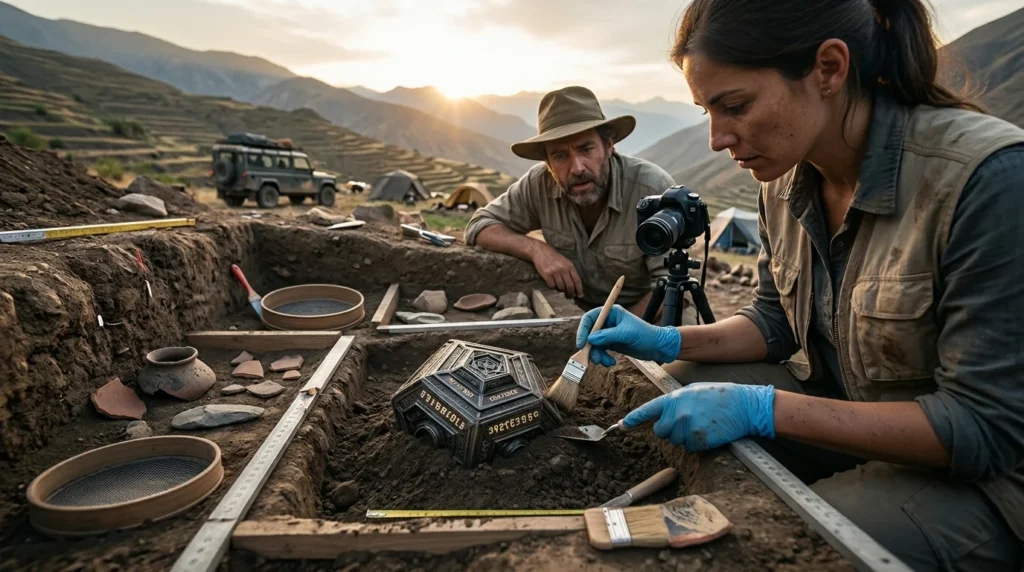
- If you find a potential mysterious relic, photograph in situ, do not clean, contact nearest university archaeology department.
- Share data openly. Mysterious relics belong to human heritage, not private sensationalism.