Hidden Collector Item Trends: 2026 Market Report on Undervalued Gems and Emerging Categories
Table of Contents
| Hidden Collector Category | Typical Price Range | Key Value Driver | Market Momentum |
|---|---|---|---|
| Fishing License Badges | 20−500 | Condition + Regional scarcity | Rising |
| Sewing Birds & Clamps | 75−200 | Decorative detail + Completeness | Steady |
| Desktop Perpetual Calendars | 50−1,000 | Mechanical intactness + Material | Surging |
| Miniature Duck Decoys | 100−5,000 | Carving quality + Signature | Strong |
| Silver Toast Racks | 100−550+ | Hallmarks + Sterling content | Steady |
| Rubber Duckies | 20−100+ | Mint condition + Rarity | Emerging |
| Snapple Caps | 50−300+ | Rare facts + Vintage | Emerging |
| McDonald’s Halloween Buckets | 85−200+ | Complete sets + Condition | Hot |
| Starbucks Mugs | 50−850+ | Limited editions + Exclusivity | Strong |
| Vintage Coffee Tins | 75−1,000+ | Condition + Graphics | Rising |
The Rise of “Analog Lifestyle” Collecting
One of the most significant hidden trends in 2026 is the return to analog living. As digital fatigue sets in, collectors are increasingly drawn to objects designed for real-life rituals—pinning, stitching, flipping, carving, and setting the table . This new mentality, amplified by social media’s “touch-sensitive living” movement, gives vintage objects an advantage that modern mass-produced items cannot replicate: they were made to be handled.
Objects that support offline rituals—such as physical books, desktop calendars, sewing tools, and tableware—are experiencing a renaissance. This is not just nostalgia; it is a rejection of the frictionless, screen-based existence that has dominated the past decade . Collectors want items they can hold, use, and pass down. The stories behind these objects matter as much as their aesthetics.
Tiny Treasures with Big Value: Small-Scale Collectibles
Some of the most promising hidden collector categories in 2026 are small enough to fit in a coat pocket. These items combine craftsmanship, daily usefulness, and easy display—qualities that resonate with modern collectors who lack the space for large furniture but crave authenticity .
Fishing License Badges (1910s-1930s)
Early 20th-century fishing licenses were designed to be worn, not filed away. Made of metal with vivid colors and durable hardware, they were exposed to sun, water, and wear—which makes surviving examples in good condition genuinely scarce .
Common badges from areas with established collector bases, such as the Eastern Seaboard, typically range from 20to100. Scarce Southern issues can fetch up to $500, especially when the badge remains readable and retains its original color and hardware . Value is driven by regional demand, legibility, and intact fasteners.
Sewing Birds and Sewing Clamps (1850s-1900s)
The sewing bird, patented by Charles Waterman of Connecticut in 1853, served as a third hand for seamstresses, clamping to a table and gripping fabric during hand-finishing . Beyond their utility, these devices were often given as sentimental gifts during engagements and weddings, with makers sculpting them into birds, cherubs, deer, dogs, fish, and frogs.
Most vintage examples trade between 75and200, with price determined by decoration, condition, and completeness (including original cushions or attached sewing accessories) . The most elaborate figural examples command premium prices, driven by collectors who value both functionality and folk-art appeal.
Desktop Perpetual Calendars (1889-1960s)
Perpetual calendars occupy a unique niche: technical enough to be clever, quiet enough to sit on a desk without demanding attention. The mechanism traces back to an 1889 patent for a watch complication, and manual desktop versions gained popularity in the early 1900s .
Their resurgent popularity aligns perfectly with current desires for paper planners, physical books, and offline rituals. Edwardian wooden turn-knob examples can reach 1,000,whilemidcenturybrassversionstypicallyrangefrom50 to $200 . Collectors often seek these for their appearance as much as their functionality, valuing the tactile satisfaction of manually setting the date.
Miniature Duck Decoys (1920s-1970s)
Miniature duck decoys—typically measuring 5 inches or less—condense the lines, paint, and personality of working decoys into sculpture-like forms . While full-size working decoys by master carvers like Elmer Crowell have sold for over $500,000 at auction, miniatures offer an accessible entry point into this collecting category.
Hand-carved miniatures can reach $5,000, especially when the carving is confident, the paint remains appealing, and the piece is signed by a known maker . Anonymous but well-executed examples sell for considerably less but still attract steady interest from folk art collectors.
Silver Toast Racks (Victorian-Edwardian)
The toast rack was built for a hyper-specific task: holding toast upright so steam would not soften it . That narrow purpose gave antique examples a crisp, sculptural appearance that adapts well to modern desks as organizers for mail or stationery.
Value depends on material, maker, age, and hallmarks. Silver plate is common, but sterling examples can climb above $550 . For sterling items, hallmarks and maker stamps are essential—these tiny marks separate attractive tabletop pieces from those with serious collectible weight.
The Quirky Collectibles Boom: From McDonalds to Snapple
Perhaps the most surprising hidden trend involves items that were never intended to be collected at all. Fast-food promotions, beverage caps, and advertising ephemera from the 1980s and 1990s are now hot commodities .
Vintage McDonald’s Halloween Buckets (1980s-1990s)
McBoo, McPunk’n, and McGoblin—the iconic Happy Meal Halloween buckets from the late 1980s and early 1990s—have become cult classics . Complete sets from 1990 have sold for 85to130, while rare advertising displays from the same era have fetched over $200. Even modern reissues have potential resale value among nostalgic collectors.
Snapple Caps (2002-2023)
Between 2002 and 2023, Snapple printed 1,677 unique “Real Facts” on the underside of their bottle caps . Now that metallic caps have been phased out, collectors are scrambling to complete sets. The oldest caps with rare facts can fetch hundreds of dollars on eBay, driven by completists who need specific numbers to finish their collections.
Rubber Duckies
Rubber duck collecting has evolved from a niche curiosity into a legitimate collectible category. Collector Charlotte Lee’s collection of over 5,600 unique rubber ducks demonstrates the depth of this market . When in mint condition, some duckies can sell for up to $100 apiece on auction sites, with special editions and vintage examples commanding premium prices.
Vintage Coffee Tins
Antique coffee tins have become among the most sought-after advertising collectibles on the market . Produced as early as the 1800s, these tins feature iconic logos, vivid color graphics, and varied shapes and lid styles. Ornate, undented, rust-free, and unfaded examples can sell from 150toover1,000, while plain but intact tins range from 75to150.
Rare Playing Cards
Playing cards are seeing steady appreciation in the collector market, with rare decks experiencing annual gains of up to 3.8% . Lower-cost “standard” decks often deliver better returns for collectors than pricey limited editions. Inheriting a stash of vintage decks could yield 5to35 per pack on eBay.
The “Old Money” Aesthetic and Brown Furniture Revival
For years, “brown furniture”—Victorian and Georgian solid timber pieces—was considered unsellable. That is changing. Following what was declared “Ralph Lauren Christmas” in 2025, the old-money aesthetic is driving renewed interest in heritage pieces with patina and provenance .
The Hero Piece Strategy
The key to selling brown furniture in 2026 is curation. Full matching suites are weakening; singular, sculptural pieces that integrate into modern interiors are strengthening . Buyers want authenticity anchors inside contemporary spaces, not recreations of the past.
A single mahogany table used as a desk, paired with contemporary seating, sells. A full set of eight balloon-back dining chairs does not. The shift is from “brown furniture” as a category to “statement timber” as a design element .
Small Brown Furniture Opportunities
Side tables, footstools, and small chests are performing particularly well . A tartan shawl or pair of brass candlesticks placed nearby enhances the presentation. The living rooms from classic 1980s John Cusack movies—complete with Oriental rugs, brass lamps, and faux-antique brown furniture—are the aesthetic reference point for this trend.
Coins, Currency, and Precious Metals
With silver and gold prices elevated in 2026, precious metal collectibles are attracting attention from both traditional numismatists and melt-value speculators .
Silver Coins and Bullion
Silver coins derive value from metal content, rarity, condition, and historical relevance. Limited mintages, survival rates, mint marks, and errors enhance desirability . Professional grading by PCGS or NGC directly impacts pricing, with certified examples commanding significant premiums over raw coins.
Sterling Silver Flatware and Small Wares
Every Tom, Dick, and Harry is dusting off their orthopedic shoes to snatch up low-priced old sterling candlesticks and salt shakers to melt down for profit . For resellers, this means two markets: collectors who value intact, hallmarked pieces, and speculators buying for metal content. Pricing should account for both the collectible premium and current melt values.
Souvenir Spoons
Sterling silver souvenir spoons, especially those from the 19th and early 20th centuries, can sell for more than $60 each at auction . Key value factors include material (sterling vs. plate), condition, age, and maker’s marks. Spoons from major world’s fairs or with detailed enamel work command the highest prices.
The Physical Media Revival
In an era of streaming and digital downloads, physical media is experiencing an unexpected comeback. First-print VHS tapes, rare CDs, and vinyl variants are among the fastest-growing vintage categories in 2026 .
Vinyl Records
The vinyl revival continues to drive demand for rare pressings, especially first editions, colored vinyl, and albums from iconic artists. Condition is paramount—sleeves and inserts matter as much as the records themselves.
Vintage Books and Book Accessories
Book-related goods are selling quickly: bookmarks, bookends, and book-themed wall prints . Vintage books with decorative bindings, first editions, or signed copies command premium prices. The appeal is tactile—a good old-fashioned book offers winter coziness that five-second videos cannot replicate.
The Art Toy Explosion
The global art toy market represents one of the fastest-growing segments in collectibles, valued at USD 8.75 billion in 2025 and projected to reach USD 14.84 billion by 2031, growing at a CAGR of 9.2% .
Blind Box and Drop Culture
The blind box format has revolutionized purchasing behavior, creating excitement through uncertainty and collectability . Consumers are drawn to limited-edition drops where scarcity drives urgency and resale value. This trend is particularly strong in Asia-Pacific but is rapidly expanding into North America and Europe.
Designer Vinyl Dominance
Designer vinyl toys account for approximately 38% of total art toy revenue, driven by scalability, durability, and cost efficiency . Vinyl enables manufacturers to produce high-quality collectibles at relatively lower costs while maintaining design precision, making it the preferred medium for both independent artists and large-scale licensed collaborations.
Licensed IP Leadership
Licensed IP-based art toys contribute over 52% of global market revenue . Strong consumer affinity for globally recognized characters from movies, anime, gaming, and music drives immediate demand upon product launches. Key players include Pop Mart, Medicom (Bearbrick), Funko, and Good Smile Company.
Sports Memorabilia and Trading Cards
The sports memorabilia market remains exceptionally strong, with signed jerseys, game-used gear, and rookie cards regularly achieving impressive prices .
Rookie Cards to Watch
Rising rookies like Jayden Daniels (NFL) and Nick Kurtz (MLB), as well as established stars like Shohei Ohtani and Alex Ovechkin, are driving demand . Even common players from iconic vintage sets—such as Don Carrithers from the 1975 Topps Baseball set—can command significant prices when graded PSA 10, driven by scarcity and competition among set collectors.
Game-Used Equipment
Photo-matched game-used items represent the pinnacle of sports memorabilia collecting. Pieces tied to iconic athletes and historic moments command premium prices, with younger collectors entering the space through social media influence and sports culture.
The Financialization of Collectibles
Across all categories, collectibles are increasingly viewed as alternative assets rather than mere hobbies . Grading services, price-tracking apps, online marketplaces, and social media transparency have transformed buying psychology. Consumers are more willing to spend on items they believe can hold or increase in value, turning purchases into semi-liquid stores of wealth .
Authentication and Grading
Professional authentication services—PSA for cards, PCGS and NGC for coins, JSA for autographs—have strengthened buyer confidence and market credibility . A graded item commands significantly higher prices than an ungraded example, even when condition appears similar.
Secondary Market Liquidity
Platforms like eBay, Whatnot, StockX, and specialized auction houses have increased liquidity and reduced friction, making it easier for casual consumers to participate alongside serious collectors . This financialization creates a virtuous cycle: more buyers attract more sellers, which attracts more buyers.
Generational Shifts in Collecting Behavior
The future of collectibles depends on whether younger generations develop the “collecting gene”—the emotional imprint formed by growing up surrounded by physical heirloom objects .
The Memory Gap Concern
Children raised in minimalist, frictionless homes with neutral colors, clean surfaces, and digital entertainment may not form the tactile memories that drive nostalgic collecting later in life . Without the smell of old wax, the coldness of marble, or the mechanical click of a tin robot, the deep historical connection to heritage objects may weaken.
Adaptation Through New Categories
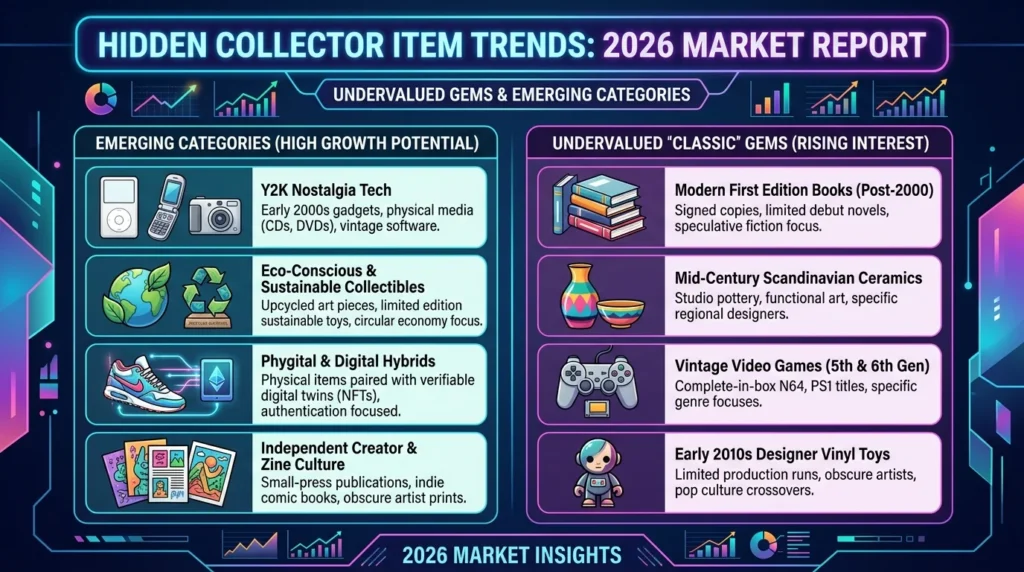
Collecting will not vanish, but it will mutate. The collecting gene may attach to first-generation technology (early Apple products, vintage gaming consoles), limited-edition art toys, or phygital crossovers that combine physical objects with digital ownership verified by blockchain .
FAQ
What are the most surprising hidden collector items in 2026?
Fishing license badges (20−500), Snapple caps (50−300+), McDonald’s Halloween buckets (85−200+), and rubber duckies (20−100+) are among the most surprising categories gaining value. Items once considered worthless are now actively traded by collectors seeking nostalgia and rarity .
Why are small antiques valuable in 2026?
Small antiques appeal to modern collectors who lack space for large furniture but crave authenticity and craftsmanship. They also support the “analog lifestyle” trend—objects designed for real-life rituals like pinning, stitching, and calendar-setting . Their compact size makes them easy to display, store, and ship.
Is brown furniture making a comeback?
Yes, but selectively. Full matching suites remain difficult to sell, but singular “hero pieces”—a mahogany table used as a desk, a small side table, a footstool—are gaining value when presented within contemporary interiors. The “old money” aesthetic driven by Ralph Lauren’s cultural influence is accelerating this trend .
What is driving the art toy market growth?
The global art toy market is growing at 9.2% CAGR, driven by blind box formats, limited-edition drops, licensed IP collaborations, and the integration of physical toys with digital assets (NFTs/phygital collectibles). Asia-Pacific leads the market, but demand is expanding globally .
How should I price silver and gold collectibles in 2026?
Adjust pricing for both collectible value and current melt prices. With precious metal prices elevated, every sterling candlestick and salt shaker has a price floor based on metal content. Hallmarks, maker, age, and condition add premium above melt .
What role does provenance play in hidden collector items?
Provenance—documented ownership history—can multiply value even for small items. A signed miniature decoy by a known carver is worth far more than an unsigned example. A hallmarked silver toast rack with clear maker’s marks commands premium pricing .
Are trading cards still a good investment in 2026?
Yes, particularly vintage cards (pre-1980) in high grades (PSA 8-10) and rookie cards of established stars. The market has matured with professional grading, price transparency, and increased liquidity through online platforms. Even common players from iconic vintage sets can be valuable due to set-collector demand .