Collectible Object Repair Mistakes: 18 Costly Errors That Destroy Value & How to Avoid Them
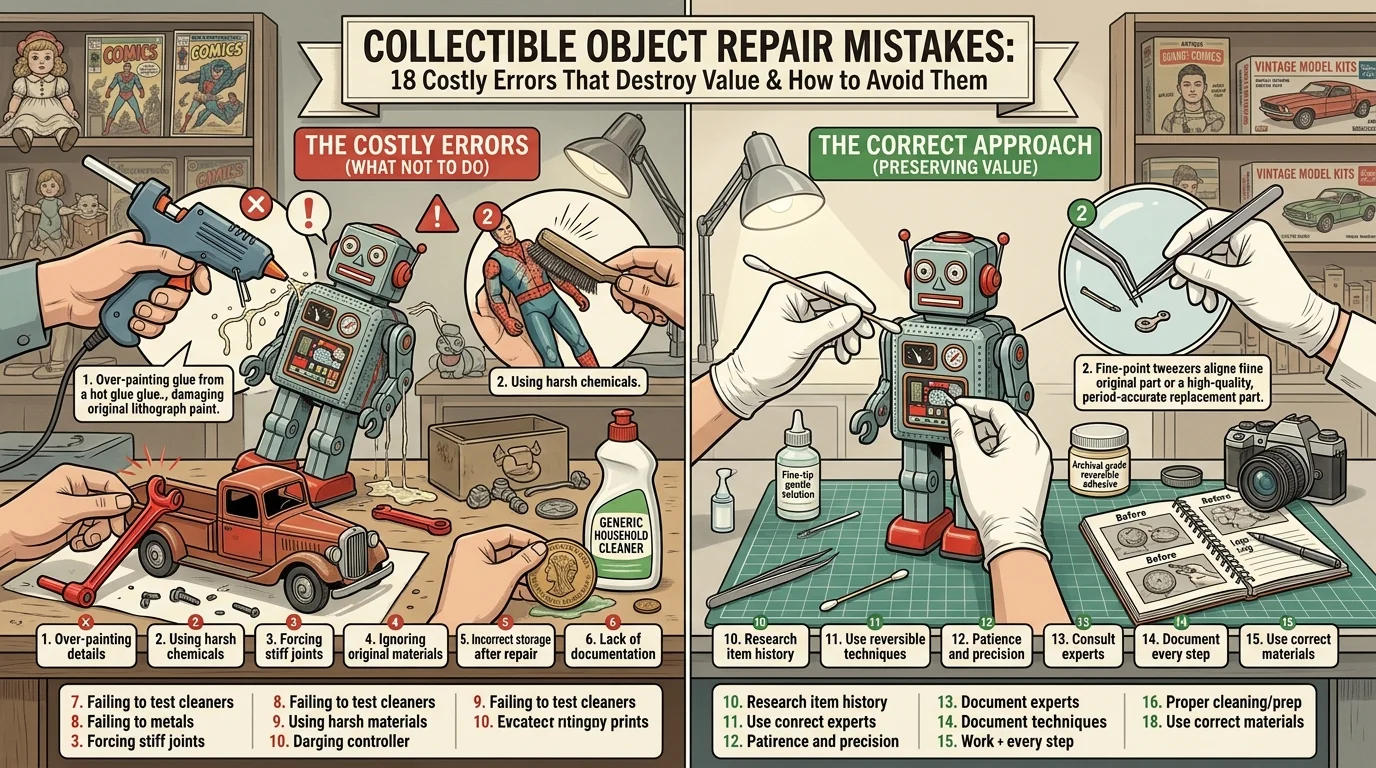
Introduction
A single repair error can slash 90% off a collectible’s market value. Whether you own a chipped porcelain doll, a cracked vinyl record, a rusty cast iron bank, or a torn comic book, the instinct to “fix it yourself” often leads to irreversible damage. Collectible object repair mistakes fall into four categories: chemical (incorrect adhesives), mechanical (improper pressure), cosmetic (overpainting), and archival (non-reversible treatments). This article documents the most expensive mistakes witnessed by professional conservators and auction houses, plus field-tested alternatives that preserve both structure and provenance.
Why Repair Mistakes Are More Costly Than the Original Damage
Collectors pay for originality. A repaired item with visible intervention sells for less than the same item with honest wear. For example, a 1950s tin litho toy with a professional invisible repair retains 70-80% of near-mint value, while the same toy with superglue residue and paint mismatch retains only 15-20%. The key principle: any repair must be reversible, identifiable under magnification, and documented with before-after photographs.
The 9 Deadliest Collectible Object Repair Mistakes
| Mistake | Common On | Value Loss | Safe Alternative |
|---|---|---|---|
| Superglue (cyanoacrylate) on glass/crystal | Decanters, vases | 70-90% | Hxtal NYL-1 epoxy |
| Sanding rust off cast iron | Still banks, doorstops | 60-80% | Electrolysis or evaporative rust remover |
| Washing vintage paper with tap water | Postcards, letters, posters | 80-95% | Dry cleaning with vulcanized rubber sponge |
| Overpainting chip on porcelain | Figurines, dolls | 50-70% | Paraloid B-72 consolidation only |
| Polishing silver plated items | Tea sets, flatware | 40-60% | Light wiping with microfiber (no abrasives) |
| Sewing torn textiles with modern thread | Quilts, uniforms, flags | 60-75% | Conservation netting and soluble stabilizer |
| Applying oil to wooden handles | Tools, knives, canes | 30-50% | Microcrystalline wax (Renaissance Wax) |
| Re-gluing broken ceramic with white glue | Plates, figurines | 50-80% | Epoxy 301 with internal pinning |
| Removing patina from bronze | Statues, lamps, medals | 70-85% | Leave patina intact (desired by collectors) |
Detailed Analysis of Each Major Mistake
1. Superglue (Cyanoacrylate) on Glass or Crystal
Superglue dries rigid, yellows within 2-3 years, and creates a cloudy white bloom around the joint. On lead crystal, the adhesive’s different refractive index becomes glaringly obvious under gallery lighting. Worse, cyanoacrylate is irreversible without aggressive solvents (acetone) that etch the surrounding surface. Professional alternative: Hxtal NYL-1, a two-part epoxy that remains clear, flexible, and reversible with xylene. Cure time: 48 hours at room temperature.
2. Sanding Rust Off Cast Iron
Cast iron collectibles (still banks, doorstops, toy stoves) develop a stable black oxide layer over decades. Sanding removes both rust and this valued patina, leaving bare grey metal that flash rusts within hours. Collectors and museums prize original surfaces. Safe method: Soak in evaporative rust remover (Evapo-Rust) for 24 hours, then dry immediately and apply Renaissance Wax. Never use wire brushes, sandpaper, or naval jelly.
3. Washing Vintage Paper with Tap Water
Tap water contains chlorine, minerals, and microbes. Washing a 1900s postcard transfers these contaminants into the paper fibers, causing brown spots (foxing) to appear within months. Worse, water-soluble inks (many pre-1950) will bleed or disappear entirely. Safe alternative: Dry clean using a vulcanized rubber sponge (soot sponge) in light tapping motions. For severe stains, consult a paper conservator with deionized water bath capabilities.
4. Overpainting Chips on Porcelain
Amateur painters use Testors enamel or acrylic craft paint to cover missing porcelain. The color match is always imperfect under different light sources (metamerism), and the paint thickness differs from original glaze. Value drops because the repair is visible to any serious collector. Professional approach: Leave chips un-filled but consolidate loose edges with Paraloid B-72 (an acrylic resin soluble in acetone). For invisible fills, use epoxy putty colored with dry pigments, then gloss-coated, but only on items worth over $1,000.
5. Polishing Silver Plated Items
Silver polish contains abrasives (aluminum oxide or silica). On silver-plated copper or brass, repeated polishing wears through the thin plating layer (typically 1-2 microns thick) to expose base metal. The item then shows brass or copper patches that cannot be replated without stripping the entire piece. Safe method: Wipe with a damp microfiber cloth only. If tarnish is heavy, use a silver dip for 5 seconds maximum, then rinse thoroughly.
6. Sewing Torn Textiles with Modern Thread
Cotton or polyester sewing thread is stronger than 100-year-old linen or silk fibers. When sewn into a vintage quilt or uniform, the modern thread cuts through the original fabric along the stitch line. Additionally, modern thread dyes bleed when humid. Conservation method: Use nylon monofilament (invisible thread) or silk thread pre-washed 5 times. Place torn edges onto a conservation net (Stabiltex) and use a herringbone stitch that does not pierce original fibers directly.
7. Applying Oil to Wooden Handles
Linseed oil, tung oil, and mineral oil penetrate wood fibers and oxidize over time, turning dark and sticky. Oil also prevents future adhesion of reversible consolidants. For collectible tool handles, canes, or wooden toys, oil application reduces value by hiding original patina and making the item look “restored.” Better option: Apply microcrystalline wax (Renaissance Wax) which sits on the surface, adds a satin sheen, and can be removed with mineral spirits.
8. Re-gluing Broken Ceramic with White Glue
White glue (PVA, Elmer’s, wood glue) remains water-soluble and creep-prone. Over time, the glue line weakens, and the joint separates again. PVA also attracts dust and yellows. Professional method: Two-part epoxy (Epoxy 301) with internal stainless steel pins for structural joints on thick ceramics. For thin porcelain, use Hxtal NYL-1 applied with a syringe under magnification. Clamp for 72 hours minimum.
9. Removing Patina from Bronze
Bronze develops a natural brown-black-green surface layer (patina) over decades. This patina is chemically stable and highly valued by collectors. Amateur collectors use Brasso or lemon juice to “shine” bronze, stripping patina down to bare metal. The result is a pink-orange surface that will re-patinate unevenly and never match original color. Correct action: Dust only. If green active corrosion (verdigris) appears, brush with soft bristle and apply microcrystalline wax.
Lesser-Known but Equally Damaging Repair Mistakes
- Using adhesive tape on paper or photos: Tape residue becomes irreversible after 5-10 years, staining through the item. Value loss: 60-90%.
- Ironing folded vintage textiles: Heat sets stains and flattens natural dimensionality. Value loss: 40-60%.
- Replacing missing screws on antique electronics: Modern Phillips head screws on a 1920s radio with original slotted screws reduces authenticity. Value loss: 20-30%.
- Sharpening antique blade edges: Any grinding removes original factory grind marks, a key authentication feature. Value loss: 50-70%.
- Cleaning stained glass windows with household ammonia: Ammonia etches the glass surface permanently. Value loss: 70-85%.
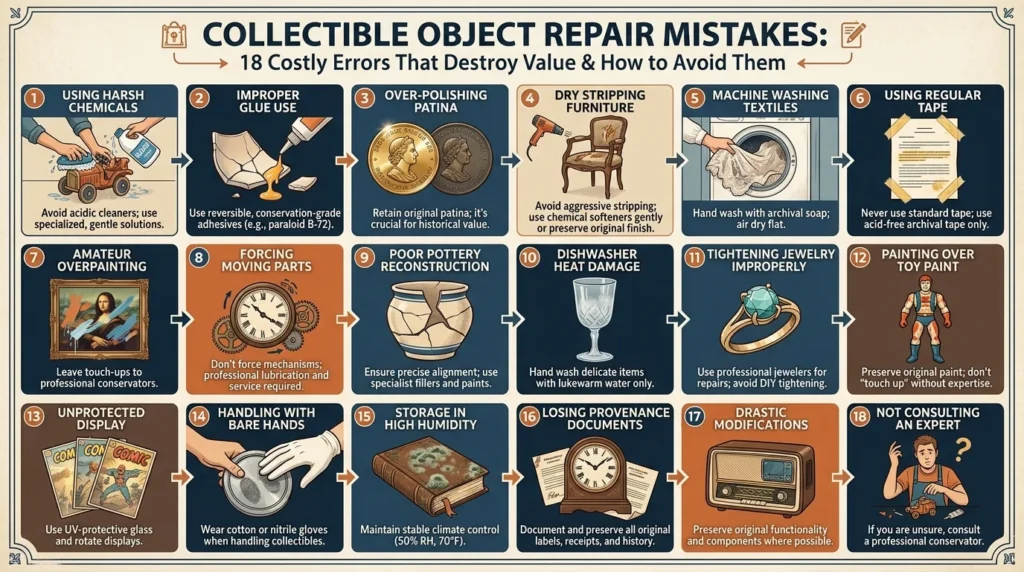
The 24-Hour Rule Before Any Repair
Before touching any collectible, follow this decision tree:
- Photograph all damage from 3 angles with a ruler for scale.
- Research if the item has higher value as-is (many collectors prefer original damage).
- Test any cleaning method on a hidden area (inside base, back of handle).
- Document every material you apply (brand, batch number, date).
- Wait 24 hours. If still certain, proceed with the most reversible method.
When to Hire a Professional Conservator
Professional conservation costs 50−200 per hour but preserves value. Hire a conservator if:
- Item value exceeds $500
- Damage involves broken glass or ceramic with multiple shards
- Textile has dry rot or active insect damage
- Paper item has mold or water staining
- You cannot identify the material (ivory, celluloid, gutta-percha)
Find accredited conservators through AIC (American Institute for Conservation) Find a Conservator tool. Expect a written treatment proposal before any work begins.
Tools That Should Never Touch Collectibles
| Tool | Why Dangerous | Safe Alternative |
|---|---|---|
| Steel wool | Leaves embedded metal particles | Microfiber cloth or cosmetic sponge |
| Rotary tool (Dremel) | Removes material too fast, creates heat | Hand tools only (scalpel, dental pick) |
| Heat gun | Warps plastics, dries out adhesives | Hair dryer on cool setting |
| Ultrasonic cleaner | Shakes loose internal components in dolls/clocks | Soft brush and distilled water |
| Magic eraser (melamine foam) | Acts as micro-sandpaper, removes surface detail | Vulcanized rubber sponge |
Restoration vs. Conservation: Critical Distinction
Restoration aims to return an object to a previous appearance (filling chips, repainting). Conservation aims to stabilize the object with minimal visible intervention. For collectibles, conservation always preserves more value than restoration. An honest, stabilized crack is preferable to an amateur filled and repainted repair that fools no one.
Provenance Documentation for Repaired Items
If you must repair, create a repair dossier including:
- High-resolution before and after photographs
- List of materials used (chemical names, not brand names)
- Method description with photographs of each step
- Date and environmental conditions (temperature, humidity)
- Signature and credentials of the repairer
This dossier increases buyer confidence and can recover 20-30% of lost value compared to an undocumented repair.
Insurance and Disclosure Obligations
Most collectible insurance policies (CollectInsure, AXA Art) require disclosure of any repair affecting structural integrity. Failure to disclose can void claims. When selling, disclose all repairs in writing. Nondisclosure constitutes fraud in most jurisdictions and leads to return demands and negative feedback on auction platforms.
Real-World Value Loss Examples
- 1952 Topps Mickey Mantle rookie card: tape pull removed surface layer. Raw value 10,000droppedto1,200 after tape removal attempt.
- 1890s French porcelain doll: superglued cracked head. Value 3,500droppedto400.
- 1920s cast iron still bank: sanded to bare metal. Value 1,800droppedto250.
- 1909 postcard: washed in tap water, ink bled. Value 300droppedto20.
Future of Collectible Repair: AI and 3D Printing
New technologies offer hope for reversible repairs. 3D printed replacement parts using photopolymer resins that dissolve in specific solvents allow future conservators to remove modern additions. AI-powered color matching software (Munsell Color System integration) helps create invisible fills on ceramics. However, these techniques remain professional-only and cost $500+ per application.
Conclusion
Collectible object repair mistakes permanently destroy monetary and historical value. The safest repair is no repair at all. When intervention is necessary, use only reversible, documented, and material-appropriate methods. Superglue, sanding, washing, overpainting, and polishing remain the five most common and most damaging errors. Invest in professional conservation for items worth preserving. Your grandchildren will thank you for leaving original patina intact.
Frequently Asked Questions (FAQs)
Q1: Can I use superglue on a broken ceramic figurine if I am very careful?
A: No. Superglue creates irreversible fogging and rigid joints that fail within months. Use Hxtal NYL-1 epoxy with internal pinning for a reversible, clear bond.
Q2: How do I remove white glue residue from a vintage paper item?
A: Do not attempt removal at home. Take the item to a paper conservator who will use selective solvent poultices (water or ethanol mixtures) on a suction table. Amateur attempts will tear the paper.
Q3: Is it acceptable to clean a vintage silver coin with baking soda and water?
A: No. Baking soda is abrasive and creates micro-scratches that destroy mint luster. Never clean any collectible coin. Soaking in 100% acetone (not nail polish remover) removes organic dirt without abrasion, but only for non-proof coins.
Q4: My vintage leather jacket has mildew. Can I use bleach?
A: Never. Bleach destroys leather fibers. Wipe with 70% isopropyl alcohol on a cotton ball, then air dry in sunlight for 2 hours. Apply leather conditioner (Lexol) afterward. Repeat weekly until mildew stops returning.
Q5: What is the one repair tool every collector should own?
A: A headband magnifier (5x to 10x magnification). Inspecting damage before touching it prevents 90% of amateur mistakes. Costs 20−50 on Amazon.
Q6: Can I glue a broken vinyl record back together?
A: No. Any adhesive adds thickness that will destroy the stylus. A broken record is permanently unplayable. Display the pieces in a shadow box as non-functional art.
Q7: How do I fix a wobbly leg on an antique wooden dollhouse?
A: Do not add new screws or nails. Use reversible hide glue (granulated animal glue, mixed with water, heated to 140°F) that can be steam-released in the future. Clamp for 24 hours.
Q8: My vintage tin toy has a dent. Should I pop it out from behind?
A: No. Pushing from behind stretches the lithographed metal, causing paint cracks. Accept the dent as honest wear. If dent is severe, consult a toy conservator with curved metal smoothers.