Advanced Antique Storage Methods: Museum-Grade Preservation for Serious Collectors
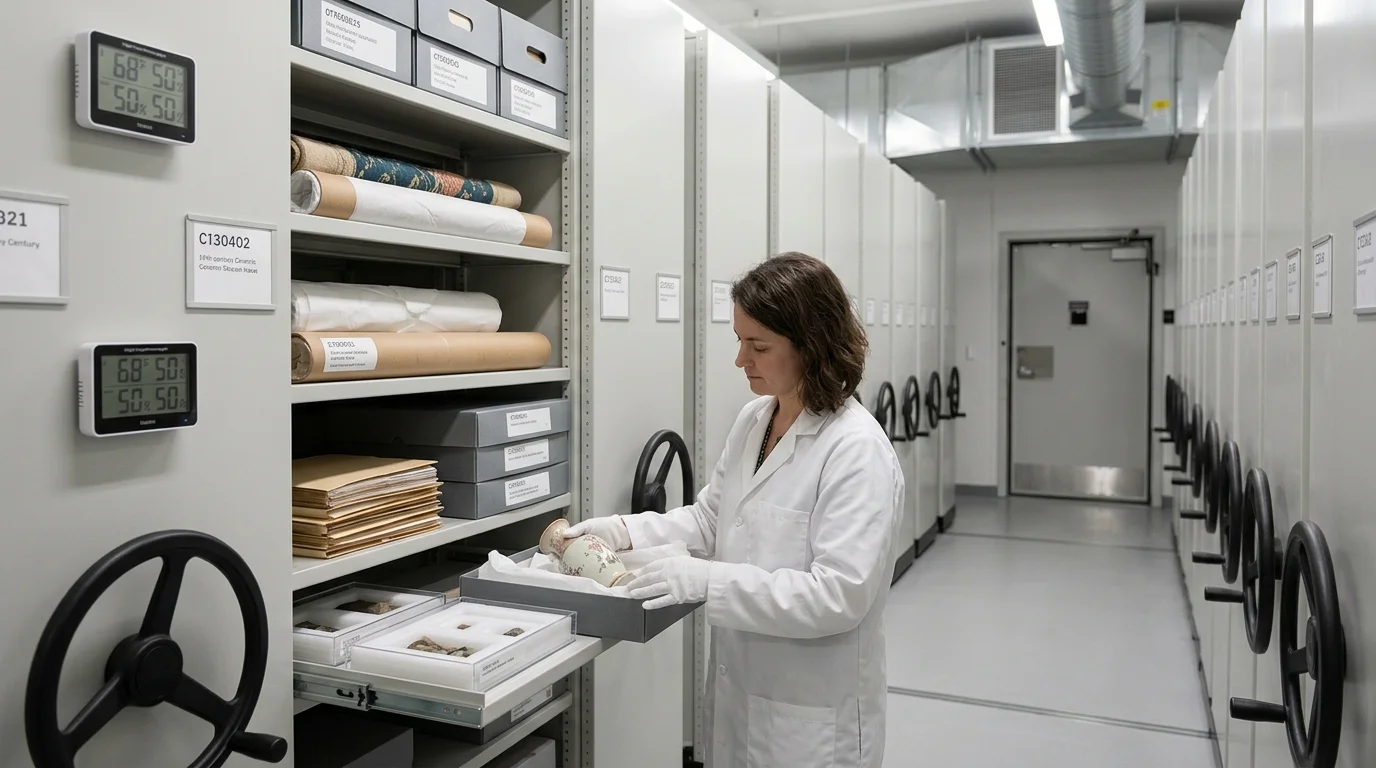
Table of Contents
- What Are Advanced Antique Storage Methods?
- Why Standard Storage Fails for Antiques
- Environmental Parameters for Different Materials
- Detailed Storage Method Table by Material Type
- Microclimate Creation and Control
- Support and Mounting Engineering
- Space Optimization Without Compression
- Monitoring and Data Logging Systems
- Frequently Asked Questions (FAQs)
- Emergency Preparedness for Storage Areas
1. What Are Advanced Antique Storage Methods?
Advanced antique storage methods are systematic preservation protocols that exceed basic dust and moisture protection. These methods integrate environmental engineering, materials science, and preventive conservation to halt or dramatically slow deterioration of irreplaceable objects.
Unlike general storage, advanced methods control six variables: temperature stability, relative humidity, light exposure (lux and UV), airborne pollutants, biological agents (insects, mold), and mechanical stress. Professional conservators and serious collectors implement these methods to maintain antique value and structural integrity for decades.
2. Why Standard Storage Fails for Antiques
| Storage Method | Failure Mode | Damage Caused |
|---|---|---|
| Cardboard boxes | Acid migration, pest harborage | Paper yellowing, textile holes |
| Plastic tubs (non-archival) | Off-gassing (plasticizers), no ventilation | Silver tarnishing, paint softening |
| Attic storage | Temperature extremes (120°F+), low humidity | Wood cracking, glue failure |
| Basement storage | High humidity (70%+), flood risk | Mold growth, metal corrosion |
| Bubble wrap | Trapped moisture, PVC contact | Glass etching, surface residue |
| Newspaper wrapping | Acid and ink transfer | Permanent staining of paper and textiles |
| Closets without air circulation | Stagnant air, microclimates | Insect infestation, musty odors |
| Garage storage | Vehicle exhaust, temperature swings | Rubber deterioration, finish damage |
Standard household storage assumes antiques are durable. In reality, most antiques have survived despite storage conditions, not because of them.
3. Environmental Parameters for Different Materials
| Material | Temperature (°F) | RH (%) | Light (lux) | UV (μW/lm) | Air Changes/Hour |
|---|---|---|---|---|---|
| Wood (furniture) | 65-70 | 45-55 | 200 | 30 | 4-6 |
| Paper (books, documents) | 60-70 | 35-45 | 50 | 10 | 4-6 |
| Textiles (cotton, linen) | 65-70 | 45-55 | 50 | 10 | 4-6 |
| Textiles (silk, wool) | 60-65 | 45-55 | 30 | 10 | 4-6 |
| Metals (iron, steel) | 65-70 | 30-40 | 200 | 30 | 4-6 |
| Metals (silver, copper) | 65-70 | 35-45 | 200 | 30 | 4-6 |
| Ceramics & Glass | 65-75 | 40-55 | 200 | 75 | 4-6 |
| Photographs | 55-65 | 30-40 | 15 | 0 | 4-6 |
| Ivory & Bone | 65-70 | 45-55 | 50 | 30 | 4-6 |
| Leather & Parchment | 60-65 | 45-55 | 50 | 30 | 4-6 |
| Natural history specimens | 65-70 | 45-55 | 30 | 30 | 6-8 |
| Mixed media objects | 65-70 | 45-50 | 50 | 30 | 4-6 |
Critical note: Never combine materials requiring different RH ranges in the same storage enclosure. Silver (30-40% RH) stored with paper (35-45% RH) may be acceptable. Silver with wood (45-55% RH) will tarnish rapidly.
4. Detailed Storage Method Table by Material Type
| Material | Primary Container | Secondary Support | Interleaving | Pest Deterrent |
|---|---|---|---|---|
| Wood furniture | Cotton muslin dust cover | Ethafoam blocks under legs | None needed | Freeze treatment before storage |
| Upholstered furniture | Tyvek cover (breathable) | Acid-free tissue in crevices | Polyethylene sheeting between cushions | Integrated pest management monitor |
| Framed paintings | Art storage box (corrugated polypropylene) | Corner guards | Glassine over paint surface | Silica gel packets |
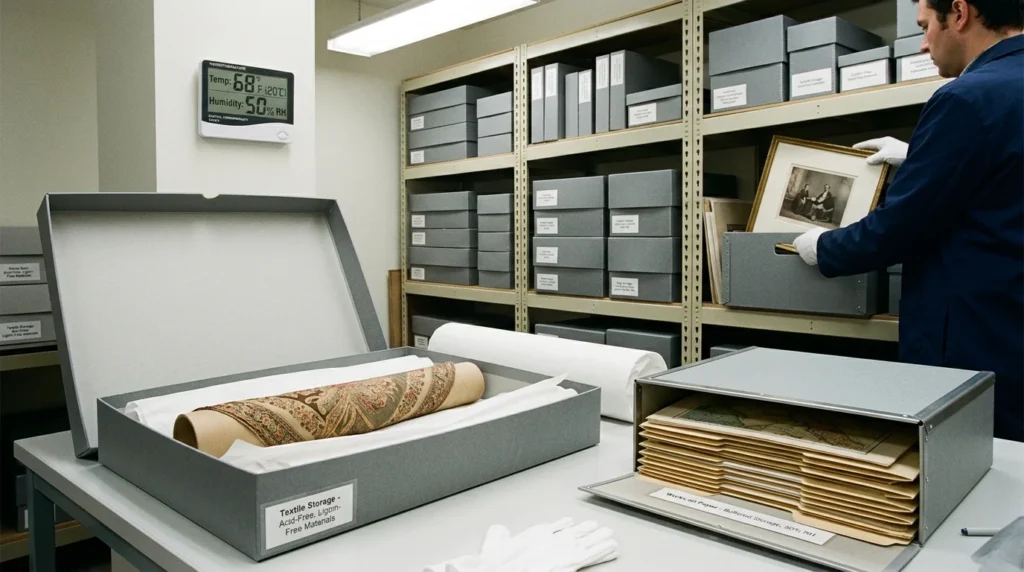
| Unframed paper | Archival flip-top box (buffered board) | Polyester film (Melinex) sleeve | Microchamber paper | Freeze for 72 hours |
| Books (leather) | Clamshell box (alkaline buffered) | Book shoe or cradle | Silicone release paper | Anoxic bag for infested items |
| Textiles (flat) | Textile storage drawer (powder-coated metal) | Archival mat board (unbuffered) | Polyester web (Reemay) | Freezer treatment |
| Textiles (3D/costume) | Acid-free tissue padded hanger | Bust form (ethafoam) | Cotton muslin over form | Naphthalene-free moth paper |
| Silverware | Silver storage flat roll (Pacific cloth) | Tarnish-inhibiting fabric divider | None | Charcoal filter in cabinet |
| Iron tools | Vapor corrosion inhibitor (VCI) bag | Silica gel preconditioned to 35% RH | Polyethylene foam blocks | None |
| Ceramics (stacked) | Corrugated plastic box | Polyethylene foam cutouts | Unbuffered tissue between pieces | No silica (neutral pH) |
| Glass (crystal) | Individual padded box | Ethafoam cradle | Calico cloth | No direct contact with plastic |
| Photographs | Polypropylene sleeves in box | Album with interleaving | Polyester sheet | 35-40% RH environment |
| Ivory | Art storage crate (microclimate) | Custom ethafoam support | Acid-free tissue | Freeze annually |
5. Microclimate Creation and Control
A microclimate is a controlled environment within a larger uncontrolled space. Advanced collectors use these methods:
Passive microclimate (low cost, low maintenance)
- Seal object inside polyethylene bag or acrylic display box
- Add preconditioned silica gel (calculated mass: 500g per cubic foot)
- Monitor with humidity indicator card
- Refresh silica gel when card changes color (every 6-24 months)
Active microclimate (high cost, precise control)
- Custom acrylic case with inlet and outlet ports
- Attach to RH-controlled air supply or dehumidifier
- Use data logger with external alarm
- Ideal for mixed-media objects with conflicting RH requirements
Oxygen-free microclimate (for pest eradication and metal preservation)
- Seal object in oxygen-impermeable barrier film (Escal)
- Insert oxygen absorber packets (Ageless brand)
- Include oxygen indicator to confirm below 0.1% O2
- Maintains for 3-5 years without intervention
Silica gel calculation formula:
Mass (grams) = Volume (cubic feet) × Desired RH change (%) × 30
Example: 5 cubic foot cabinet, from 60% to 45% RH requires 5 × 15 × 30 = 2,250 grams of silica gel.
6. Support and Mounting Engineering
Proper support prevents physical damage during storage:
Furniture
- Place ethafoam blocks (not rubber or wood) under each foot to elevate 1-2 inches for airflow
- Remove heavy drawers and store separately if over 40 pounds
- Loosen screws on chairs with woven cane seats to relieve tension
- Never stack furniture. Maximum two high with padded separators if identical frames
Ceramics and glass
- Custom-cut polyethylene foam using hot wire cutter (not scissors which create jagged edges)
- Support rim and foot simultaneously. Never support only one point.
- Bowls on their side, not nested inside each other
- Crystal stemware hanging by bowl, not by stem. Use padded clamp systems.
Textiles
- Roll, never fold. Folding creates permanent creases and breaks fibers.
- Roll on acid-free tube minimum 4 inches diameter. Padding increases diameter further.
- For hanging costumes, use broad shoulder supports (minimum 4 inches across)
- Distribute weight across waist and hip supports, not only hanger hook
Paintings (unstretched)
- Store flat between layers of archival corrugated board
- Interleave with silicone release paper (not glassine which sticks over time)
- Rotate stack position every 6 months to prevent pressure points
7. Space Optimization Without Compression
Advanced storage maximizes density while maintaining separation:
| Storage Furniture | Best For | Density (sq ft / item) | Ventilation Rating |
|---|---|---|---|
| Flat files (map cases) | Paper, textiles, photographs | 0.5-1.0 | Poor (add silica packets) |
| Compactor shelving (mobile) | Mixed collections | 0.2-0.4 | Moderate (requires HVAC assist) |
| Sliding rack systems (clothing) | Costumes, textiles on hangers | 0.3-0.6 | Good |
| Drawer cabinets (metal) | Small objects, ceramics | 0.4-0.8 | Moderate |
| Open adjustable shelving (sealed room) | Books, boxes, furniture | Variable | Excellent |
| Ceiling-mounted racks | Seasonal textiles, area rugs | 0.1-0.3 (horizontal space) | Poor (only for clean, stable items) |
Optimization rules:
- Maintain minimum 2 inches air gap between stored items
- Do not fill shelves beyond 80% capacity to allow air circulation
- Use vertical space with removable hanging systems
- Store flat items upright (books, framed works) when possible
- Document location grid system to avoid unnecessary disturbance
8. Monitoring and Data Logging Systems
You cannot control what you do not measure. Install:
Minimum system (under $200)
- Two remote hygrothermographs (SensorPush, Govee)
- Calibrate with salt test kit every 6 months
- Manual weekly logging in spreadsheet
Professional system (500−500−2,000)
- Data loggers with 10,000+ reading capacity (Pendant, Rotronic)
- Monthly download to computer
- Alarm alerts for RH beyond ±10% of setpoint
Museum-grade system ($2,000+)
- Wireless mesh network of 20+ sensors
- Real-time cloud monitoring
- Automated HVAC integration
- Pest monitoring traps with counting sensors
Calibration protocol:
- Prepare saturated salt solution in sealed container
- Place sensor inside for 24 hours
- Adjust reading to known RH of salt (75% for NaCl, 33% for MgCl2)
- Repeat annually or after any sensor drop
9. Frequently Asked Questions (FAQs)
Q1: What is the single most important factor in advanced antique storage?
A: Relative humidity stability. Fluctuations are more damaging than constant moderate values. Wood expands and contracts with RH changes, causing joints to loosen and surfaces to crack. Maintain ±5% RH year-round if possible. Temperature is secondary.
Q2: Can I store different antique materials together in one cabinet?
A: Only if they share compatible RH requirements. Metal + paper (acceptable), metal + wood (not acceptable), textile + ceramic (acceptable with buffering), leather + anything (isolate leather due to acid migration). When in doubt, separate.
Q3: How often should I inspect antiques in advanced storage?
A: Low-risk items (ceramics, metals) every 12 months. High-risk items (paper, photographs, textiles) every 6 months. Any stored item with silica gel requires humidity indicator check every 3 months. Document all inspections.
Q4: What is the best storage method for extremely valuable antiques ($50,000+) ?
A: Professional museum storage crate with custom polyethylene foam cradle, oxygen-free barrier film for metal, active microclimate control, and GPS tracking. Use a climate-controlled commercial storage facility with 24/7 monitoring. Never store at home.
Q5: How do I store antiques during a move using advanced methods?
A: Use double-walled corrugated boxes with ethafoam corner blocks. Do not use newspaper or bubble wrap. Pack each item in its own box. Label boxes with orientation arrows and fragility. Transport in climate-controlled truck not exceeding 85°F. Unload within 48 hours. Inspect for condensation upon arrival.
10. Emergency Preparedness for Storage Areas
Advanced storage includes disaster response planning:
Fire protection
- Install clean agent extinguishers (Halon alternative, FM-200) near storage
- Do not use water sprinklers in antique storage (water damage)
- Store fire-safe cabinets for extremely valuable items (1-hour rating minimum)
Flood prevention
- Store antiques minimum 6 inches above floor
- Install water detection sensors on floor
- Keep battery-operated sump pump if basement storage
- Maintain off-site digital inventory for insurance claims
Pest outbreak response
- Freeze infested items at -20°F for 72 hours minimum
- Use pheromone traps for specific insects (webbing clothes moth, carpet beetle)
- Do not use pesticide foggers or bug bombs (chemical residue damages surfaces)
- Quarantine new acquisitions for 30 days before adding to main storage
Power outage protocol
- Battery backup for data loggers and alarms (48-hour minimum)
- Passive silica gel systems function without power for 6-12 months
- Manual venting schedule: open storage area for 15 minutes every 4 hours if RH exceeds 65%