Historical Relic Investment Comparison: A Comprehensive Asset Class Analysis for 2026
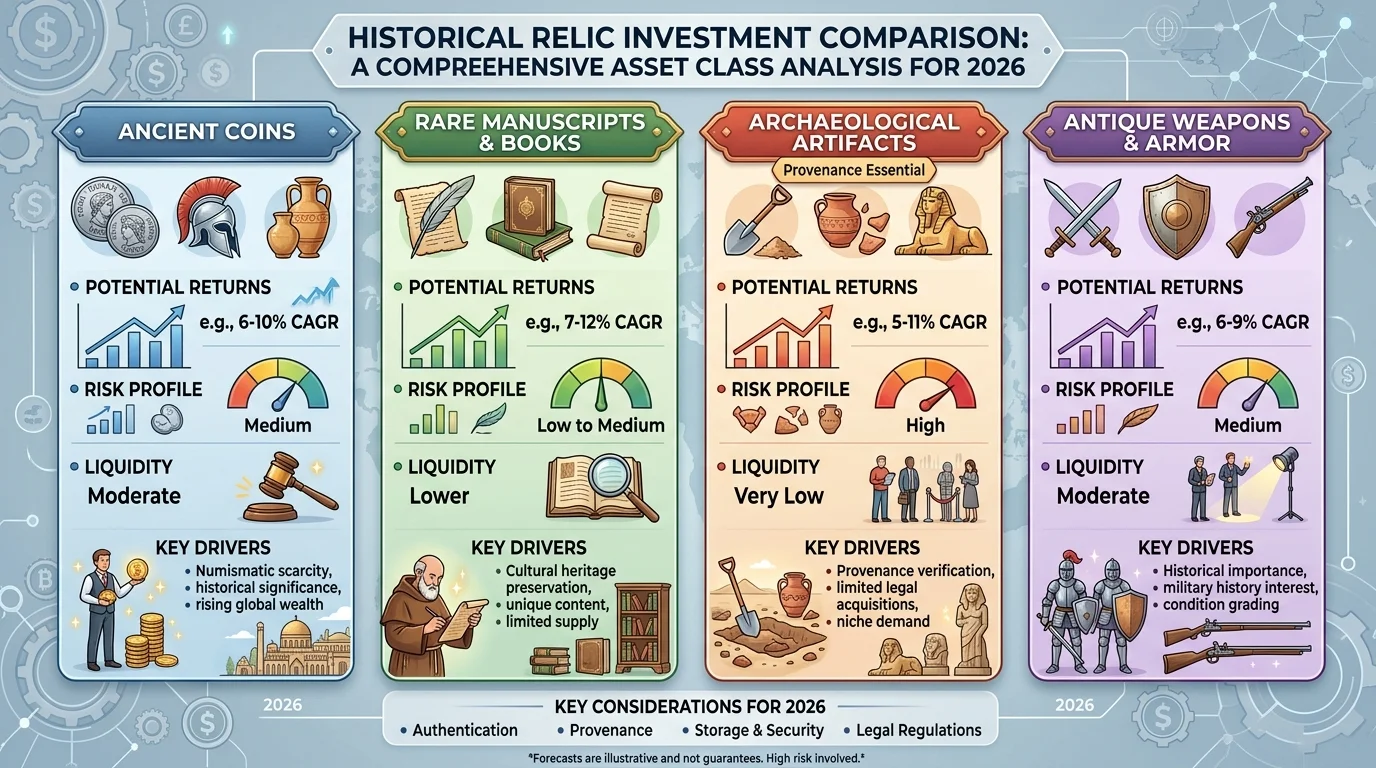
The landscape of alternative investments has expanded dramatically over the past two decades, with historical relics and collectibles emerging as legitimate portfolio components alongside traditional assets like stocks and bonds. As global wealth diversifies and markets mature, collectors are increasingly viewing historical relics not merely as passion-driven acquisitions but as strategic investments that store value, provide portfolio diversification, and often deliver competitive returns . This comprehensive historical relic investment comparison analyzes the performance characteristics, risk profiles, and practical considerations of major collectible categories to help investors make informed allocation decisions.
Understanding the Historical Relic Investment Landscape
Historical relics encompass a broad spectrum of tangible assets, including fine art, antique furniture, vintage jewelry, historical coins, rare books, and cultural artifacts. Unlike traditional financial assets, these tangible investments offer unique advantages including aesthetic enjoyment, historical significance, and low correlation with mainstream financial markets . However, they also present challenges such as limited liquidity, high transaction costs, and valuation complexity that potential investors must understand before committing capital.
The investment case for historical relics rests on three primary pillars: scarcity, historical provenance, and cultural significance. Items that combine these attributes have demonstrated remarkable value appreciation over extended periods, often outperforming traditional assets during specific market conditions. The following sections provide detailed comparisons across major categories.
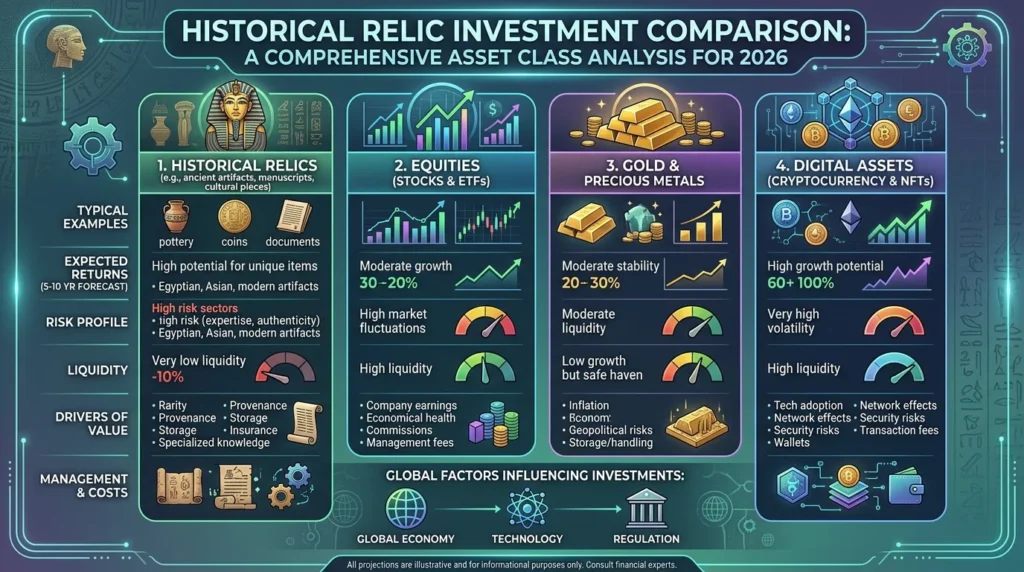
Comparative Analysis: Major Historical Relic Categories
Fine Art Investment Performance
Fine art represents the most established segment of the historical relic investment market. According to the MM Asia-Africa-Oceania Art Price Index, which tracks thousands of auction records across major houses including Sotheby’s, Christie’s, and Phillips, the annual compound growth rate for Asian and African art reached 7.7 percent over the past 25 years, while American art achieved 4.4 percent and European art achieved 2.3 percent . Within this framework, Chinese art demonstrated exceptional performance with a 9.2 percent annual compound growth rate from 2000 through early 2025.
The long-term return picture for art presents a more complex narrative. Analysis of 10-year rolling dollar returns from 1938 through 2024 reveals that art experienced its most prolonged低迷 since 1954, with returns reaching -0.9 percent in 2023 and -1.4 percent in 2024 . This underperformance relative to the S&P 500, which has delivered double-digit annual growth since 2018, suggests that art values are currently at generational lows. However, this divergence may present a historical buying opportunity, as wealth generated by technological advancement seeks alternative stores of value.
The Chinese art market demonstrated resilience in 2025 with a 9 percent rebound in spring auction prices following nearly four years of decline . Oil paintings and modern works outperformed the broader market, while ink paintings declined 24.8 percent in the spring 2025 season, revealing significant sub-category variation.
Historical Coins and Numismatics
Historical coins have emerged as a compelling alternative investment based on peer-reviewed academic research spanning 2000 through 2024. A comprehensive study published in the journal of the European Research Studies compared historical coin returns against stocks, gold, REITs, bonds, Bitcoin, fine art, and luxury watches. The findings demonstrate that historical coins offer competitive returns with lower volatility than many alternatives and show significantly low correlation to major financial markets .
Certified gold coins, particularly those minted before 1933, performed as the top segment within the category, driven by authenticity verification and documented scarcity. The research supports treating historical coins as a legitimate component of alternative investment portfolios, with tokenization and digitization increasingly improving market accessibility for smaller investors.
Vintage Jewelry and Heritage Pieces
The vintage and antique jewelry market has experienced substantial growth, driven by appreciation for artisanal craftsmanship, scarcity, and historical narratives that modern mass-produced pieces cannot replicate . Houses such as Cartier and Van Cleef & Arpels maintain entire heritage collections, and pieces from these maisons continue to command premium prices at auction.
The global antique ring market alone reached 3.29billionin2024,withprojectionsindicatinggrowthto5.23 billion by 2031 . High-grade natural diamonds have demonstrated annual investment returns up to 15 percent for top-quality stones, though these investments require significant capital thresholds, typically minimums of $10,000 for entry-level one-carat diamonds. Heritage diamonds that appear at major auction houses regularly exceed estimates, such as a antique diamond fringe necklace that sold for 4.26 million Swiss francs at Sotheby’s Geneva, nearly double its high estimate.
Porcelain and Ceramics
Ceramics represent a category where extreme returns are possible but unpredictable. The most remarkable example in recent years involved an 18th-century Chinese wine ewer discovered in a Derbyshire attic that sold at auction for £390,000 . This piece, one of only three known examples worldwide, had been destined for a charity shop before its appearance on the BBC program Bargain Hunt. The other two known examples reside in museums in Beijing and Taiwan, demonstrating how extreme scarcity combined with imperial provenance can generate extraordinary value.
However, such outcomes are exceptional rather than typical. The Chinese ceramics and miscellaneous items market showed resilience in 2025 with 11.95 percent year-over-year growth in the first half, reaching 4.27 billion yuan in auction sales, making it the only major category to achieve positive growth during that period .
Asset Class Performance Summary Table
| Asset Category | 25-Year Annual Return | Volatility Level | Liquidity | Market Correlation | Investment Minimum |
|---|---|---|---|---|---|
| Chinese Fine Art | 9.2% (2000-2025) | High | Low | Low | 5,000−10,000 |
| Asian/African Art | 7.7% (2000-2025) | High | Low | Low | 5,000−10,000 |
| American Art | 4.4% (2000-2025) | Medium | Low | Low | 5,000−10,000 |
| European Art | 2.3% (2000-2025) | Low | Low | Low | 5,000−10,000 |
| Historical Gold Coins | Competitive with stocks | Low-Medium | Medium | Very Low | 500−2,000 |
| Vintage Jewelry | Variable (15% for top diamonds) | Medium | Medium | Low | $10,000+ |
| Porcelain-Ceramics | Variable | Medium-High | Low | Low | 1,000−5,000 |
| S&P 500 Stocks | 4.9% (200-year real return) | Medium-High | High | N/A | Low |
| Government Bonds | 2.6% (200-year real return) | Low | High | Positive | Low |
| Gold | 0.4% (200-year real return) | Medium | High | Low | Low |
Source: Deutsche Bank Long-Term Asset Return Study (200-year data) ; MM Art Price Index (25-year data) ; Numismatics Research 2000-2024
Traditional Asset Comparison Context
To properly evaluate historical relic investments, understanding traditional asset performance provides essential context. Deutsche Bank’s comprehensive long-term asset return study, analyzing 56 economies over 200 years, found that global inflation-adjusted returns placed stocks first at 4.9 percent annualized, followed by 60/40 stock-bond portfolios at 4.2 percent, government bonds at 2.6 percent, and gold at just 0.4 percent . Cash performed worst of all, losing 2 percent annually to inflation over the two-century period .
However, the 21st century has reversed some historical patterns. Since 2000, gold achieved 7.45 percent real annual returns, exceeding US stocks at 5.8 percent, German stocks at 3.9 percent, and UK stocks at 3.3 percent . This reversal underscores that no asset class maintains permanent dominance, and diversification across traditional and alternative assets remains prudent.
The 60/40 stock-bond portfolio has demonstrated remarkable resilience historically, with only a 0.1 percent probability of nominal losses over 25-year periods across all studied economies . However, current valuation levels suggest more modest forward returns, with US stock valuations at historic highs comparable only to the 2000 dot-com bubble period.
Risk Factors and Considerations
Valuation Challenges
Unlike publicly traded securities with continuous pricing, historical relics require specialized expertise for valuation. The auction process introduces complexities including buyer’s premiums typically adding 20-25 percent to hammer prices, and the risk of buy-ins where items fail to sell . Research on French Impressionist paintings sold between 1985 and 2001 demonstrated that downside risk assessment depends critically on how unsold lots are incorporated into analysis.
Liquidity Constraints
Historical relics cannot be sold instantly like stocks or ETFs. Converting a significant collection to cash may require months or years, particularly for specialized categories with limited buyer pools. Auction houses typically require consignment lead times, and private sales depend on finding appropriate buyers.
Condition and Authenticity Risks
The value of historical relics depends fundamentally on condition and authenticity. Undiscovered damage, poor restoration work, or questioned provenance can eliminate value entirely. Unlike financial assets where pricing is transparent and standardized, each relic requires individual assessment by qualified experts.
Transaction Costs
Buying and selling historical relics involves substantial transaction costs. Auction house commissions typically range from 10-25 percent of hammer price for buyers and sellers combined. Insurance, storage, and conservation costs add ongoing expenses that financial assets do not require.
Strategic Recommendations for Investors
For investors considering historical relic allocation, several principles emerge from this comparative analysis. First, treat relics as long-term holdings of five years minimum, as short-term transaction costs will consume any potential gains. Second, focus on categories where you possess genuine knowledge or can access trusted expertise, as information asymmetry favors specialists. Third, prioritize certified and documented pieces, particularly for coins and jewelry where third-party grading provides authenticity verification.
The current market environment presents mixed signals. While art valuations appear attractive relative to recent history, with long-term returns at 70-year lows, the recovery may require patience . The Chinese art market rebound in spring 2025, with a 9 percent gain following a 48 percent decline from its 2020 peak, suggests stabilization but not necessarily immediate appreciation . Meanwhile, historical coins offer lower volatility and established return patterns that may suit conservative alternative investors .
Frequently Asked Questions
Q: How do historical relic returns compare to stock market returns over the long term?
A: Over 200 years, global stocks have returned 4.9 percent inflation-adjusted annually, outperforming most relic categories. However, top-tier relics have significantly outperformed this average. Chinese art achieved 9.2 percent annual returns from 2000-2025, and certain coins and diamonds have shown competitive or superior returns to stocks during specific periods .
Q: What is the minimum investment needed to start collecting historical relics as investments?
A: Entry points vary significantly by category. Historical coins can be acquired for 500−2,000 for certified pieces. Small porcelain items and prints may start around 1,000.Vintagejewelryinvestment−gradepiecestypicallyrequire10,000 or more for meaningful exposure .
Q: Are historical relics good portfolio diversifiers?
A: Yes. Research demonstrates that historical coins and art show significantly low correlation to major financial markets, meaning their values do not move in tandem with stocks and bonds. This diversification benefit represents one of the strongest arguments for including relics in investment portfolios .
Q: How has the Chinese art market performed recently?
A: After declining 48 percent from its 2020 peak, the Chinese art market rebounded 9 percent in spring 2025. The long-term compound annual growth rate from 2000 through early 2025 stands at 9.2 percent, substantially outperforming American and European art markets over the same period .
Q: What are the main risks of investing in historical relics?
A: Primary risks include limited liquidity, high transaction costs, valuation complexity, condition and authenticity issues, storage and insurance expenses, and the potential for extended periods without price appreciation. Some categories, particularly contemporary art, have experienced declines exceeding 28 percent from peak values .
Q: Can historical relics be used as loan collateral?
A: Yes, major auction houses and specialized lenders accept fine art and certain collectibles as collateral. Research indicates that loan-to-value ratios between 50-100 percent may be supportable depending on category and market conditions, though this practice remains less developed than collateralized lending against traditional assets .
Q: Which historical relic category has shown the strongest recent performance?
A: Ceramics showed 11.95 percent year-over-year growth in the first half of 2025, making it the top-performing category in the Chinese auction market. High-grade diamonds have demonstrated up to 15 percent annual returns for exceptional stones, though these represent top-tier pieces rather than category averages .
Q: How does inflation impact historical relic investments?
A: Tangible assets like historical relics generally provide inflation protection, as their values tend to rise with overall price levels. Gold has demonstrated this clearly with 7.45 percent real returns since 2000. However, the 200-year gold return of just 0.4 percent real shows that inflation protection is not guaranteed across all time periods .