Collectible Archive Setup Guide: Professional Systems for Heritage Preservation
The market for rare relics and antiques has evolved dramatically, expanding from exclusive auction houses to global digital platforms. Understanding how different marketplaces compare—whether for selling a family heirloom, acquiring an investment-grade artifact, or simply valuing a collection—requires analyzing factors such as reach, fees, authentication standards, and pricing dynamics. This guide provides a comprehensive comparison of the primary rare relic markets, evaluates their distinct characteristics, and explains why rarity alone does not guarantee value.
Table of Contents
| Section | Topic |
|---|---|
| 1 | Market Overview and Size |
| 2 | Comparative Analysis: Major Sales Channels |
| 3 | Understanding Value Drivers |
| 4 | Pricing Terminology Explained |
| 5 | Geographic Market Dynamics |
| 6 | Emerging Trends and Digital Transformation |
| 7 | Frequently Asked Questions |
1. Market Overview and Size
The global antiques and collectibles market demonstrated significant scale and resilience in 2025, valued at approximately 150.2billion.Projectionsindicategrowthto156.3 billion in 2026, reaching $229.7 billion by 2035, representing a compound annual growth rate of 4.4 percent .
North America remains the largest regional market, while the Asia-Pacific region is experiencing the fastest growth. The fine art and painting segment alone generated approximately 59.9billionin2025,projectedtoincreaseto88.4 billion by 2035 .
The top five market participants—Sotheby‘s, Christie’s International, eBay, Heritage Auctions, and Bonhams—collectively held 12.7 percent of the global market share in 2025, with Sotheby‘s leading at 5.1 percent .
2. Comparative Analysis: Major Sales Channels
Choosing the correct sales channel significantly impacts final realized prices. Each platform type serves different seller profiles and relic categories.
Heritage Auctions: The Premium Institutional Channel
Heritage Auctions operates as the world’s largest collectibles auction house and the third-largest auction house globally. The company achieved total sales of $1.76 billion in 2023, setting numerous auction records .
Key features include free submission review processes, complimentary expert consultation, and selective acceptance focused on exceptional pieces. This platform works best for high-value items exceeding several thousand dollars. However, the selective acceptance criteria mean common items are typically rejected .
The institutional approach mirrors exclusive cryptocurrency platforms catering to high-net-worth individuals, with rigorous certification processes comparable to top-tier exchange security measures.
eBay: The Accessible Mass Marketplace
eBay provides contrast to exclusive auction houses through open access for any seller. The platform reaches over 134 million potential buyers globally with quick, simple listing processes .
However, significant drawbacks include high competition potentially suppressing prices and substantial seller fees that erode profit margins. The lack of specialized focus can lead to pricing inefficiencies, where uninformed sellers undervalue items or buyers overpay due to information asymmetry .
This channel suits mid-range collectibles valued between 50and2,000, common items with broad appeal, and sellers willing to manage their own shipping and customer service.
Stack’s Bowers: Specialized Numismatic Excellence
Stack‘s Bowers combines historical expertise with modern auction technology, offering both live and online rare coin and currency auctions. Unique advantages include free online or in-person appraisals, no additional charges for photography, security, storage, or marketing, and payment within 45 days following successful auctions .
This specialized focus serves serious coin and currency collectors almost exclusively. The transparent fee structure and secure handling of valuable items represent best practices in the industry .
APMEX: The Online Bullion Giant
As one of the largest online marketplaces for coins and precious metals, APMEX offers efficient selling processes backed by significant industry expertise. The company serves as an authorized purchaser of United States Mint bullion coins, provides guaranteed payment within one business day of receipt, and maintains streamlined online quote request systems .
This channel specializes in precious metals and bullion coins, offering less flexibility for other relic categories. Fast payment processing reflects blockchain technology‘s instant settlement capabilities .
Local Coin and Antique Dealers: The Traditional Approach
Despite digital revolution, physical dealers remain viable options. Advantages include immediate payment, in-person expert evaluation, and potential for relationship building leading to preferred rates. However, localized reach limits buyer pools, and immediate payment convenience often comes with lower offers than auction outcomes .
This option works best for sellers prioritizing immediate payment over maximum value, common items with modest value, and those preferring face-to-face transactions.
Comparison Summary Table
| Platform | Best For | Fee Structure | Authentication | Speed of Sale |
|---|---|---|---|---|
| Heritage Auctions | High-value, rare items | Buyer‘s premium 15-25% | Expert pre-screening | 2-6 months |
| eBay | Mid-range, common items | Variable, 10-15% + fees | Seller-dependent | Days to weeks |
| Stack‘s Bowers | Coins and currency | No hidden fees | Expert numismatic | 1-2 months |
| APMEX | Bullion and precious metals | Built into pricing | Assay verification | Days |
| Local Dealers | Immediate cash needs | Lower offers (50-70% of value) | In-person inspection | Immediate |
3. Understanding Value Drivers
The relationship between rarity and value proves more complex than commonly assumed. Many factoids accepted as truth fail under scrutiny.
The Fallacy of Supply and Demand Alone
Traditional economics presents pricing as simple supply and demand interaction. However, antiques and collectibles cannot be aggregated into broad categories with averaged prices. Items must be judged by individual characteristics including condition, provenance, demand, and rarity .
Adam Smith‘s 1776 work The Wealth of Nations established supply and demand theory for manufactured goods and commodities. For more than 240 years, economists have disputed applying this theory broadly, yet it persists as bedrock economic principle in public perception. Using supply and demand alone leads to buying and pricing errors in the antiques business .
Rarity Without Demand Creates No Value
Common misconceptions include the belief that rare antiques are automatically valuable. The reality presents three distinct scenarios:
An item can be antique but not rare. An item can be rare but not antique. An item can be both antique and rare but not valuable .
The 1933 double eagle 20USgoldcoinranksamongtherarestcoins,withallbutahandfuldestroyedfollowingtheGoldReserveAct.Onespecimensoldfor7.59 million in 2002 because American coin collecting represents big business with strong demand. The same scenario in a country with lower living standards and fewer collectors would result in the coin becoming merely a historical footnote—short supply but low demand .
Age Does Not Equal Value
No direct correlation exists between age and value. A 2,000-year-old pottery oil lamp from the Middle East can be purchased inexpensively because every home once had one. Shoveling in many Middle Eastern locations today still uncovers them .
Conversely, Action Comics number one from 1938, stored without plastic sleeves, lost to washing machines or thrown away, became scarce and valuable despite being less than one-tenth the age of the oil lamp. The rule of supply and demand trumps all, but demand must exist .
Two People Create a Market
Only two people are required to establish value: the one who owns an item and another who wants it. Demand can be low with only one buyer, yet the price can be high if the seller demands more money. When a buyer and seller agree on a price without duress, they have established market value. If multiple buyers compete, demand increases, and traditional supply and demand dynamics elevate prices further .
4. Pricing Terminology Explained
Understanding valuation terminology prevents confusion when reviewing appraisals or auction estimates.
| Term | Definition | Application |
|---|---|---|
| Auction Value | Estimated price an item would achieve at auction based on comparable sales | Insurance, estate planning, pre-sale estimates |
| Insurance Replacement Value | Amount required to replace an item from retail sources within limited time | Insurance policies, claims |
| Fair Market Value | Price between willing buyer and willing seller with reasonable knowledge, neither compelled to act | IRS charitable contributions, estate taxes |
| Cash Value (Resale Value) | Fair market value minus selling expenses including commissions up to 40-50 percent | Quick sale expectations |
Insurance replacement value represents what an individual or agency would pay to replace an item from a retail source in the appropriate marketplace. Fair market value, defined by the IRS, forms the basis for charitable contributions and estate appraisals. Cash value, often incorrectly used synonymously with fair market value, actually represents fair market value minus selling expenses including commissions and advertising costs .
5. Geographic Market Dynamics
The rare relic trade demonstrates significant geographic concentration on both supply and demand sides.
European Export Dominance
France supplies 58 percent of European antique exports, reaching 139millionintradevalue—morethanallotherEuropeancountriescombined.Germanyrankssecondat12percent(28 million), followed by the Netherlands at 6 percent (15million),Austriaat6percent(14 million), and Belgium at 6 percent ($14 million) .
This dominance reflects Paris‘s position as a premier auction hub with dense networks of galleries, dealers, and auction houses facilitating global sales. France’s vast inventory of cultural assets built over centuries of artistic and political influence provides structural advantages .
American Demand Leadership
The United States leads global imports, purchasing 105millionor44percentofEuropeanantiquesexports.TheUnitedKingdomrankssecondat20percent(48 million), followed by intra-EU trade at 11 percent (26million),ChinaandHongKongcombinedat10percent(25 million), and Switzerland at 6 percent ($15 million) .
American collectors and institutions remain key drivers of demand for cultural assets. However, policy changes including tariffs on antiques could influence future trade flows. BADA reports indicate UK antiques exports to the US may have fallen by as much as 49 percent since tariff announcements began in April 2025 .
Online Marketplace Geography
Research using named entity recognition and natural language processing reveals that Western markets, particularly the United States and United Kingdom, dominate sales across various cultural heritage categories. Roman, Egyptian, Viking, and Near Eastern objects sell most frequently. Surprisingly, Cyprus and Egypt—countries with relatively strict prohibitions against heritage item sales—rank among the top ten selling countries on eBay .
Jewelry, statues, figurines, and religious items sell in greater quantities, while masks and vessels achieve generally higher prices. Metal, stone, and terracotta appear commonly, while rarer materials including ivory, papyrus, and wood command premium pricing. Few sellers dominate the market, with the top ten sellers controlling 40 percent of sales in certain months .
6. Emerging Trends and Digital Transformation
Several significant trends are reshaping the rare relic market.
Youthquake Collecting
Millennial and Generation Z collectors are涌入新兴收藏品类. High-end sneakers, vintage watches, and pop culture memorabilia increasingly attract tech-savvy younger collectors who track market sentiment online and approach collecting as speculative investment .
Phygital Markets
Phygital markets connect physical artworks with digital versions providing immutable provenance and fractional ownership options. Small investors can now participate in owning珍贵 artworks through分散投资机会 .
Sustainability as Driver
Sustainability significantly influences consumer purchasing behavior. Antique furniture and decorative arts are repositioned as high-quality, environmentally friendly luxury alternatives emerging from circular economy principles. This attracts consumers focused on ethical consumption and carbon footprint reduction .
Tariff and Regulatory Impacts
Trade policy changes affect market dynamics. Christie‘s reported projected global sales of 6.2billionfor2025,whileSotheby’sreported7 billion. However, tariff disputes and the potential movement of the London market overseas created uncertainty. The global art market grew 4 percent in 2025 with estimated $59.6 billion in sales, following two consecutive years of declining values .
7. Frequently Asked Questions
Q1: Is a rare relic always valuable?
No. Rarity without demand creates no value. An item can be rare but unwanted, resulting in low or no market value. Demand from at least one buyer must exist for value to materialize.
Q2: What is the best place to sell a rare relic?
The optimal channel depends on item value, category, and your timeline. High-value items benefit from premium auction houses like Heritage or Sotheby‘s. Mid-range items may perform well on eBay. Immediate cash needs suggest local dealers, though at lower prices.
Q3: How do I determine the fair market value of my item?
Fair market value requires comparing your item against recent sales of comparable items in similar condition. Professional appraisals provide documented valuations. Auction records show actual achieved prices. Price guides offer estimates but may be outdated.
Q4: Are online marketplaces safe for selling valuable antiques?
Reputable platforms including eBay and Heritage Auctions maintain buyer and seller protection policies. However, fraud risks exist. Use platform payment systems, document items thoroughly before shipping, insure shipments, and be wary of off-platform transaction requests.
Q5: Why do some very old items sell for little money?
Age alone does not create value. Supply relative to demand determines price. Common items produced in large quantities that survived in abundance—such as ancient oil lamps or 19th-century stoneware—remain inexpensive despite significant age.
Q6: What is the difference between auction value and insurance value?
Auction value estimates what an item would achieve at auction based on comparable sales. Insurance replacement value represents the amount required to replace the item from retail sources, typically higher than auction value due to retail markups.
Q7: How are tariffs affecting the antique trade?
Tariff disputes have impacted exports. BADA reports indicate UK antiques exports to the US may have fallen by up to 49 percent since tariff announcements began in April 2025. Buyers and sellers should consider potential tariff costs in cross-border transactions.
Q8: Can certificates of authenticity be trusted?
Certificates of authenticity emerged in large numbers after World War II as more of the general public began buying art. Many early certificates should be viewed as red flags. The experience and integrity of the dealer matter more than paper documentation. If an item needs a certificate to prove authenticity, proceed with caution .
Q9: Does conservation ruin antique value?
Conservation effects vary by collecting category. American furniture collectors prize original surfaces and patina, paying premiums for over 200 years of accrued wear. Refinishing dramatically devalues such pieces. European furniture collectors show less concern about original surfaces. Each category has specific conservation standards .
Q10: Do antiques always increase in value over time?
No. Some values increase, some remain stable, and many decrease. Twenty-to-thirty-year-old appraisals often disappoint owners expecting consistent appreciation like treasury bonds. Taste changes significantly affect demand. Chippendale and Georgian furniture styles dominated American homes for decades but have seen dramatic price declines as modern styles gained preference .
Q11: Which countries dominate antique exports and imports?
France dominates European exports at 58 percent market share. The United States leads imports at 44 percent, followed by the United Kingdom at 20 percent. This concentration shows how few countries control the global antique trade .
Q12: How large is the global antiques market?
The market was valued at approximately 150.2billionin2025,projectedtoreach229.7 billion by 2035 at a compound annual growth rate of 4.4 percent .
raremarketcomparison antiquemarketanalysis sellraremetals collectiblesvaluetips relicvalueterms marketcomparison antiquesellingguide rarecollectibleworth globalantiquemarket auctionvsdealer heritageassetvaluing collectiblepricing relicmarketplace
Image Suggestions:
- Comparison chart showing Heritage Auctions vs eBay vs local dealer fee structures
- Geographic flow map of European antique exports to global destinations
- 1933 double eagle gold coin photograph illustrating rarity without demand paradox
- Auction house salesroom with bidders and displayed items
- Price comparison infographic showing auction value versus insurance replacement value
- Online marketplace interface showing antique listing with bidding history
This response is AI-generated, for reference only.
collectible archive setup guide Mujy is topic py 1 detailed article likh kar do yad rakhna seo optimized ho table ho FAQs or or title b SOe k lehaz se mere keyword k mutabiq ho english ma liko 1500 words ka sath me single line ma hashtags liko without emogi or other line other line or page line hashtag b y do
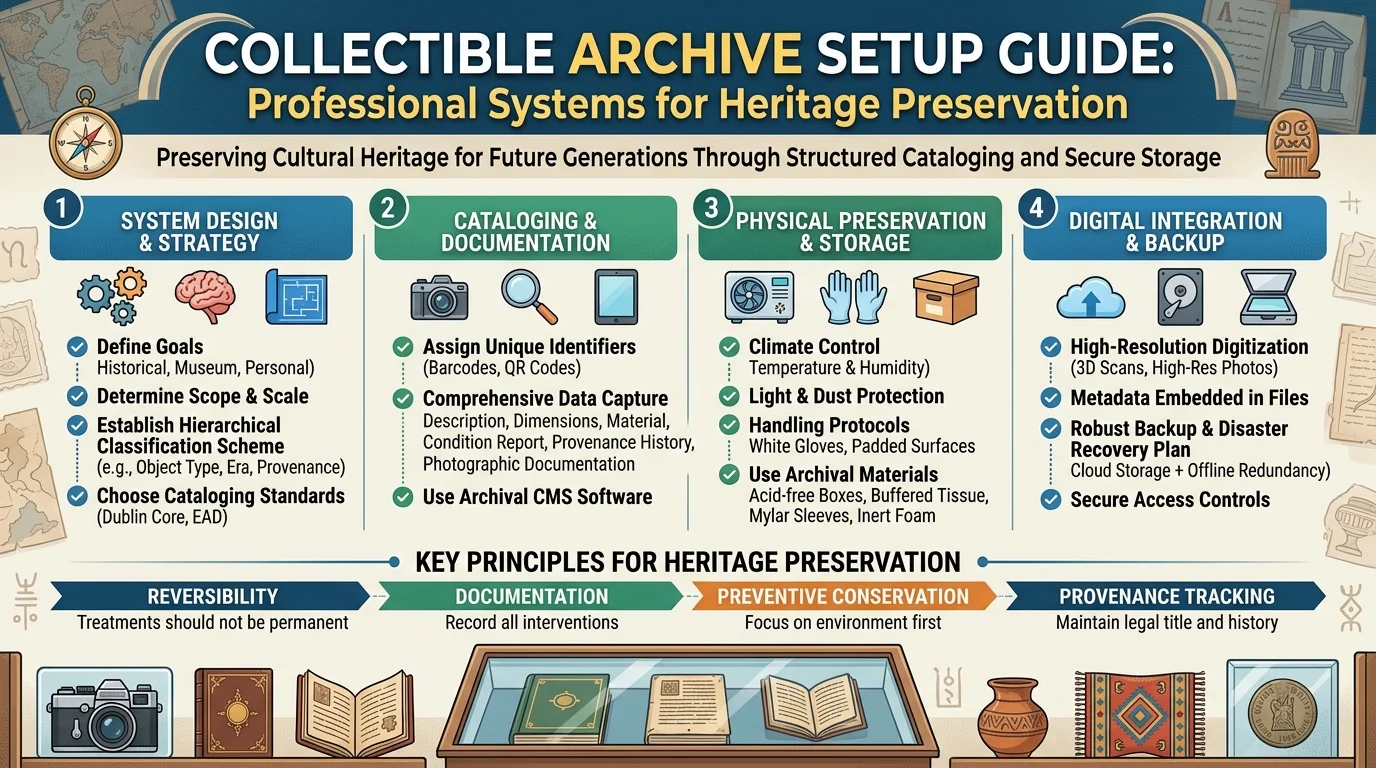
Collectible Archive Setup Guide: Professional Systems for Heritage Preservation
A properly designed collectible archive is the foundation of any serious collection. Whether you manage a museum collection, a personal antique trove, or a family heritage archive, the difference between random storage and a professional archive comes down to three factors: documentation, environmental control, and accessibility. This guide provides a complete framework for setting up a collectible archive that protects your items from deterioration, allows you to locate any piece instantly, and preserves information for future generations. From selecting storage materials to implementing digital cataloging systems, every component is explained in practical terms.
Table of Contents
| Section | Topic |
|---|---|
| 1 | Planning Your Archive: Needs Assessment |
| 2 | Environmental Specifications and Monitoring |
| 3 | Storage Furniture and Containers |
| 4 | Documentation and Cataloging Systems |
| 5 | Handling Protocols and Tools |
| 6 | Security and Disaster Preparedness |
| 7 | Ongoing Maintenance Schedule |
| 8 | Frequently Asked Questions |
1. Planning Your Archive: Needs Assessment
Before purchasing any storage materials, conduct a thorough assessment of your collection. This planning phase prevents wasted expenditure on inappropriate supplies.
Collection Inventory
Create a preliminary list of all items requiring archive storage. Record the following for each item or category:
Dimensions including height, width, depth, and any irregular projections
Weight for assessing shelf load requirements
Material composition including wood, metal, textile, paper, ceramic, glass, or composite
Condition noting existing damage, active deterioration, or previous repairs
Access frequency indicating how often each item will be retrieved
Special requirements such as oversized storage, hanging needs, or isolation from other materials
Space Evaluation
Measure your available storage space including ceiling height, floor area, door widths, and access routes. Identify environmental factors including windows, exterior walls, HVAC vents, water pipes, and electrical panels. Note any existing pest evidence such as droppings, damage, or insect activity.
Budget Allocation
Professional archive setup requires investment. Allocate funds across these categories:
| Category | Recommended Percentage |
|---|---|
| Storage furniture and shelving | 35-45 percent |
| Enclosures and wrapping materials | 25-35 percent |
| Environmental control equipment | 15-20 percent |
| Cataloging software and hardware | 10-15 percent |
| Handling tools and safety equipment | 5-10 percent |
2. Environmental Specifications and Monitoring
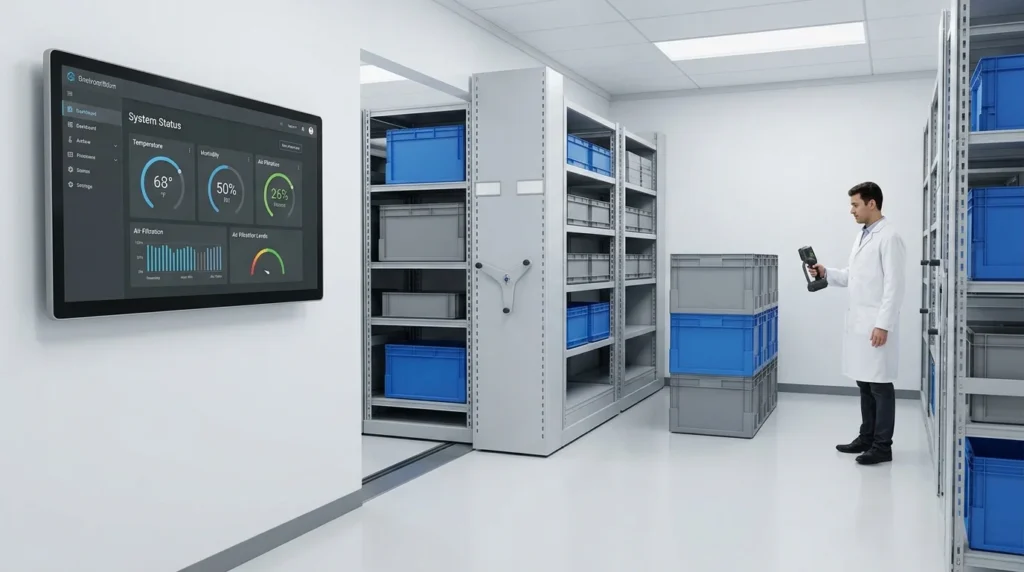
Environmental control is the single most important factor in long-term collectible preservation. Without proper conditions, even the best containers cannot prevent deterioration.
Temperature Standards
The widely accepted standard for mixed collections is 18 to 21 degrees Celsius maintained continuously. Temperature stability matters more than exact numbers. Fluctuations exceeding 3 degrees per day cause materials to expand and contract repeatedly, leading to structural fatigue.
Different material categories have optimal temperature ranges:
| Material | Optimal Temperature |
|---|---|
| Metals and ceramics | 18-20 C |
| Wood and furniture | 18-21 C |
| Paper and parchment | 16-18 C |
| Textiles | 16-18 C |
| Photographic materials | 10-15 C |
| Paintings | 18-21 C |
For mixed collections, maintain 18-20 C as a compromise that serves all materials adequately.
Relative Humidity Standards
The standard for mixed collections is 45 to 55 percent relative humidity, with stability again being critical. Humidity below 40 percent causes organic materials to become brittle and crack. Humidity above 60 percent promotes mold growth, metal corrosion, and insect activity.
Daily humidity fluctuations should not exceed 5 percent. Seasonal fluctuations should not exceed 10 percent from summer to winter averages.
Environmental Monitoring Equipment
Install the following monitoring devices:
Digital hygrothermographs with data logging capabilities record temperature and humidity continuously. Units costing 50 to 150 dollars provide adequate accuracy for most collections. Position devices at different heights and locations, as conditions vary significantly within the same room.
Pest monitoring traps capture insects for identification before populations establish. Sticky traps placed along walls and near entry points should be checked monthly.
Light meters measure illumination levels. For storage areas, light levels should not exceed 200 lux. Ultraviolet meters ensure UV radiation remains below 75 microwatts per lumen.
Environmental Control Equipment
Based on your climate and space, you may need:
Portable dehumidifiers for spaces exceeding 55 percent RH seasonally. Select units with automatic drainage to avoid emptying collection trays.
Humidifiers for spaces dropping below 40 percent RH. Ultrasonic or evaporative units are preferred over steam units which add heat.
Air purifiers with HEPA filtration remove dust and mold spores. Select units sized for your cubic footage.
Heating and cooling system modifications may be required for spaces without existing climate control.
3. Storage Furniture and Containers
The physical infrastructure of your archive directly protects items from mechanical damage and environmental fluctuations.
Shelving Systems
Powder-coated steel shelving is the professional standard. Open wire shelving allows air circulation, preventing microclimates from forming around stored items. Solid metal or wood shelves can trap moisture against item bottoms.
Specifications for archival shelving:
Each shelf should support at least 200 pounds distributed weight
Shelf depth should exceed your largest item by at least 5 centimeters
Height between shelves should allow 10 centimeters clearance above tallest items
Shelves should be adjustable in 3-centimeter increments
Units must be anchored to walls to prevent tipping
Do not use particle board shelving. The adhesives off-gas formaldehyde and other volatile compounds that damage collectibles.
Cabinets for Small and Sensitive Items
Flat files with shallow drawers are ideal for paper, textiles, and flat objects. Map cases with drawers 5 to 15 centimeters deep provide excellent organization. Metal cabinets are preferred over wood, which can off-gas acids.
For valuable or very sensitive items, museum-quality steel cabinets with powder-coated finishes provide the highest protection. These are expensive but necessary for irreplaceable collections.
Enclosures by Material Type
Different materials require different enclosure strategies:
| Material | Enclosure Type | Specific Requirements |
|---|---|---|
| Paper documents | Archival folders and boxes | Acid-free, lignin-free, buffered |
| Photographs | Polyester sleeves or acid-free paper | Unbuffered, pass-through testing |
| Textiles | Muslin wraps or archival boxes | Washed, unbleached cotton |
| Metal objects | Polyethylene containers | Silica gel, out of contact with other metals |
| Ceramics and glass | Individual padded boxes | Separators between pieces |
| Books | Archival slipcases or boxes | Support spines, no direct contact |
| Leather | Breathable cotton wraps | No plastic, periodic inspection |
Box and Folder Specifications
Archival boxes must be acid-free and lignin-free with a pH of 7.5 to 9.0 for buffered materials. For photographs and some textiles, unbuffered boxes with pH of 7.0 are required. Corrugated board should be made from virgin fiber, not recycled content.
Folders and tissue paper should meet the same specifications. Avoid colored folders as dyes may migrate. Use only pencil for labeling folders and boxes. Ink can bleed and transfer.
4. Documentation and Cataloging Systems
Documentation transforms a storage area into an archive. Without records, you have boxes of unknown items.
Unique Identification System
Every item in your archive requires a unique identifier. The most common systems use prefixes indicating category followed by sequential numbers. Example: 2024.001 indicates an item accessioned in 2024, the first item of that year.
Label objects using archival methods. For items without sensitive surfaces, write the identifier on acid-free paper labels attached with cotton string. For paper items, write identifiers lightly in pencil on the verso lower edge. Never adhere labels directly to valuable objects.
Cataloging Database
Professional archives use collection management software. Options range from free to thousands of dollars:
Free and low-cost options include CatalogIt at approximately 30 dollars monthly for personal collections, Airtable customized for collection tracking, and Excel or Google Sheets for very small collections.
Professional options include TMS (The Museum System), CollectionSpace (open source), and PastPerfect for medium institutions.
Regardless of software, each catalog record must include:
Unique identifier
Object name and brief description
Material and technique
Dimensions including metric and imperial
Date or period of manufacture
Maker or manufacturer if known
Provenance including acquisition date and source
Condition notes with date of examination
Location within the archive
Digital images from multiple angles
Location Control System
Your catalog must track exactly where each item resides. Implement a location hierarchy:
Room or area designation such as Archive Room West
Unit number such as Shelf Unit 3
Shelf number such as Shelf B
Box or container number such as Box 14
Specific position such as Folder 2
Update location records immediately whenever an item moves. Deferred updates create chaos within weeks.
Photography Standards
Photograph every item before storage. Use consistent setup:
Neutral grey or white background
Scale reference included in each frame
Color chart for accurate reproduction
Camera mounted on tripod
Consistent lighting at 45-degree angles
File naming matching the item‘s unique identifier
Store master images in TIFF or RAW format. Create JPEG derivatives for web and reference use.
5. Handling Protocols and Tools
Improper handling damages more collectibles than any environmental factor. Establish and enforce handling protocols.
Required Handling Tools
Stock the following tools for safe object movement:
Cotton or nitrile gloves in multiple sizes
Microfiber dust cloths for surface cleaning
Soft-bristled brushes for dust removal
Foam supports and cradles for irregular objects
Padded book supports for volumes
Two-person lift guidelines for items over 10 kilograms
Flat carts with padded surfaces for moving multiple items
Handling Rules
Establish written handling rules enforced for everyone accessing the archive:
Never handle collectibles after applying hand lotion or eating
Remove all jewelry including rings, bracelets, and watches
Support the primary weight of any object from beneath
Never lift objects by handles, appendages, or rims
Hold objects over padded surfaces to minimize fall damage
Move one object at a time
Never rush or multitask while handling
Training Requirements
Anyone handling collection items must demonstrate competence. Train on:
Proper glove use and changing protocols
Safe lifting techniques for different object types
Two-person lifting and communication
Emergency procedures for drops or accidents
Identifying condition changes requiring conservator attention
6. Security and Disaster Preparedness
Archives face risks from theft, fire, water damage, and natural disasters. Planning reduces these risks.
Physical Security
Restrict archive access to authorized personnel only. Install:
Lockable doors with keys or codes controlled and logged
Window locks or security film on glazing
Security cameras covering entry points and storage areas
Alarm system monitored off-site
For high-value collections, consider safes or security cabinets for the most valuable items.
Fire Protection
Water sprinkler systems protect archives from fire but risk water damage. Alternative systems include:
Gaseous fire suppression using inert gases that displace oxygen
Water mist systems producing fine droplets with less damage
Fire-rated storage cabinets for irreplaceable items
Smoke detectors should be installed throughout archive spaces and tested monthly.
Water Damage Prevention
Position shelving at least 10 centimeters above floors to prevent water contact from minor flooding. Avoid storing items directly on concrete floors where moisture wicks upward. Install water sensors on floors near pipes, HVAC units, and exterior walls.
Identify water shutoff valves and train staff on emergency use.
Disaster Response Kit
Assemble a kit for immediate response to water damage:
Disposable gloves and masks
Plastic sheeting to cover dry areas
Absorbent pads and towels
Freezer-grade plastic bags for wet items
Freezer space identified for freezing wet materials
Contact list for emergency conservators
Disaster Plan
Document a written disaster plan including:
Emergency contact numbers including conservators, plumbers, electricians
Water shutoff and electrical cutoff locations
Salvage priorities listing most valuable or irreplaceable items
Step-by-step response procedures for fire, flood, and storm damage
Freezer and temporary storage arrangements
Review and update the plan annually. Conduct practice drills for common scenarios.
7. Ongoing Maintenance Schedule
An archive requires regular attention to remain functional.
Daily Tasks
Check temperature and humidity readings
Verify environmental control equipment operation
Inspect for odors suggesting mold or overheating
Weekly Tasks
Empty dehumidifier collection trays
Check pest traps and record findings
Spot check accessible items for visible changes
Monthly Tasks
Download and review environmental data logs
Inspect stored items for pests, mold, or corrosion
Verify fire and security system operation
Clean floors and accessible surfaces
Quarterly Tasks
Inspect less accessible storage areas
Review catalog for incomplete records
Test disaster response equipment
Rotate displayed items if applicable
Annual Tasks
Complete full collection inventory
Update condition reports for all items
Recalibrate environmental monitoring equipment
Review and update disaster plan
Perform deep cleaning of storage areas
8. Frequently Asked Questions
Q1: What is the most important factor in archive setup?
Environmental control, specifically stable temperature between 18-21 degrees Celsius and stable relative humidity between 45-55 percent. Without proper environmental conditions, even the best containers cannot prevent deterioration.
Q2: Can I use regular cardboard boxes for collectible storage?
No. Regular cardboard contains lignin and acids that damage collectibles through direct contact and off-gassing. Use only archival boxes made from acid-free, lignin-free virgin fiber.
Q3: How often should I inspect stored collectibles?
Visually inspect accessible items weekly. Perform complete condition reviews annually. High-value items or those in active deterioration require more frequent inspection.
Q4: Is it safe to store different materials together?
Generally no. Different materials have different environmental requirements and can interact chemically. Metal corrodes when in contact with leather or wood. Textiles absorb metal corrosion products. Store each material category separately when possible.
Q5: What should I do if I find mold in my archive?
Isolate affected items immediately. Wear respiratory protection. Do not attempt to clean mold without consulting a professional conservator. Address the humidity problem that caused the mold before returning any items to storage.
Q6: How do I choose between buffered and unbuffered enclosures?
Use buffered enclosures for most paper and organic materials. Use unbuffered enclosures for photographs, textiles, and some leather. When in doubt, consult a conservator for your specific material types.
Q7: What is the best shelving material for archives?
Powder-coated steel is the professional standard. It is strong, non-reactive, and allows air circulation. Avoid wood shelving which off-gases acids. Avoid particle board which off-gases formaldehyde.
Q8: Can I use plastic storage bins from the hardware store?
Only if the plastic is polyethylene or polypropylene (recycling codes 2, 4, or 5). Avoid PVC (recycling code 3) which off-gases plasticizers. Even acceptable plastics should not seal completely, as trapped moisture causes damage. Drill ventilation holes if using plastic bins.
Q9: How do I track item locations in a large archive?
Implement a location hierarchy from room to specific shelf position. Enter location data into your cataloging database. Update location records immediately whenever any item moves. Use color-coded shelf labels for quick identification.
Q10: How much does a professional archive setup cost?
Costs vary dramatically based on collection size and value. A small personal archive for 100 items might cost 500 to 2,000 dollars for basic materials. A professional archive for 10,000 items in a dedicated room might cost 20,000 to 100,000 dollars including environmental control equipment.
collectiblearchivesetup archiveorganization antiqueinventorysystem collectiblestoragesolutions archivalmaterials heritagecollectionmanagement catalogingcollectibles archivestorageguide preservationarchive collectibleshelvingsystem collectiondocumentation archivalenvironmentalcontrol