Ancient Greece: Democracy, Philosophy, and Power
Ancient Greece shaped some of the most influential ideas in Western history. Its city-states produced new forms of government, bold philosophical questions, dramatic works of art, scientific observations, and military strategies that still attract attention today. Yet ancient Greek civilization was never a single, unified nation. It was a collection of independent communities with different laws, customs, economies, and ambitions.
At the center of this world were three powerful forces: democracy, philosophy, and political power. Athens experimented with citizen government and encouraged public debate. Thinkers such as Socrates, Plato, and Aristotle explored justice, knowledge, ethics, and the nature of the state. Meanwhile, Sparta, Athens, Thebes, and Macedon competed for influence through alliances, warfare, trade, and diplomacy. Together, these developments created a civilization whose legacy reaches far beyond the ancient Mediterranean.
The Rise of the Greek City-State
Ancient Greek civilization developed across a rugged landscape of mountains, valleys, and islands. This geography made travel overland difficult and encouraged communities to grow independently. Rather than forming one centralized kingdom, many Greek-speaking communities became poleis, or city-states. A polis usually included an urban center, surrounding farmland, religious sanctuaries, and a population connected by shared laws and traditions.
Each city-state governed itself. Athens developed a system that gradually moved toward democracy, while Sparta created a highly disciplined military society. Corinth became a major center of trade and craftsmanship. Thebes gained prominence through military innovation and political rivalry. These differences meant that there was no single Greek model of government or culture.
Despite their divisions, Greek communities shared important cultural bonds. They spoke related dialects, worshiped many of the same gods, participated in religious festivals, and recognized common traditions in poetry and mythology. Panhellenic events, including athletic competitions, helped create a sense of shared identity. Even so, local loyalty usually remained stronger than any broad idea of Greek national unity.
From Kings to Aristocrats
In the early history of many Greek communities, kings held political and religious authority. Over time, however, power often shifted to aristocratic families who controlled land, weapons, and important public offices. These elites dominated courts, councils, and military leadership. Ordinary farmers had limited political influence, while debt and economic hardship could push some citizens into dependency or even slavery.
Social tensions encouraged political change. In several city-states, lawgivers attempted to establish written rules and reduce arbitrary aristocratic power. Athens, for example, remembered Draco for his severe written laws and Solon for reforms that addressed debt, class conflict, and citizenship. These changes did not create democracy immediately, but they helped establish the principle that political authority should operate through public laws rather than private family privilege.
Athenian Democracy and Citizen Power
Athens is widely associated with the birth of democracy, a term derived from the Greek words for “people” and “rule.” Athenian democracy developed gradually, especially through the reforms of Solon, Cleisthenes, and later leaders such as Pericles. It was based on the idea that eligible citizens should participate directly in public decision-making.
The Athenian system included several important institutions:
- The Assembly: Citizens gathered to debate and vote on laws, war, diplomacy, and other major matters.
- The Council of Five Hundred: This body prepared issues for discussion and helped manage the daily work of government.
- People’s courts: Large citizen juries heard legal cases and made decisions.
- Public offices: Many officials were selected by lot, reflecting the belief that ordinary citizens should share in government.
- Ostracism: Citizens could vote to exile a politically dangerous individual for a limited period.
Athenian democracy was innovative, but it was not democratic by modern standards. Women, enslaved people, foreigners, and many residents without citizen status could not vote or hold political office. The population of eligible citizens was only a portion of the total population. Political participation also required free time, education, and the ability to attend meetings, advantages that were not equally available to everyone.
Even with these limitations, Athens introduced ideas that remain central to political thought. Public officials could be questioned. Laws could be debated. Citizens were expected to speak, listen, judge, and accept responsibility for the direction of their community. Political life became a public activity rather than a private possession of kings or aristocratic families.
Rhetoric and the Art of Persuasion
In Athens, success in public life depended heavily on speech. Citizens argued cases in court, debated proposals in the Assembly, and defended their reputations before large audiences. Rhetoric became an essential skill, and teachers known as sophists offered instruction in argument, grammar, and persuasive speaking.
This emphasis on rhetoric had both positive and negative consequences. It encouraged citizens to examine issues from multiple perspectives and gave talented speakers a path to influence. At the same time, persuasive language could be used to manipulate crowds or conceal weak arguments. The tension between truth and persuasion became one of the central concerns of Greek philosophy.
Greek Philosophy and the Search for Truth
Greek philosophy began as an attempt to understand the world through reason rather than relying entirely on mythological explanations. Earlier thinkers, often called the pre-Socratics, asked questions about the origin of the universe, the nature of matter, and the principles governing change. Some proposed that everything came from water, air, fire, or an abstract substance. Others argued that reality was constantly changing or that true reality was unchanging and difficult to perceive.
These early investigations established a habit of questioning assumptions. Greek philosophers did not all agree, but their arguments created a tradition in which ideas were tested through observation, logic, debate, and criticism.
Socrates and the Examined Life
Socrates became one of the most influential figures in ancient philosophy, even though he left no written works of his own. Much of what is known about him comes from the writings of Plato and other authors. Socrates challenged people in public places by asking questions about courage, justice, virtue, knowledge, and the good life.
His method exposed contradictions in confident opinions. Rather than presenting himself as a teacher who possessed all the answers, Socrates often emphasized the limits of human knowledge. He believed that self-examination was essential and that a person should care more about the condition of the soul than about wealth, reputation, or political success.
Socrates’ approach could be uncomfortable and politically controversial. In 399 BCE, he was tried and convicted by an Athenian jury on charges that included impiety and corrupting the young. He was sentenced to death and accepted the decision rather than abandoning his principles. His trial raised enduring questions about free speech, public opinion, civic duty, and the relationship between the individual and the state.
Plato’s Vision of Justice
Plato, a student of Socrates, preserved and expanded many Socratic ideas through philosophical dialogues. He explored politics, education, love, knowledge, art, and morality. In his most famous political work, he imagined a well-ordered state governed by people trained to understand wisdom and justice.
Plato was deeply skeptical of direct democracy. He believed that public opinion could be unstable and that unprepared leaders might win power through emotional appeals. His ideal state was divided into social groups with different responsibilities, including producers, guardians, and philosopher-rulers. Education played a central role because Plato believed that leadership required disciplined intellectual and moral development.
Plato’s political model was not a practical blueprint for every society, but it raised important questions. Should political leaders be chosen for popularity, wealth, birth, expertise, or character? What kind of education creates responsible citizens? Can a state be just if its institutions are efficient but its people are unequal? These questions continue to influence political philosophy.
Aristotle and the Study of Government
Aristotle, a student of Plato, approached politics in a more practical and analytical way. He studied different constitutions and classified governments according to who ruled and whether rulers acted for the common good. He examined monarchy, aristocracy, and constitutional government, along with their corrupt forms: tyranny, oligarchy, and extreme democracy.
Aristotle did not treat government as an abstract idea disconnected from daily life. He argued that humans are naturally political because they achieve their full potential within a community. A successful state, in his view, should promote virtue, stability, and participation while avoiding extreme inequality and factional conflict.
His work helped establish political science as a field of systematic study. Rather than asking only what government ought to be, Aristotle also asked how governments actually function, why they change, and what causes them to collapse. His observations about constitutions, citizenship, class divisions, and political stability influenced later thinkers for centuries.
Sparta and the Power of Military Discipline
Athens is often remembered for democracy and philosophy, but Sparta represented a very different approach to power. Spartan society was organized around military readiness, communal discipline, and the control of a large dependent population known as the helots. Spartan citizens were expected to serve as soldiers and to place the needs of the state above personal comfort.
According to tradition, Spartan boys entered a rigorous state training system at a young age. They learned endurance, obedience, combat skills, and loyalty to the community. Spartan women generally enjoyed more property rights and public independence than women in Athens, partly because men spent much of their lives in military service. Even so, Sparta remained a highly controlled and unequal society.
The Spartan government combined several institutions, including kings, a council of elders, elected officials, and a citizen assembly. Its political structure was designed to prevent any single group from gaining unlimited authority. In practice, however, the system depended on military power and the continued subordination of the helot population.
The contrast between Athens and Sparta became one of the defining tensions of Greek history. Athens valued naval strength, trade, public debate, and cultural achievement. Sparta emphasized land warfare, social discipline, and conservative stability. Neither city-state was simply “better”; each revealed different possibilities and dangers in the organization of political power.
War, Empire, and the Struggle for Influence
Power in ancient Greece was shaped by constant competition. Greek city-states fought among themselves, formed temporary alliances, and competed for access to land, trade routes, and strategic ports. Warfare was not an occasional interruption but a central part of political life.
The Persian Wars created a rare moment of cooperation. Greek forces resisted the expansion of the Persian Empire in a series of conflicts during the early fifth century BCE. Famous battles, including Marathon, Thermopylae, Salamis, and Plataea, became symbols of resistance and collective identity. Greek victory strengthened Athens in particular, especially because its navy played a crucial role in the struggle.
After the Persian threat receded, Athens used its leadership of an alliance to build an empire. Tribute from allied communities helped finance the city’s fleet, public buildings, festivals, and cultural projects. The alliance gradually became an Athenian-dominated system, and communities that attempted to leave could face military pressure. Athens therefore became both a center of democracy and an imperial power.
The Peloponnesian War
The rivalry between Athens and Sparta eventually led to the Peloponnesian War, which lasted from 431 to 404 BCE. Athens relied on naval strength, walls, trade, and financial resources. Sparta depended on its army and its network of allies. The conflict devastated many communities and weakened the Greek world.
The war also exposed the fragility of political systems under pressure. Athens experienced plague, factional struggles, controversial military decisions, and shifts in public opinion. Political leaders could be celebrated one year and condemned the next. The conflict demonstrated how fear, ambition, anger, and pride could overwhelm careful judgment.
Sparta won the war, but its victory did not create lasting stability. Thebes later defeated Sparta, and other city-states continued to resist domination. This cycle of rivalry prevented the Greek city-states from forming a durable unified government, leaving them vulnerable to a stronger power from the north.
Macedon and the Expansion of Greek Culture
In the fourth century BCE, Macedon rose under King Philip II. He reorganized the Macedonian army, developed the use of the long spear known as the sarissa, and exploited divisions among the Greek city-states. After defeating a coalition that included Athens and Thebes at the Battle of Chaeronea in 338 BCE, Philip gained control over much of Greece.
His son, Alexander the Great, expanded Macedonian power across the Persian Empire and into Egypt and parts of Central and South Asia. Alexander’s conquests created a vast political realm that connected Greek communities with older civilizations in the Near East and beyond.
The period following Alexander’s death is often called the Hellenistic age. Greek language, art, education, and political institutions spread across an enormous region. At the same time, Greek culture absorbed influences from Egypt, Persia, Mesopotamia, and other societies. Major cities became centers of scholarship, commerce, and cultural exchange.
Hellenistic rulers used Greek traditions to strengthen their legitimacy, but they also governed diverse populations through monarchies rather than citizen democracies. This period shows how Greek culture could travel far beyond the independent city-state while changing in the process.
Religion, Art, and Everyday Greek Life
Greek politics and philosophy cannot be separated from religion. The Greeks worshiped a large group of gods and goddesses associated with natural forces, human emotions, civic identity, and family relationships. Zeus, Athena, Apollo, Artemis, Demeter, Aphrodite, and Dionysus each had distinct myths and rituals.
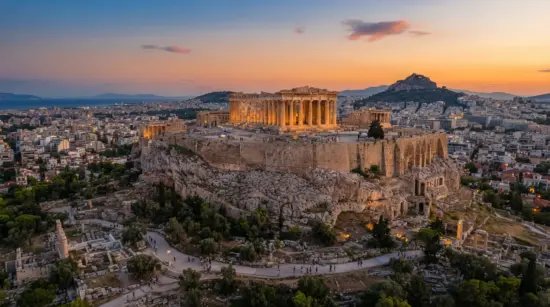
Religious festivals were also public events. They brought communities together, reinforced local identity, and connected political authority with divine tradition. Temples dominated city landscapes, while sacrifices, processions, athletic competitions, and theatrical performances formed part of civic life.
Greek art reflected an interest in proportion, movement, and the human form. Sculptors developed idealized representations of the body, while architects refined systems of columns and decoration. Theaters hosted tragedies and comedies that explored guilt, fate, family conflict, political responsibility, and the weaknesses of human character.
Daily life remained unequal. Men with citizen status generally held the greatest political authority. Women’s roles varied between city-states but were usually centered on household responsibilities, family relationships, and religious activities. Enslaved people performed domestic, agricultural, industrial, and commercial labor. The achievements of Greek civilization were therefore supported by social systems that denied freedom and political rights to many people.
The Lasting Legacy of Ancient Greece
The influence of ancient Greece can be seen in modern discussions of democracy, civic responsibility, education, ethics, logic, theater, architecture, medicine, mathematics, and historical writing. Greek thinkers created vocabulary and frameworks that continue to shape universities, courts, legislatures, and public debate.
However, the Greek legacy should not be treated as a simple story of progress. Athenian democracy excluded much of its population. Philosophers sometimes defended rigid social hierarchies. Greek city-states regularly used violence against rivals and subjected conquered populations to domination. The same civilization that celebrated freedom could depend on slavery and empire.
Understanding ancient Greece requires holding these contradictions together. Its history is valuable not because it provides a perfect political model, but because it reveals how ideals operate within real societies. Democracy can coexist with exclusion. Philosophy can challenge power while also reflecting the assumptions of its time. Military strength can create order but cannot guarantee lasting unity.
Frequently Asked Questions About Ancient Greece
What was ancient Greece?
Ancient Greece was a civilization made up of independent city-states and kingdoms that shared language, religious traditions, myths, and cultural practices. It was not a unified country for most of its history. Athens, Sparta, Corinth, Thebes, and later Macedon were among its most important political centers.
Did ancient Greece invent democracy?
Athens developed the earliest well-known form of direct democracy, especially during the fifth century BCE. Eligible male citizens could participate in assemblies, courts, and some public offices. However, women, enslaved people, foreigners, and many other residents were excluded, so Athenian democracy was far narrower than modern democratic systems.
Why are Socrates, Plato, and Aristotle important?
Socrates emphasized questioning, self-examination, and the search for moral knowledge. Plato explored justice, education, politics, and the nature of reality through philosophical dialogues. Aristotle studied logic, ethics, science, politics, and government in a systematic way. Together, they established ideas and methods that influenced philosophy for centuries.
How were Athens and Sparta different?
Athens was known for democratic institutions, naval power, trade, public debate, philosophy, and the arts. Sparta was organized around military discipline, social control, and a powerful land army. Both were influential city-states, but they represented sharply different approaches to citizenship, education, government, and power.
What caused the decline of the Greek city-states?
Repeated wars weakened the major city-states and deepened political divisions. The Peloponnesian War damaged Athens and its allies, while later conflicts exhausted Sparta, Thebes, and other powers. Macedon took advantage of this fragmentation under Philip II and brought much of Greece under its influence.
What is the Hellenistic period?
The Hellenistic period began after the conquests of Alexander the Great and continued as his successors ruled large territories in the eastern Mediterranean and Asia. Greek language and culture spread widely, while Greek traditions blended with Egyptian, Persian, and other local customs. It was an era of major cities, scientific study, trade, and cultural exchange.
Conclusion: A Civilization of Ideas and Contradictions
Ancient Greece transformed the way people thought about government, knowledge, citizenship, ethics, art, and power. Athens demonstrated the possibilities of public participation, while Socrates, Plato, and Aristotle challenged people to examine justice and the responsibilities of