Antique Storage Mistakes to Avoid: Preserving Heritage Through Proper Care
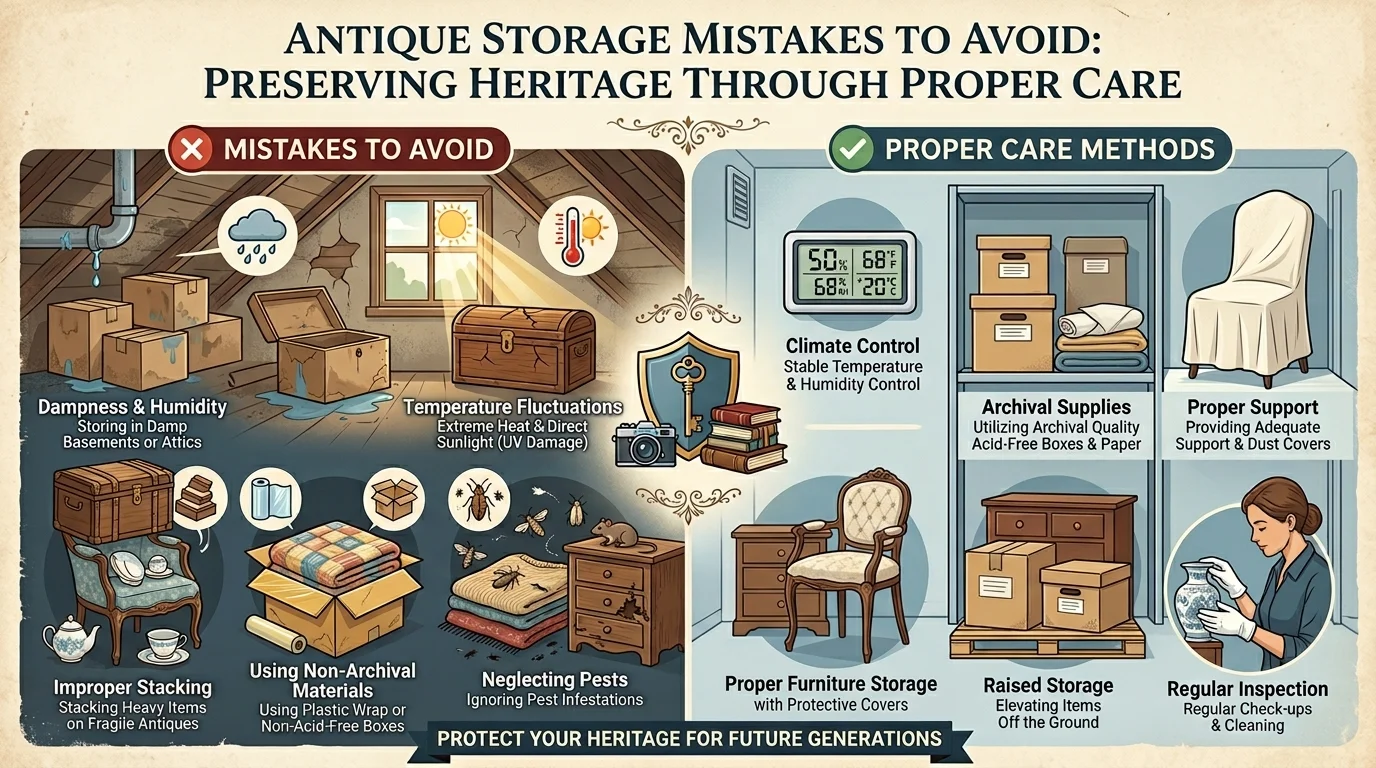
Storing antiques incorrectly can destroy value, cause irreversible damage, and turn family heirlooms into worthless debris. Unlike modern furniture or household items, antiques are constructed from natural materials that respond to environmental conditions in specific ways. Wood expands and contracts. Metal corrodes in humidity. Textiles weaken from light exposure. Paper becomes brittle when too dry and molds when too damp. This guide identifies the most destructive antique storage mistakes and provides professional solutions to preserve your collectibles for future generations.
Table of Contents
| Section | Topic |
|---|---|
| 1 | Environmental Control Mistakes |
| 2 | Physical Storage Position Errors |
| 3 | Material and Container Mistakes |
| 4 | Cleaning and Preparation Errors |
| 5 | Long-Term Storage Planning Failures |
| 6 | Category-Specific Storage Protocols |
| 7 | Frequently Asked Questions |
1. Environmental Control Mistakes
The environment surrounding stored antiques determines their survival or destruction. Most storage damage comes not from accidents but from slow environmental degradation.
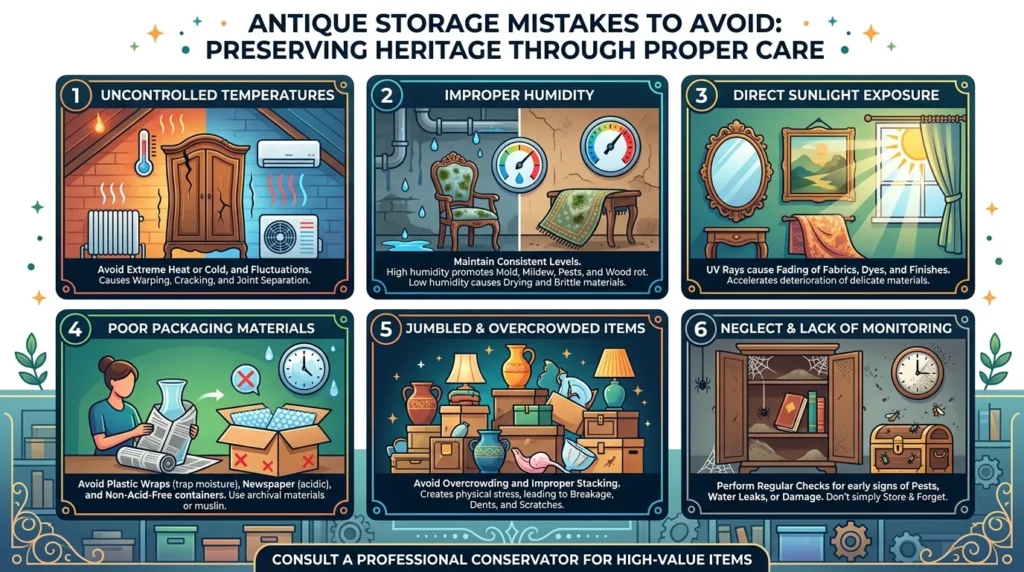
Mistake One: Storing in Attics
Attics represent the single most destructive storage location for antiques. Summer temperatures in uninsulated attics can exceed 50 degrees Celsius, causing wood to warp, glue joints to fail, and finishes to craze. Winter temperatures drop below freezing, causing differential contraction between different materials. A wooden table with metal hardware expands at different rates than its fasteners, creating stress fractures.
The humidity cycle in attics is equally destructive. Humid summer air causes wood to swell. Dry winter air causes shrinkage. Repeated cycles loosen joints permanently. Professional conservators never store antiques in attics regardless of protective wrapping.
Mistake Two: Storing in Basements
Basements offer stable temperatures but introduce humidity problems. Ground moisture migrates through concrete floors and walls. Relative humidity in basements frequently exceeds 70 percent, creating ideal conditions for mold growth on organic materials. Metal components rust. Paper artifacts develop foxing stains. Leather grows surface mold that cannot be fully removed.
If basement storage is unavoidable, professional dehumidification maintaining 45-55 percent relative humidity is essential. Items must be elevated at least 15 centimeters above the floor on non-porous supports.
Mistake Three: Storing in Garages or Sheds
Garages and sheds combine the worst aspects of attics and basements. Temperature extremes, humidity fluctuations, pests, vehicle exhaust fumes, and chemical vapors from paints or fuels all attack stored antiques. Professional collectors never store valuable items in these environments regardless of protective measures.
Mistake Four: Direct Sunlight Exposure
Ultraviolet radiation from sunlight destroys organic materials rapidly. Textiles fade and weaken. Paper becomes brittle and yellow. Wood finishes crack and discolor. Paintings develop pigment changes that cannot be reversed.
Even indirect sunlight through windows causes damage over time. Storage areas should have no windows or windows covered with UV-blocking film. Display areas with antiques must use UV-filtered glazing on frames and cases.
Mistake Five: Ignoring Temperature Fluctuations
Stable temperature matters more than ideal temperature. An antique stored at 22 degrees with daily fluctuations of 5 degrees experiences more stress than an antique stored at 18 degrees with no fluctuation. Professional storage facilities maintain temperature within plus or minus 2 degrees consistently.
2. Physical Storage Position Errors
How an antique is positioned during storage directly affects its structural integrity.
Mistake Six: Stacking Items
Stacking chairs, tables, or boxes on top of antiques causes cumulative damage. A seemingly light stack of boxes applies constant pressure that deforms upholstery, cracks veneer, and stresses joints. The antique at the bottom of any stack bears the weight of everything above.
Professional storage uses individual supports for each item. Nothing rests on anything else. Vertical storage racks for paintings and mirrors keep items separated. Furniture is stored right-side up on its own feet, never inverted or stacked.
Mistake Seven: Storing Flat Instead of Upright
Paintings, mirrors, and framed items stored flat accumulate dust on horizontal surfaces. More critically, items stored flat are more likely to have objects placed on top of them. Upright storage with proper hanging hardware or padded storage racks prevents this risk.
Paper items stored flat in archival boxes is correct for single sheets. Oversized items stored flat long-term develop creases and stress lines. Professional paper storage uses vertical hanging for large items when possible.
Mistake Eight: Allowing Contact with Walls
Antiques stored against bare walls experience moisture migration from wall surfaces. Cold exterior walls cause condensation on the back of furniture and frames. This hidden moisture promotes mold growth and metal corrosion.
All stored antiques must have air circulation space behind and around them. Minimum clearance of five centimeters from walls is essential. Rugs and textiles should never hang directly against exterior walls.
Mistake Nine: Improper Loading of Drawers and Shelves
Filled drawers and shelves place stress on antique furniture. A chest of drawers originally designed for lightweight 18th-century clothing experiences structural stress when filled with heavy modern items. Drawer bottoms sag. Runners wear unevenly. The carcase twists.
During storage, drawers should be emptied or filled only with very lightweight materials. If items must be stored inside furniture, distribute weight evenly across multiple drawers and avoid overfilling.
3. Material and Container Mistakes
The materials used to wrap and contain antiques often cause more damage than they prevent.
Mistake Ten: Using Newspaper for Wrapping
Newspaper ink transfers onto antiques, leaving permanent stains. The acids in newsprint accelerate degradation of organic materials. Paper items wrapped in newspaper develop acid burns within months. Textiles absorb ink from direct contact.
Professional wrapping uses unbleached muslin, acid-free tissue paper, or glassine paper. These materials are chemically stable and will not transfer inks or acids.
Mistake Eleven: Using Bubble Wrap Directly on Surfaces
Bubble wrap against delicate surfaces causes two problems. The plastic can outgas plasticizers that damage finishes. More critically, trapped moisture between bubble wrap and the antique creates microclimates where condensation forms. Metal items develop spot corrosion under each bubble.
Bubble wrap should only be used as an outer protective layer over a layer of acid-free tissue or unbleached muslin. The soft inner layer prevents direct plastic contact and absorbs minor moisture.
Mistake Twelve: Sealing Items in Plastic Bags
Completely sealed plastic bags trap moisture. An antique placed in a sealed bag during humid conditions develops condensation inside the bag. This moisture supports mold growth and corrosion that cannot escape. Metal items in sealed plastic frequently emerge covered in green or white corrosion.
If plastic must be used for temporary protection, perforate the bag to allow moisture exchange. For long-term storage, breathable fabric covers or acid-free boxes are superior.
Mistake Thirteen: Using Cardboard Boxes
Cardboard contains lignin, sulfur compounds, and acids that damage antiques directly through contact and indirectly through outgassing. Brown corrugated cardboard is particularly aggressive. White cardboard is less harmful but still not archival.
Professional storage uses acid-free corrugated board boxes or rigid polyethylene containers. For valuable items, museum-quality archival boxes with metal-reinforced corners provide optimal protection.
Mistake Fourteen: Using Rubber Bands or Metal Clips
Rubber bands degrade into sticky residues that bond to surfaces and cannot be removed without solvent damage. Metal paper clips rust, leaving permanent brown stains on paper. Staples create holes and rust.
Archive-safe fasteners include cotton tape, unbleached linen cord, and polyethylene clips. For paper items, encapsulation in polyester film provides secure protection without fasteners.
4. Cleaning and Preparation Errors
What you do before storage matters as much as the storage conditions.
Mistake Fifteen: Over-Cleaning Before Storage
Removing patina reduces antique value permanently. Silver polish removes desirable oxidation patterns. Furniture polish builds up in layers that eventually become cloudy and difficult to remove. Harsh cleaners strip original finishes.
Before storage, only remove loose surface dust with a soft brush or low-suction vacuum. Leave patina, original finishes, and surface oxidation intact. Professional conservators clean only when necessary for preservation, not for appearance.
Mistake Sixteen: Applying Wax or Oil Before Storage
Wax and oil coatings applied before storage cause problems. Wax can yellow and become opaque over time. Drying oils oxidize and become increasingly difficult to remove. Non-drying oils remain liquid, seep into adjacent materials, and attract dust.
Wooden antiques should be stored with their original finish exposed, not coated with additional products. If a protective coating is needed, consult a professional conservator for appropriate materials.
Mistake Seventeen: Storing Items While Wet or Damp
Any moisture trapped during storage will cause damage. Items brought in from humid environments must be acclimated before storage. Items cleaned with water or solutions must be completely dry, which may take days or weeks depending on material density.
Professional drying protocols involve controlled environments with air circulation. Never use heat guns or hair dryers to accelerate drying. Rapid drying causes cracking and warping.
Mistake Eighteen: Ignoring Existing Damage Before Storage
Small problems become large problems during storage. A loose leg on a chair becomes a detached leg. A small patch of mold becomes a completely moldy surface. A tiny crack becomes a split.
Inspect all items before storage and address stabilization needs. Professional conservation may be required for active problems. At minimum, document existing damage with photographs and notes to distinguish pre-storage damage from storage-related damage.
5. Long-Term Storage Planning Failures
Storage that works for months may fail over years.
Mistake Nineteen: Storing and Forgetting
Items placed in storage and ignored for years develop undetected problems. Mold growth progresses invisibly inside textile folds. Insect infestations spread from one item to another. Corrosion advances under seemingly intact surfaces.
Professional storage includes regular inspection schedules. Every item should be examined at least annually. Visual inspection without handling is adequate for general monitoring. Any change in appearance, odor, or texture requires investigation.
Mistake Twenty: Failing to Label Properly
Unlabeled or poorly labeled storage leads to unnecessary handling. Each time an item is moved or unwrapped to identify it, damage risk increases. Labels attached directly to antiques with adhesives cause stains. Labels written in ink bleed and transfer.
Professional labeling uses acid-free tags tied with cotton tape to the item. Tag information includes item identification, storage date, condition notes, and handling instructions. Containers are labeled on the outside with contents lists.
Mistake Twenty-One: Inadequate Pest Prevention
Silverfish, carpet beetles, woodworms, and rodents destroy stored antiques. Storage areas without pest monitoring allow infestations to establish and spread. Cardboard and paper products in storage areas attract silverfish and cockroaches.
Professional pest management includes sealed storage containers, regular trapping and inspection, and control of food sources. Insect pheromone traps monitor for specific pests. Rodent bait stations placed strategically around storage areas prevent entry.
6. Category-Specific Storage Protocols
Different antique categories require specific storage approaches.
| Category | Critical Mistake | Correct Protocol |
|---|---|---|
| Wooden Furniture | Storing in uninsulated buildings | Climate-controlled space, elevated on felt pads, covers breathable |
| Upholstered Furniture | Stacking items on cushions | Individual supports, pest monitoring, no weight on fabric |
| Paintings | Storing flat under other items | Upright on padded racks, separated by archival board |
| Paper Documents | Using plastic sleeves without buffering | Archival folders in acid-free boxes, polyester encapsulation |
| Textiles | Folding with sharp creases | Rolled on archival tubes, padded hangers for garments |
| Metal Objects | Storing without humidity control | Silica gel in sealed containers, out of contact with other metals |
| Ceramics and Glass | Nesting smaller items inside larger | Individual padded containers, no direct contact between pieces |
| Leather Items | Storing in sealed plastic | Breathable cotton covers, no folding, periodic conditioning |
| Photographs | Storing in standard paper envelopes | Archival sleeves, polyester or polypropylene, cool storage |
| Books | Shelving too tightly or leaning | Upright with moderate spacing, supported by bookends, no direct sunlight |
7. Frequently Asked Questions
Q1: Is it safe to store antiques in a climate-controlled storage unit?
Climate-controlled storage units are acceptable if they maintain temperature between 18-21 degrees Celsius and relative humidity between 45-55 percent year-round. Verify the unit’s performance with a data logger before committing valuable items. Avoid units with concrete floors without elevated pallets.
Q2: How often should I inspect stored antiques?
Annually for stable items in good environmental conditions. Quarterly for items in less-than-ideal conditions or items known to have active problems. Monthly for items with active mold, corrosion, or infestation.
Q3: What is the best way to cover furniture during storage?
Unbleached cotton muslin sheeting allows moisture exchange while blocking dust. Never use plastic tarps or vinyl covers, which trap moisture. Covers should drape loosely, not touch the floor where moisture wicks upward.
Q4: Can I store antiques in a self-storage unit without climate control?
Only for very short periods and only if local climate is mild year-round. Most self-storage units without climate control experience temperature extremes and humidity fluctuations that damage antiques. Professional collectors avoid non-climate-controlled storage entirely.
Q5: How do I store antique textiles?
Clean textiles before storage. Roll rather than fold to prevent crease damage. Use archival tubes for rolling. Wrap in washed unbleached muslin. Store in acid-free boxes in cool, dark, dry conditions. Inspect regularly for insect activity.
Q6: Is silica gel effective for antique storage?
Silica gel controls humidity in sealed containers but must be conditioned to the correct relative humidity before use. Blue indicating silica gel contains cobalt chloride, a carcinogen. Use non-indicating or orange-indicating gel instead. Recharge gel in an oven according to manufacturer instructions.
Q7: How do I store antique silver to prevent tarnish?
Anti-tarnish cloths and strips absorb sulfur compounds that cause tarnishing. Sealed containers with anti-tarnish materials reduce but do not eliminate tarnish. Avoid rubber bands, elastic, and latex gloves which accelerate tarnishing. Polishing before storage removes protective patina and is not recommended.
Q8: What should I do if I find mold on a stored antique?
Isolate the affected item immediately. Do not attempt to clean mold without respiratory protection. Dry mold is less dangerous than wet mold. Consult a professional conservator for mold remediation. Do not return mold-cleaned items to storage without addressing the humidity problem that caused the mold.
Q9: Can I store antiques in an outdoor shed if I wrap them well?
No. Wrapping does not protect against temperature extremes, humidity cycles, or pests. Outdoor sheds are never acceptable for antique storage regardless of wrapping quality.
Q10: What is the single worst antique storage mistake?
Storing items in an attic or basement without environmental controls, especially when wrapped in plastic. This combination creates extreme temperature cycles, high humidity, trapped moisture, and no monitoring access. Antiques stored this way for even one year often suffer irreversible damage.
antiquestoragemistakes avoidantiquestorageerrors vintagefurniturepreservation collectiblestoragetips antiqueenvironmentcontrol properantiquecare storagehumiditydamage atticantiquestoragedangers basementstoragemistakes archivalstoragematerials antiquewrappingerrors longtermantiquestorage pestpreventionantiques textileantiquestorage paintingstoragetips silverantiquetarnishprevention