Hidden Antique Restoration Secrets: Professional Techniques Revealed
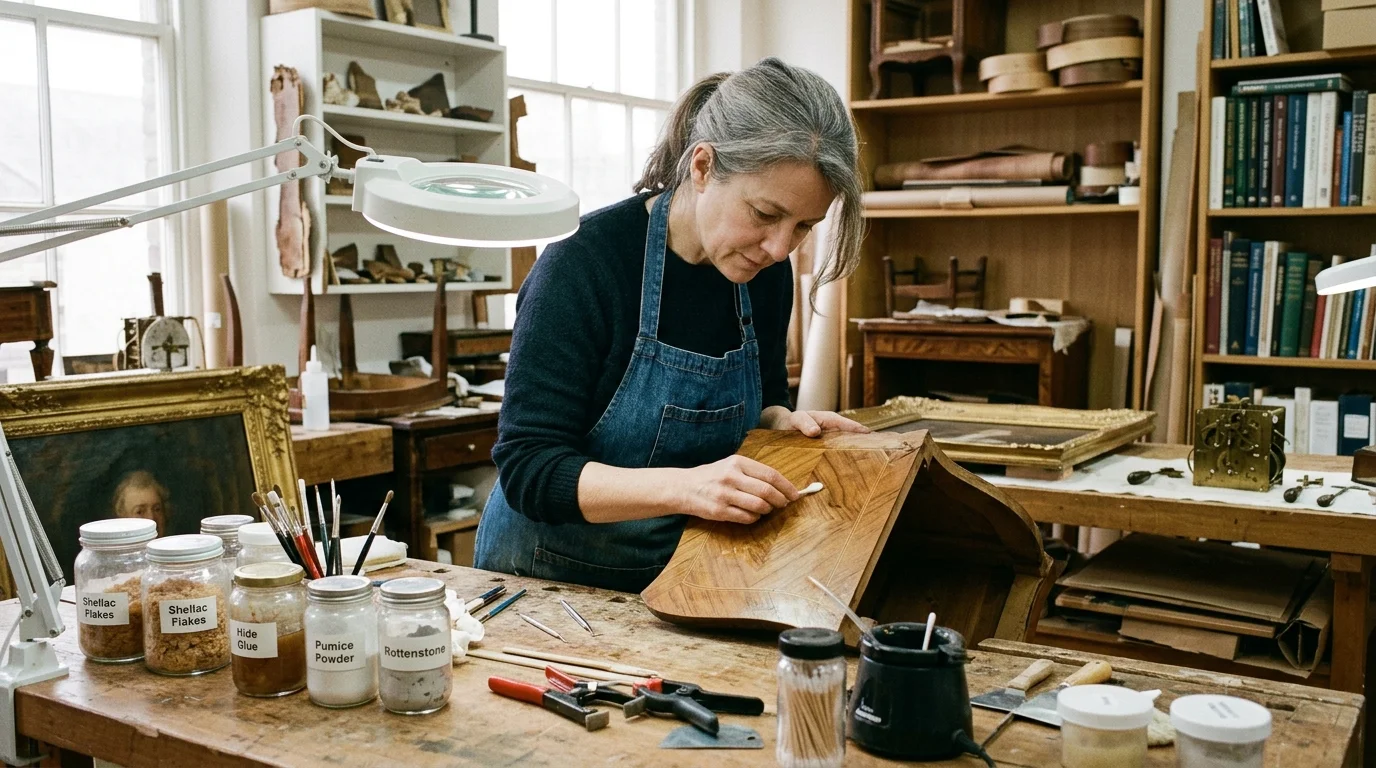
Table of Contents
| Section | Topic |
|---|---|
| 1 | The Confidential Nature of Restoration |
| 2 | Scientific Secrets: Seeing the Invisible |
| 3 | Professional Tool Secrets from Museum Labs |
| 4 | Ethical Secrets: What Restorers Don’t Tell You |
| 5 | Discovery Secrets: What Hidden Findings Reveal |
| 6 | The Three Restoration Paths |
| 7 | Frequently Asked Questions |
1. The Confidential Nature of Restoration
The restoration world operates with a remarkable degree of confidentiality. Galleries and dealers often decline to comment on their restoration methods, jealously protecting their artisanal connections and trade secrets . This secrecy exists for good reason: restoration expertise is a valuable commodity built on decades of experience, specialized training, and hard-won lessons from past disasters.
Many professional restorers admit to early failures. Dorte Slot, Gallery Director of Copenhagen’s Dansk Møbelkunst, confesses to “a few disasters, especially in the early years of the gallery.” After more than two decades, her team now maintains well-established relationships with craftsmen, each within their field of expertise .
The secret to successful restoration, according to industry experts, is knowing who to trust and when to leave things alone. As Ike Udechuku from Ampersand House wisely notes, “I guess the last word on restoration is about knowing when to leave things as you found them” .
2. Scientific Secrets: Seeing the Invisible
Modern restoration has moved far beyond visual inspection. Conservators now employ sophisticated scientific techniques that reveal what the naked eye cannot see.
Micro-SORS: Reading Through Layers
One of the most guarded secrets in recent years involves Micro-Spatially Offset Raman Spectroscopy (Micro-SORS). This cutting-edge technique allows researchers to uncover the chemical composition of hidden layers of paint in frescoes, paintings, and statues without causing any damage to the objects .
In a groundbreaking application, scientists partnered with The National Archives in London to analyze 18th-century historical documents including sealed letters seized on ships. Using adapted Raman microscopes, the team successfully recovered invisible texts through layers of paper in a completely non-invasive manner .
This means conservators can now read sealed letters without breaking seals, see hidden drawings beneath paintings without removing overpaint, and identify original pigments beneath centuries of grime.
X-Ray Vision and Metal Analysis
The Inner Mongolia Museum, often called an “artifact hospital,” uses X-ray diffractometers to analyze bronze patina and identify harmful corrosion before any treatment begins . Handheld X-ray fluorescence spectrometers allow conservators to determine the elemental composition of artifacts instantly, revealing original materials, later additions, and even hidden inscriptions.
During work on the Berthouville Treasure, a collection of Roman silver, conservators radiographed complicated pieces to better understand manufacturing details. On two large Centaur cups, X-rays revealed hidden inscriptions on the liners that had been completely invisible to the naked eye .
CO2 Snow: The Spa Treatment for Metals
Perhaps one of the most surprising secrets from museum labs is the use of CO2 snow for cleaning delicate metal surfaces. At the Cleveland Museum of Art, conservators used micron-size particles of solid carbon dioxide shaved from blocks of dry ice to clean brass mounts on an 18th-century French clock .
Unlike commercial dry-ice blasting which produces millimeter-sized pellets, this novel method passes a fine, controllable stream over the surface. The technique removes green corrosion product from finely textured recesses without altering patina and surface color, allowing the metal to appear as originally intended .
3. Professional Tool Secrets from Museum Labs
Professional restorers employ tools and techniques that would surprise most antique owners.
The Silly Putty Secret
Getty Museum conservators adapted a gel based on the chemical composition and physical properties of Silly Putty to remove tenacious varnish residues from the French clock case. This innovative formulation targets specific degradation products without affecting stable underlying surfaces .
The Glue Peel Method
For corrosion reduction on unvarnished brass, conservators used an animal glue peel—an established practice with new modifications. The glue combined with additives causes a chemical reduction that minimizes corrosion blemishes on metal surfaces, working like a “spa treatment” for the artifact .
Low-Pressure Vacuum Cleaning
In the organic artifact restoration laboratory, conservator Shi Liqin used a low-pressure vacuum cleaner to gently remove surface dust from a thousand-year-old embroidered leather bag. This technique applies localized negative pressure to targeted areas, smoothing every crease without risking damage to fragile fibers .
Japanese Clamping Systems
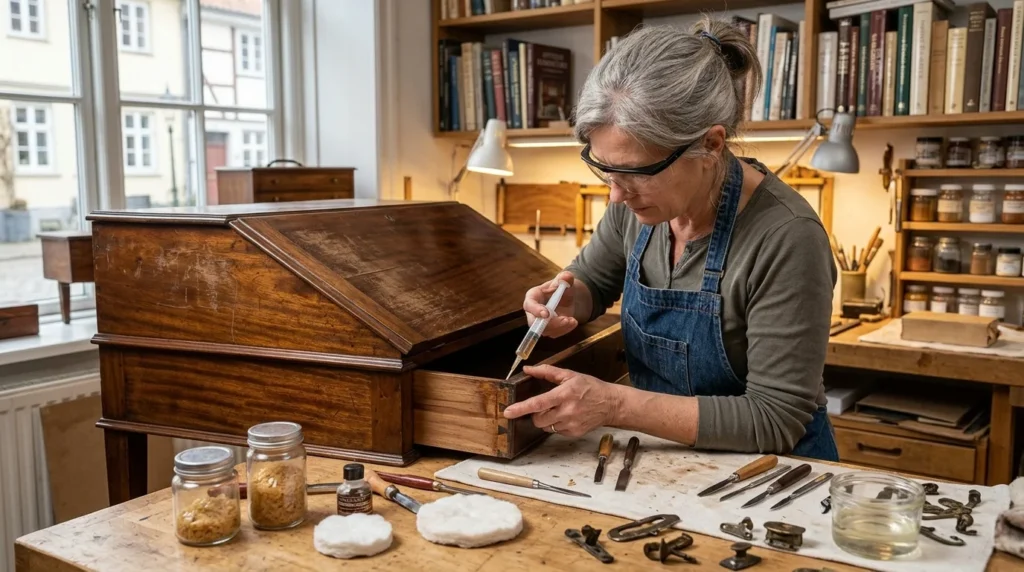
For stabilizing delicate marquetry during adhesive drying, conservators use an adaptation of a Japanese-style clamping system called shinbari. This traditional technique applies even pressure without leaving marks or causing additional stress to already-fragile components .
4. Ethical Secrets: What Restorers Don’t Tell You
Behind closed doors, restorers grapple with ethical questions that most collectors never consider.
The Minimal Intervention Principle
Professional conservators adhere to strict protocols: minimal intervention, discernibility, and reversibility . This means they only treat what needs treatment, ensure repairs can be distinguished from original material on close examination, and use methods that future conservators can undo.
As Elisabetta Trioschi from Compendio Gallery in Rome explains, “the main piece of advice is to avoid hiding restoration; carry out restoration only in order to maintain the functionality of the item” .
When to Leave Things Broken
One of the most closely guarded secrets is knowing when not to restore. Malte Wrobel, Industrial Designer and Restorer at Frank Landau in Frankfurt, states: “One of the main reasons not to restore an object is a beautiful patina. It is always worth keeping it and leaving the scratches and cracks where they are” .
These minor imperfections in the finish, evolved through decades of use, are what make a piece unique and utterly irreplaceable as a testament to its history, authenticity, and longevity.
The Reconstruction Confession
Some restorers admit that what clients call “restoration” is often actually renovation or reconstruction. The distinction is significant: true restoration aims “to stabilize the original material, and to preserve the condition of the piece against further decay, with the minimum of intervention” .
Historical Restorer Mistakes Revealed
The Getty Museum’s exhibition “The Secret Life of Drawings” revealed how early restorers took artistic license in their repairs. On a drawing by Poussin, an 18th-century restorer lost the figure of a muse to an oval tear, filled the hole with antique paper, and then redrew the figure, mimicking Poussin’s distinctive style .
By today’s standards, this type of restoration is considered unethical because it blurs the line between artist and restorer. Modern conservators would never add original content to fill a loss.
5. Discovery Secrets: What Hidden Findings Reveal
Restoration often uncovers secrets that change our understanding of artifacts entirely.
Drawings Behind Drawings
When conservators at the Getty Museum treated a drawing by Baccio Bandinelli, they discovered something remarkable. The artist had used iron gall ink made of ground oak gall nuts mixed with iron shavings, a dark corrosive ink that made the paper brittle. Shadows of ink visible through the sheet suggested there was a drawing on the back .
The conservator humidified the drawing and slowly removed the mount, discovering a previously unknown drawing of Hercules on the back. Before this discovery, the sheet was considered a good example of Bandinelli’s figural studies. Now it is known to be preparatory for the artist’s most important sculptural commission .
Dating Through Watermarks
Hidden watermarks provide another secret dating method. A study sheet for a series of engravings revealed a watermark depicting a horn suspended from a crown with the initials WR. This same watermark appears in other sheets known to have been made in Stuttgart in 1592, providing definitive dating evidence .
Revealing Hidden Gold
During conservation of the Berthouville Treasure, conservator Susan Lansing Maish discovered hidden traces of gold in a statuette’s drapery. The team now suspects the entire tunic was once gold—a finding that significantly changes understanding of the artifact’s original appearance and value .
6. The Three Restoration Paths
Professional restorers operate along three distinct pathways, and understanding these secrets helps collectors make informed decisions .
| Path | Approach | Best For | Cost Level |
|---|---|---|---|
| Museum Conservation | Minimal intervention, reversible methods, full documentation | Extremely rare, historically significant pieces | Highest |
| Antique Shop Restoration | Practical repairs, aesthetic improvements | Moderately valuable antiques, functional items | Moderate |
| Hybrid On-Site | Combined on-site and shop work, phased approach | Family heirlooms, items that shouldn’t be moved | Variable |
The hybrid approach offers particular advantages: no shipping costs, far less transportation risk, fragile parts receive careful shop treatment, and the artifact remains in its historic home .
7. Frequently Asked Questions
Q1: Why are restoration techniques considered secret?
Restoration expertise is built on decades of experience, specialized training, and hard-won lessons. Professionals protect their methods and contacts because these represent significant investments of time and resources. Additionally, some techniques require years of practice to master.
Q2: Can I perform professional-level restoration at home?
Professional restoration requires specialized tools, materials, and training. The most important secret that restorers share is knowing when to call a professional. For valuable or sentimental items, amateur attempts often cause irreversible damage.
Q3: What is the most common mistake people make with antiques?
According to industry experts, the most common mistake is not knowing what restoration is actually needed. Many restorers will never admit uncertainty, leading to incorrect treatments . Professional collectors provide written instructions for every piece.
Q4: How can I find a qualified restorer?
Industry associations like the Verband der Restauratoren (Association of Restorers) provide recommendations for qualified professionals . Look for restorers who explain not only what they can repair but also what cannot or should not be attempted.
Q5: Is refinishing always bad for antiques?
Refinishing can significantly reduce historical and monetary value because it removes patina—the surface aging that proves authenticity. For many collectors, patina preservation is more important than aesthetic perfection.
Q6: What is the difference between restoration and conservation?
Conservation aims to stabilize original material and preserve against further decay with minimal intervention. Restoration often involves more extensive repair and aesthetic improvement. The distinction matters significantly for value and historical integrity.
Q7: Can science really read sealed letters without opening them?
Yes. Micro-SORS technology allows researchers to recover invisible texts through layers of paper in a completely non-invasive manner. This technique has been successfully demonstrated on 18th-century sealed letters .
Q8: Why don’t museums make all their antique clocks run?
Museum conservators display objects in a state of suspension rather than functionality for long-term preservation . Running mechanisms causes wear and risks damage to original parts. Instead, museums document functions through audio and video recordings.
Q9: What should I request when buying a restored item?
Always request photos of the item before restoration to ensure authenticity remains uncompromised . This documentation reveals what was original and what was added or altered during restoration.
Q10: Is it better to buy restored or unrestored antiques?
Industry experts recommend buying from respected galleries that have handled restoration properly . Don’t buy unrestored pieces unless you are prepared to devote the time and energy needed for correct restoration, including finding qualified professionals.
hiddenantiquerestorationsecrets professionalrestorationtechniques antiqueconservationsecrets museumrestorationmethods artifactrepairsecrets conservatortradecraft vintagefurniturerepair restorationethics hiddenartdiscovery xrayartifactanalysis co2snowcleaning microsorstechnology antiquepatina