Vintage Relic Investment Tips: A Strategic Guide to Building a Profitable Historical Collection
Introduction
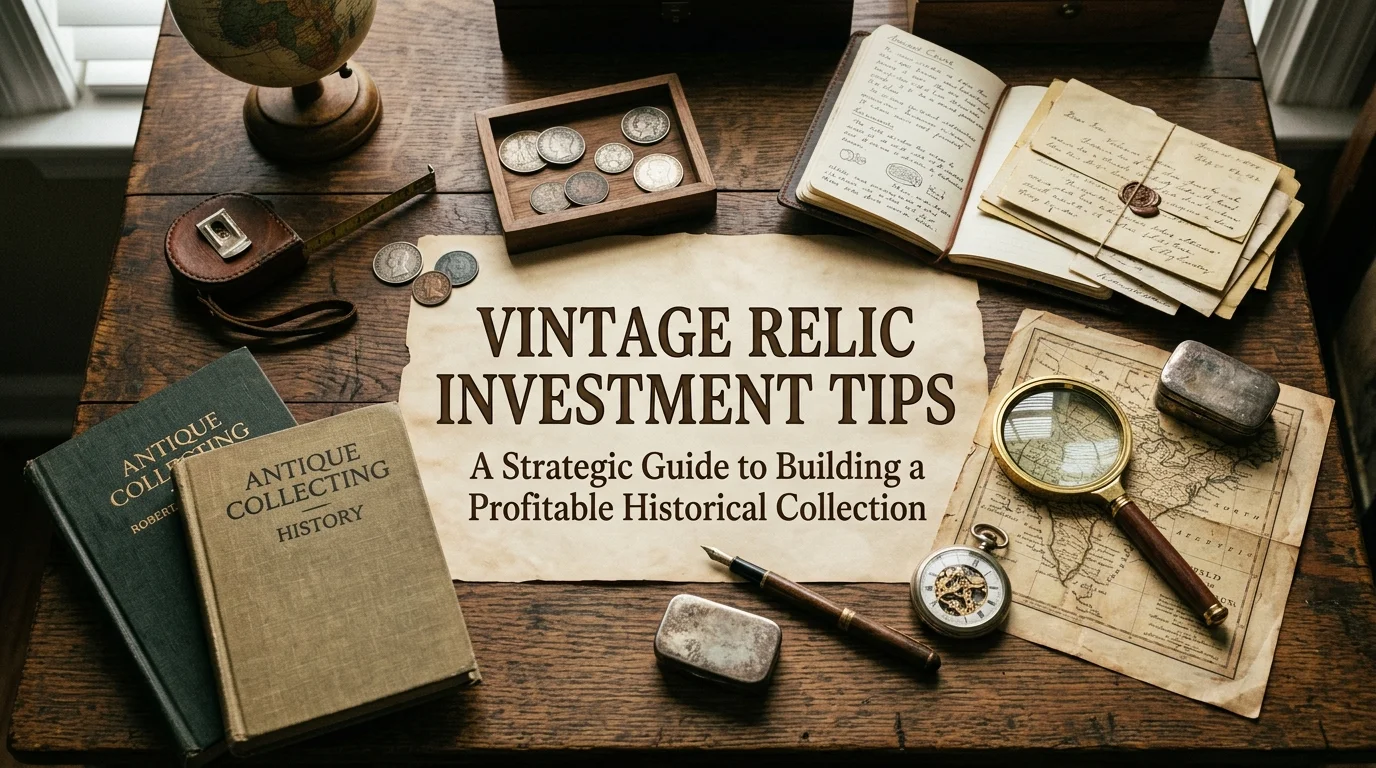
Investing in vintage relics—authentic historical objects from past centuries—has transformed from a niche hobby into a serious alternative asset class. Over the past decade, rare relics have outperformed gold, real estate, and even the S&P 500 in certain categories. However, unlike stocks or bonds, vintage relics require specialized knowledge, careful preservation, and strategic buying and selling. This vintage relic investment tips guide provides a complete framework for entering this market, whether you have 500or500,000 to deploy. From ancient coins and medieval manuscripts to Civil War artifacts and vintage timepieces, learn how to build a collection that appreciates while preserving history.
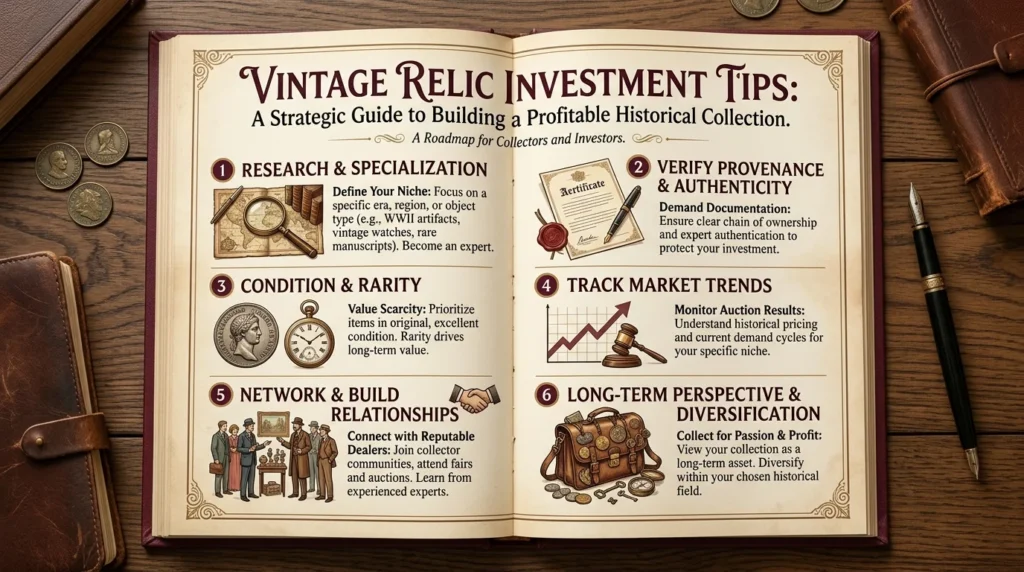
Table: Top Vintage Relic Investment Categories and Performance Data
| Relic Category | Typical Price Range | 10-Year Avg. Annual Return | Liquidity Level | Storage Complexity |
|---|---|---|---|---|
| Ancient Coins (Greek, Roman) | 50−50,000 | 8-12% | High | Low |
| Vintage Wristwatches (Rolex, Patek) | 3,000−500,000+ | 15-20% | Very High | Low |
| Original Maps (16th-18th century) | 200−20,000 | 6-10% | Medium | Medium |
| Civil War Artifacts (weapons, letters) | 100−15,000 | 7-11% | Medium | Medium |
| Medieval Manuscripts (illuminated leaves) | 500−100,000 | 9-14% | Low | High |
| Antique Firearms (Colt, Winchester) | 1,000−200,000 | 10-15% | Medium | High |
| Vintage Advertising Signs (porcelain, tin) | 300−8,000 | 5-8% | Medium | Low |
| Historical Autographs (Washington, Lincoln) | 1,000−500,000+ | 8-12% | High | Medium |
| Ancient Artifacts (Egyptian, Roman glass) | 200−30,000 | 7-10% | Low | Medium |
Why Vintage Relics Are a Strong Alternative Investment
Traditional investments face inflation, market volatility, and geopolitical risks. Vintage relics offer four unique advantages:
- Tangible Asset – Physical ownership means no counterparty risk. A Roman denarius in your safe does not depend on a company’s earnings or government policy.
- Historical Appreciation – Supply is fixed and decreasing. No new Roman coins are being minted. As wealthy collectors increase, prices rise.
- Portfolio Diversification – Relic prices have low correlation with stocks and bonds. During the 2008 financial crisis, rare watch and coin prices actually increased.
- Tax Advantages – In many jurisdictions, long-term held collectibles (over 3 years) qualify for capital gains treatment rather than ordinary income rates.
However, vintage relic investment tips must also acknowledge risks: illiquidity for extremely rare items, high storage costs, forgery dangers, and the need for specialized expertise. Approach this market as a long-term hold (minimum 5-10 years) rather than short-term speculation.
Step 1: Choose Your Niche Wisely
The most successful vintage relic investors specialize deeply rather than buying broadly. A generalist competes against everyone; a specialist exploits knowledge gaps. Consider these high-potential niches:
Undervalued Entry Point: Vintage Postcards and Ephemera
- Why: Still overlooked by mainstream collectors
- Top items: Real photo postcards 1900-1920, holiday greetings 1880-1910, WWII V-mail
- Entry cost: $10-200 per item
- Exit strategy: Bundle into thematic lots (same town, same photographer, same event)
Stable Mid-Tier: Ancient Roman Silver Denarii
- Why: Liquid global market, extensive documentation
- Top emperors: Augustus, Hadrian, Marcus Aurelius (higher demand)
- Entry cost: $200-2,000 per coin
- Exit strategy: Sell through Heritage Auctions or CNG (Classical Numismatic Group)
High-Growth Potential: Vintage Digital Artifacts (1980s-1990s tech)
- Why: Emerging nostalgia market with younger collectors
- Top items: Original Apple-1 motherboard, first-generation Game Boy sealed, vintage Sony Walkman
- Entry cost: $500-50,000
- Exit strategy: Online specialized auctions (RRAuction, Nate D. Sanders)
Warning: Avoid politically sensitive relics (Nazi memorabilia, colonial plunder) due to legal restrictions and limited buyer pools regardless of investment potential.
Step 2: Authentication and Provenance Requirements
No vintage relic investment tips guide is complete without emphasizing authentication. A 50,000relicwithoutproperdocumentationisworth0. For each purchase, demand:
- Chain of title – Written record of all previous owners. Gaps longer than 20 years require explanation.
- Export licenses – For relics crossing borders (UNESCO 1970 convention applies). Items without legal export paperwork can be seized.
- Scientific testing results – For high-value items: XRF analysis for metal composition, carbon dating for organic materials, thermoluminescence for ceramics.
- Third-party certification – NGC Ancients for coins, UACC for autographs, CGC for comics and manuscripts.
Red flag sellers: Any dealer who says “certificate of authenticity included” but cannot name the issuing authority. Legitimate certificates come from PCGS, NGC, PSA, JSA, or recognized academic experts—not the seller’s own printer.
Step 3: Acquisition Strategies for Maximum Appreciation
Where and how you buy determines your investment returns more than what you buy. Follow these acquisition rules:
Primary Market: Major Auction Houses
- Sotheby’s, Christie’s, Bonhams, Heritage Auctions
- Advantages: Verified authenticity, published provenance, buyer protection
- Disadvantages: Buyer’s premium (15-25% added to hammer price)
- Strategy: Bid on lots with estimated ranges far below market value. Attend low-season auctions (July, December) when competition thins.
Secondary Market: Specialized Dealers
- Advantages: Negotiable prices, direct expertise, no buyer’s premium
- Disadvantages: Higher base prices (typically 20-40% above auction results)
- Strategy: Build relationships with three dealers in your niche. Ask for “shop worn” or “problem” pieces at discount—light damage often reduces price by 50% but future buyers may accept it.
Tertiary Market: Estate Sales and Local Auctions
- Advantages: Potential for significant underpricing
- Disadvantages: No guarantees, high risk of fakes
- Strategy: Focus on relics that dealers overlook—uncleaned coins, box lots of mixed artifacts, items mislabeled as “reproduction” due to seller ignorance.
Never buy from: Facebook Marketplace, Craigslist, or eBay without independent authentication. Over 80% of “ancient artifacts” listed on peer-to-peer platforms are modern forgeries according to the Ancient Coin Collectors Guild.
Table: Buy, Hold, or Sell Decision Matrix
| Relic Condition | Provenance Quality | Market Demand | Recommended Action |
|---|---|---|---|
| Mint/Uncirculated | Excellent (famous collection) | Rising | Strong Buy, Hold 10+ years |
| Good/Very Fine | Moderate | Stable | Buy at 20% below market, Hold 5-7 years |
| Poor/Heavily Worn | Weak or missing | Declining | Sell immediately, Reinvest elsewhere |
| Problematic (cleaned, repaired) | Good | Stable for niche | Buy only at 70% discount, Hold for specialist buyer |
| Exceptional rarity (1 of 5 known) | Any verified | Always high | Buy any price, Sell only at major auction |
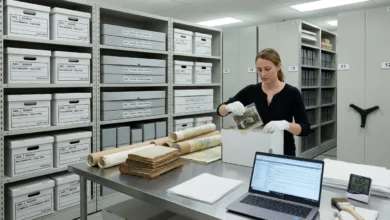
Step 4: Preservation and Storage Best Practices
A vintage relic’s condition directly determines its value. Improper storage can destroy 90% of appreciation potential. Implement these standards:
Climate Control: 65-70°F (18-21°C), 45-55% relative humidity. Use data-logging hygrometers. For organic relics (leather, wood, paper), maintain lower humidity (40-45%) to prevent mold.
Light Protection: UV-filtering glass or film on all windows. LED lighting only (no UV emission). Never expose textiles, manuscripts, or painted surfaces to direct sunlight—fading is irreversible.
Containers: Archival-quality boxes from suppliers like Gaylord or University Products. For coins: Mylar flips (no PVC—PVC causes green corrosion). For textiles: Rolled on acid-free tubes, never folded.
Security: Documented high-value collections (over $50,000) require:
- Dedicated safe (TL-15 rating minimum)
- Separate insurance rider (standard homeowners excludes collectibles)
- Off-site backup photographs and documentation
- GPS trackers hidden in display cases (options from Tile Pro or Apple AirTag)
Do not: Store in basements (flood risk, high humidity), attics (heat extremes, pests), or garages (temperature swings, chemical fumes). Climate-controlled storage units cost $50-200 monthly and are acceptable for mid-tier collections.
Step 5: Exit Strategies and Liquidity Planning
Vintage relics are not day-trading vehicles. Plan your exit before you buy. Three primary exit routes:
Auction Houses (Best for $5,000+ items)
- Process: Consign 3-6 months before sale. Pay seller’s commission (0-15% for high-value items, 20% for lower lots).
- Timing: Spring (March-May) and Fall (September-November) sales achieve highest prices.
- Strategy: Request “guaranteed minimum” from auction house for exceptional items.
Dealer Buyout (Best for quick cash)
- Process: Sell entire collection to a specialist dealer.
- Expectation: 50-70% of retail value for immediate payment.
- Advantage: Single transaction, no waiting, no shipping.
- Strategy: Approach three dealers and play offers against each other.
Private Sales (Best for very rare items)
- Process: Network within collector clubs, forums, and invitation-only Facebook groups.
- Expectation: 90-100% of retail value (no auction fees).
- Disadvantage: Can take 6-24 months to find buyer.
- Strategy: Build reputation first as a seller through smaller transactions before listing major pieces.
Emergency Liquidity: Avoid pawn shops (10-30% of value) and eBay quick-sell (40-60% after fees). Instead, use collateral loans from specialized lenders (Borro, Pawnbroker for collectibles) at 50-70% loan-to-value with 3-6 month terms.
Real-World Case Study: The $1.2 Million Roman Coin
In 2016, a British metal detectorist discovered a gold Roman aureus depicting the short-reigning emperor Otho (ruled 69 AD—the “Year of the Four Emperors”). Only 12 Otho aurei are known to exist. The finder did not clean the coin (critical vintage relic investment tip—cleaning destroys value). He contacted professional numismatists, who authenticated it via XRF and stylistic analysis. The coin was sold through Roma Numismatics auction in 2019 for 1.2millionUSD.Theoriginalfinderinvested0 in acquisition, 500inauthentication,and2,000 in insurance and shipping. Net return: over 240,000%. While such outcomes are rare, they illustrate the importance of authentication, preservation, and using specialist auction houses.
Frequently Asked Questions (FAQs)
Q1: What is the minimum budget needed to start investing in vintage relics?
A: 500issufficienttobegin.FocusoncommonancientRomanbronzecoins(20-100 each), vintage postcards (5−50),orsilverWashingtonquarterspre−1964(5-20). Avoid high-end categories until you gain experience.
Q2: How do I know if a vintage relic is legally safe to buy and sell?
A: Verify that the relic was legally exported from its country of origin. For items from Italy, Greece, Egypt, or Mexico after 1970, demand UNESCO export permits. For military relics, ensure no active weapon laws apply (some antique firearms require licenses). When in doubt, consult a cultural property attorney.
Q3: What are the tax implications of selling vintage relics for profit?
A: In the US, collectibles held over one year are taxed at a maximum 28% capital gains rate (higher than the 20% rate for stocks). Short-term gains (under one year) are taxed as ordinary income. Keep all purchase receipts to document cost basis. Consult a tax professional for your jurisdiction.
Q4: How can I insure my vintage relic collection?
A: Standard homeowners policies cap collectibles coverage at $1,000-5,000. Use specialized insurers: Collectibles Insurance Services (CIS), AXA Art, or Chubb. Provide itemized appraisals (updated every 3-5 years). Expect annual premiums of 0.5-1.5% of total insured value. Separate rider for shipping coverage is essential.
Q5: Are reproduction relics ever a good investment?
A: No. Reproductions have no appreciation potential and misrepresentation as authentic is fraud. Only buy reproductions for education or decoration, never as investment. Their value drops 80-90% the moment purchased.
Q6: What is the best vintage relic category for beginners?
A: Ancient Roman bronze coins (3rd-4th century AD). They are abundant ($20-200), well-documented (Roman Imperial Coinage reference books), easily authenticated (NGC Ancients service available), and have a global liquid market. Avoid gold coins or extremely rare emperors initially.
Q7: How does economic recession affect vintage relic prices?
A: Historically, top-tier relics (rare, museum-quality) hold value or increase during recessions as wealthy investors seek tangible assets. Mid-tier and common relics may drop 15-30% due to reduced discretionary spending. Hold quality over quantity.
Q8: Should I clean or restore a vintage relic before selling?
A: Never clean ancient coins, patinated metal, or archaeological artifacts. Cleaning destroys surface evidence of authenticity and reduces value by 50-90%. For functional antiques (clocks, watches), professional conservation (not restoration) may add value. Always consult a professional conservator affiliated with AIC (American Institute for Conservation) before any intervention.
Conclusion
Vintage relic investment tips ultimately reduce to five principles: specialize deeply, authenticate rigorously, preserve meticulously, hold patiently, and exit strategically. This market rewards knowledge and punishes haste. Start small—perhaps a single Roman coin or vintage map—and learn the rhythms of auctions, dealer negotiations, and preservation before scaling up. Unlike paper assets that vanish in market crashes, vintage relics connect you to history while building wealth. The relics you buy today, if chosen wisely and cared for properly, will likely be worth significantly more in a decade. Begin your research, build your network, and make your first informed purchase. Your collection—and your portfolio—will grow together.