Advanced Antique Display Setups: Museum-Grade Strategies for Collectors
Introduction
Displaying antique collectibles requires more than placing objects on a shelf. Advanced antique display setups integrate three critical disciplines: conservation science (protecting artifacts from environmental damage), visual storytelling (creating emotional engagement through design), and security engineering (preventing theft and accidents). Whether you own a single heirloom or a comprehensive collection, this guide draws from museum best practices, lighting innovations, and forensic protection methods to help you create exhibitions that rival institutional standards.
Core Principles of Advanced Antique Display
The foundation of any professional display rests on four principles: protection, visibility, narrative, and adaptability. Each object’s specific material needs determine its display requirements. Paper and textiles demand low light levels (50 lux maximum) and stable humidity (45-50% RH), while metals and ceramics tolerate higher illumination but require protection from handling . The advanced collector balances these competing needs through layered design strategies.
| Principle | Application | Key Consideration |
|---|---|---|
| Protection | Environmental control, UV filtering, security | Match display method to material vulnerability |
| Visibility | Lighting quality, viewing angles, background contrast | Eliminate glare while revealing detail |
| Narrative | Grouping, labeling, thematic flow | Tell a story without overcrowding |
| Adaptability | Modular components, adjustable lighting | Plan for collection growth and rotation |
Display Case Selection: Beyond Glass Boxes
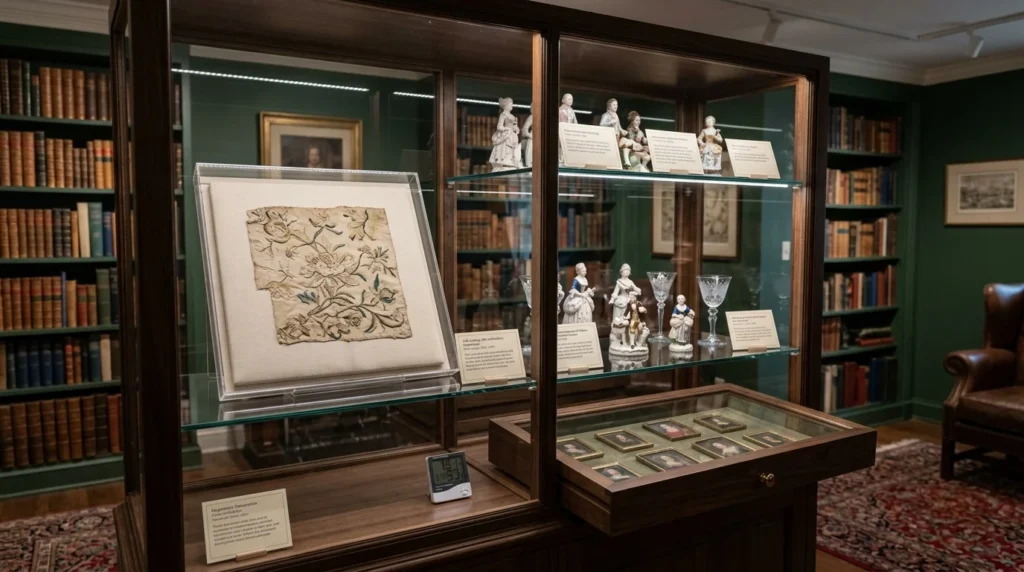
The choice of display case fundamentally affects both preservation and presentation. Professional cases fall into three categories based on their protective capabilities.
Passive Display Cases
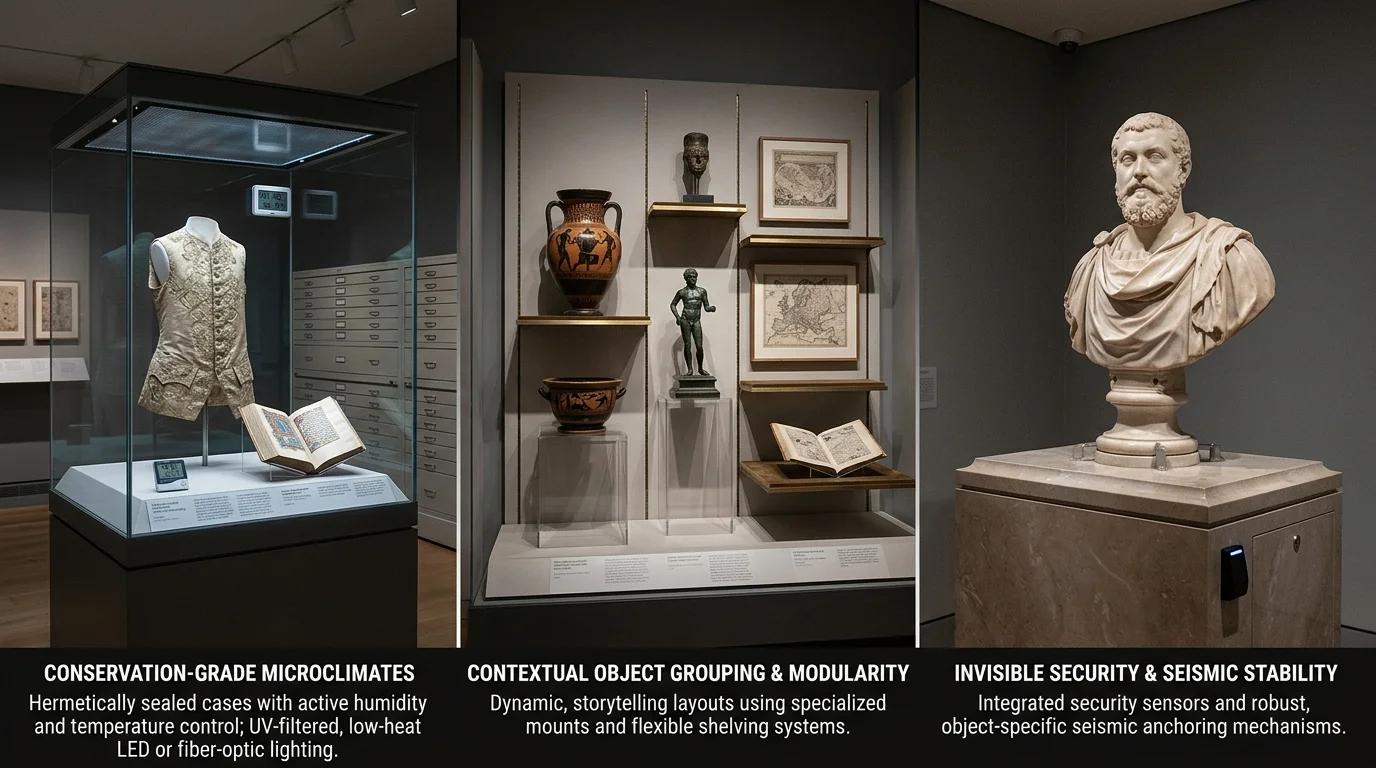
These cases rely on physical sealing to create a stable microclimate. Research at the University of Warwick demonstrates that airtightness is the single most important factor in passive case performance . Air exchange mechanisms, including the “stack effect” in vertically-hinged doors, can allow external pollutants and humidity fluctuations to enter the case . For advanced collectors, passive cases work best for stable materials (ceramics, glass, metals) stored in already climate-controlled rooms.
Active (Climate-Controlled) Cases
These cases integrate sensors and conditioning systems to maintain temperature and humidity within narrow ranges. Smart museum display cases now feature remote monitoring capabilities, data logging, and automated alerts when environmental parameters drift outside safe thresholds . For organic materials (wood, textiles, leather, paper) or collections in variable home environments, active cases provide superior protection.
Seismic-Protected Cases
For valuable or fragile items in earthquake-prone regions, cases with seismic isolation devices automatically recover after ground movement, preventing tipping and collision damage . These systems add significant cost but are essential for irreplaceable objects.
Professional Lighting Strategies for Antique Display
Lighting transforms a storage cabinet into an exhibition. However, improper lighting damages collectibles while poor lighting hides their qualities. Advanced antique display setups employ layered, controllable illumination.
The Cold Light Source Imperative
Traditional lighting generates heat and ultraviolet radiation that accelerate fading, fiber embrittlement, and chemical degradation. Professional cold light source systems guide illumination through concealed channels and diffusion systems rather than directing fixtures at the artifact . This approach prevents localized heating while maintaining even coverage across the object’s surface.
The Royal Armouries Museum in Leeds demonstrates this principle. Their gladiator exhibition uses cooler 4000K light to highlight stone artifacts and warmer 3000K to illuminate life-sized figures, with wireless control allowing scene-specific programming . The same flexibility applies to home collections: programmable LED systems let you adjust intensity and color temperature for different objects or viewing occasions.
UV-Free High Color Rendering
Standard LED fixtures emit blue-spectrum light that damages sensitive materials over time. Professional display cases now use patented LED systems with no UV or blue light damage, achieving Color Rendering Index (CRI) values above 95 to restore artifact colors accurately . When selecting lighting for your display, prioritize UV-free specifications and high CRI over brightness.
Light Layering Techniques
| Light Type | Purpose | Typical Placement |
|---|---|---|
| Ambient | General room illumination | Ceiling fixtures or natural light (filtered) |
| Accent | Highlight specific artifacts | Track lighting, spotlights inside cases |
| Task | Reading labels or details | Adjustable case-mounted fixtures |
| Security | Low-level after-hours illumination | Perimeter or case-base lighting |
Conservation-Driven Display Design
The most beautiful display fails if it damages the objects within. Advanced display setups incorporate protection at every level.
Airtightness and Microclimate Control
Airtightness is the foundation of artifact protection . It prevents harmful gases, moisture, and pollutants from entering the display environment. For commercial display case manufacturers, precision production using laser cutting and CNC machining ensures consistent sealing . Home collectors can approximate this by adding weather stripping to existing cases and monitoring interior humidity with small sensors.
Security Integration
Professional displays embed security features without visible intrusion. These include museum-specific locks with key interchangeability rates below 1:150,000, glass break detectors that sense the sound of breaking tempered or laminated glass, and bus-system alarm hosts that trigger remote alerts . For home collections, consider vibration sensors on valuable cases and discreet camera coverage.
Forensic Documentation as Display
The Museum of the Treasure of San Gennaro in Naples has developed an advanced protection method: forensic mapping of individual gemstones. Using microscopes and specialized equipment, the museum has photographed over 10,000 stones, creating unique “fingerprints” based on internal characteristics . If stolen, these stones remain identifiable even if recut. For collectors of high-value items with gemstones, hallmarks, or serial numbers, creating similar photographic documentation serves both protection and insurance purposes.
Spatial Design: Scale, Balance, and Placement
Professional display is as much about what you exclude as what you include. Overcrowding destroys visual impact and increases handling accidents.
Scale and Proportion
Scale refers to the size relationship between objects, furniture, and room dimensions. Large-scale furniture belongs in large rooms; small-scale pieces fit intimate spaces . When selecting a display case or shelving unit, ensure it claims appropriate wall space without overwhelming the room. A 19th-century English credenza centered on a wall serves as a “backbone” from which other display elements radiate .
Balance Through Asymmetry
Balance does not mean symmetry. Professional designers create visual equilibrium using asymmetrical arrangements. A large artwork centered above a credenza balances the wall space, while sconces placed at equal distance beyond the credenza expand the composition visually . The key is “organized layering”—each element relates to others without creating visual chaos.
Placement and Negative Space
There is no minimum number of objects for a successful display, but there is a maximum. Professional rule of thumb: display only the top 20% of your collection at any given time . Rotate the rest seasonally. This approach keeps displays fresh, reduces cumulative light exposure on individual objects, and ensures each piece receives proper attention.
The “dare to be spare” philosophy means each displayed object is selected deliberately. An eclectic collection of fifteen items—ranging from a Chinese export teacup to a granite stone from Maine—can work when each piece is positioned with a seasoned eye to create order, balance, and harmony .
Tablescaping Within Displays
Creating mini-compositions inside a larger display (tablescaping) adds depth. A marble urn displayed on a small tea table creates its own visual zone within the credenza surface. Group items by color, material, or theme to create focal points that draw viewers in for closer inspection .
Digital Integration and Immersive Experiences
Advanced antique display increasingly incorporates digital elements that enhance rather than distract from physical objects.
Augmented Reality and Interactivity
Smart display cases can integrate AR recognition, touch-based explanations, and voice navigation, allowing static artifacts to “speak” to visitors . For home collectors, QR codes placed discreetly on labels can link to videos, documents, or audio narratives about each object’s provenance and history.
Digital-Physical Hybrid Exhibitions
The “Ways in Patterns” exhibition transformed Beijing’s Forbidden City motifs into immersive digital projections across seven conceptual rooms, using 4K projection devices to maintain image precision . While full digital immersion exceeds most home budgets, scaled-down versions using tablet displays or projection on adjacent walls can create context without overwhelming the artifacts themselves.
The Xiaoxitian Temple exhibition in China exemplifies this balance, using VR headsets to allow visitors to “fly” among suspended figures while keeping physical artifacts as the exhibition’s centerpiece .
Practical Implementation for Collectors
Step 1: Assess Your Environment
Before purchasing any display equipment, measure temperature and humidity in your intended display area for at least one week. Avoid basements (high humidity, flood risk), attics (extreme temperature fluctuations), and exterior walls (condensation risk). The ideal location is an interior room with climate control.
Step 2: Select Appropriate Cases
For valuable or sensitive items, invest in purpose-built display cases from museum suppliers. For general collections, modify commercial cases by adding weather stripping, UV-filtering film, and interior LED lighting.
Step 3: Install Layered Lighting
Wire dimmable LED fixtures with separate circuits for ambient and accent lighting. Position accent lights at 30-45 degree angles to reduce glare. Never place fixtures directly above artifacts.
Step 4: Design the Layout
Sketch your intended layout on paper before moving objects. Consider negative space, viewing sightlines, and traffic flow. Place the most important item at average eye level (58 inches from floor). Work outward from this anchor piece.
Step 5: Label and Document
Every displayed object needs a label with name, date, origin, and a one-sentence story hook. Keep a digital catalog linking each object to photographs, purchase records, and conservation history.
Maintenance Schedule for Advanced Displays
| Frequency | Action |
|---|---|
| Daily | Dust case exteriors with microfiber cloth |
| Weekly | Check humidity sensors and light levels |
| Monthly | Inspect seals, hinges, and locking mechanisms |
| Quarterly | Clean case interiors with canned air (no vacuums) |
| Annually | Replace UV-filtering films, recalibrate sensors |
| As needed | Rotate displayed objects to limit cumulative light exposure |
Common Mistakes in Antique Display
Overcrowding is the most frequent error. More than twelve items in a 36-inch case creates confusion and increases handling accidents. Direct sunlight is the most damaging: even fifteen minutes can fade a 19th-century photograph. Touching artifacts to glass allows condensation to form between surfaces. Inconsistent heights prevent comfortable viewing; all artifacts should have their key detail at roughly the same eye level. Missing labels mean 70% of viewers will not ask what an artifact is .
Future Trends in Antique Display
Smart display cases with remote environmental monitoring are becoming standard . Forensic fingerprinting of individual gemstones and hallmarked items will likely expand . AI-powered lighting systems that adjust intensity based on real-time occupancy and ambient light levels are entering the market. Recycled acrylic and sustainable materials are replacing virgin plastics in display case construction. Collectors who invest in adaptable, technology-ready display systems now will benefit from these advances without complete replacement.
Conclusion
Advanced antique display setups transform storage into storytelling. By integrating conservation-grade protection, layered lighting strategies, thoughtful spatial design, and emerging digital tools, collectors can create exhibitions that honor their objects’ historical significance while engaging contemporary audiences. The investment in proper display equipment and design pays dividends in preserved value, reduced damage risk, and daily enjoyment of your collection.
Frequently Asked Questions (FAQs)
Q1: What is the ideal lighting for displaying antique paper or textiles?
A: Maximum 50 lux, 2700K-3000K color temperature, with 99% UV filtering. Use cold light sources (LED with no UV/blue damage) positioned at 30-45 degree angles to prevent glare. Never use halogen or fluorescent bulbs .
Q2: How do I choose between a glass display case and open shelving?
A: Glass cases provide protection from dust, humidity fluctuations, and handling. Use them for valuable, fragile, or frequently touched items. Open shelving works for sturdy, low-value items or collections you rotate regularly .
Q3: What is the most important factor in preventing display-related damage?
A: Stable humidity between 45-50% RH. Fluctuations cause materials to expand and contract, leading to cracking, warping, and accelerated chemical degradation .
Q4: How do I create a museum-quality label for my display?
A: Include object name, date, region, material, dimensions, and a one-sentence story hook. Use acid-free paper laminated with matte UV film. Place labels at a consistent 10-degree tilt for easy reading at bottom-right of each object .
Q5: Can I display different types of artifacts together in one case?
A: Yes, but only if they share the same environmental requirements. Never mix paper (needs low light, 45-50% RH) with metal (higher light tolerance, 35-40% RH) in a sealed case. Use separate cases or ensure the case environment meets the most sensitive material’s needs.
Q6: How often should I rotate displayed items?
A: Seasonally, or every 3-4 months. Rotation limits cumulative light exposure, reduces dust accumulation, and keeps displays fresh. Store rotated items in archival conditions during their off-display periods.
Q7: What security measures should a home collector implement?
A: Vibration sensors on valuable cases, discreet camera coverage, museum-quality locks (not standard cabinet locks), and a documented inventory with photographs. For items over $5,000, consider separate collectibles insurance .
Q8: How do I clean a display case without damaging artifacts?
A: Remove artifacts before cleaning. Use canned air for interior dust, never vacuums. Clean glass exterior only with microfiber cloth and distilled water. Never spray cleaners near open cases. Allow cases to air out before returning artifacts.
Final Recommendation for Action
Select one antique from your collection today. Assess its material vulnerabilities. Choose or modify a display location that meets its environmental needs. Install appropriate lighting. Position it as the centerpiece of a small vignette with two supporting objects. Label it properly. Photograph the result. This single display will teach you more than reading twenty articles. Then expand methodically. The best display setup is the one you implement with attention to both preservation and beauty