Antique Object Explanation Archive: Complete Guide to Identifying, Understanding, and Documenting Historical Treasures
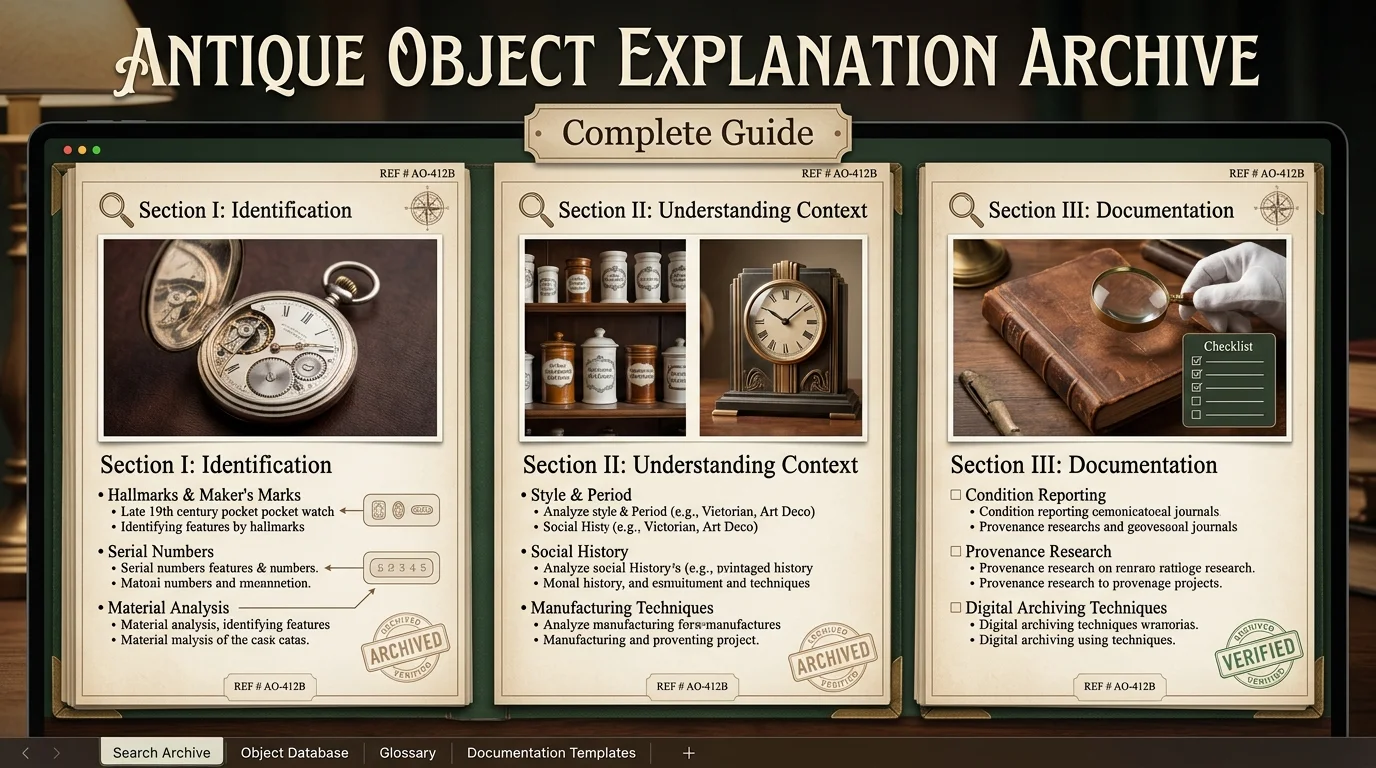
Table of Contents
| Object Category | Key Examples Covered | Primary Identification Features |
|---|---|---|
| Textiles & Garments | Aaban (Algerian garment) | Tapestry-woven wool, geometric patterns, fringe details |
| Games & Recreation | Reversible games board (16th c. India) | Ebony/ivory inlay, sadeli micromosaic, unidentified game layout |
| Jewelry & Adornment | Byzantine gold pectoral with coins | Rigid gold tube necklace, solidus coins, pseudo-medallion |
| Ancient Terracottas | Cypriot figurines (2000 BCE – 200 CE) | Mold-made, painted details, mythological subjects |
| Provenance Research Tools | Souths At Auction database | Auction catalog transcriptions, buyer/seller records (1919-1945) |
What Is an Antique Object Explanation Archive?
An antique object explanation archive is a structured collection of information that documents historical artifacts beyond simple identification . Unlike standard price guides or auction catalogues, a true explanation archive provides context: who made an object, why it was used, how it was made, what it meant to its original owners, and how it survived to the present day.
The most comprehensive reference works, such as Judith Miller’s “The Illustrated Dictionary of Antiques & Collectibles,” contain over 3,000 entries and 1,500 specially commissioned photographs and drawings covering topics from ancient Chinese ceramics to twentieth-century toys . These resources help collectors cut through specialized jargon—terms like “bourdaloue” (a small portable toilet) or “Zwischengoldglas” (glass with gold leaf sandwiched between layers)—and make sense of the sometimes bewildering language used by experts .
Case Study 1: The Aaban – An Algerian Woman’s Garment
One of the most informative examples in museum archives is the aaban, a simple yet culturally significant garment from 19th-century Algeria preserved in the Victoria and Albert Museum collection .
What Is an Aaban?
The aaban is a tapestry-woven cloth made from wool and cotton on a wool warp. In its unwrapped form, it resembles a blanket and could be used for this purpose. Women draped these cloths around their bodies, fastening them with shoulder brooches and holding them in place at the waist with a girdle .
How Was It Made?
The weaving process was remarkably labor-intensive. The weaver used a simple upright frame loom made from canes, with no shuttle. She passed the weft yarn from side to side with her fingers and jammed it tight with a metal handcomb .
Edgar Barclay, who collected six examples of aabans between 1872 and 1880, described the process: “The width of the fabric corresponds to the individual weaver’s body length” . The woman measured the distance from her chin to the ground and wove the cloth to that dimension.
Why Does This Object Matter?
The aaban represents a cultural tradition that was disappearing even as Barclay documented it. He feared that “the beautifully patterned textiles created in this way were becoming a lost art” and purchased examples to ensure their survival . In his book “Mountain Life in Algeria” (London, 1882), Barclay expressed concern that “modern civilisation” would replace these textiles with “villanous coloured pocket-handkerchiefs, and chilly white cotton goods” .
For collectors today, the aaban demonstrates several key principles of antique object explanation:
- Material analysis: The combination of wool and cotton, tapestry-woven on wool warps
- Provenance: Documented collection history through Edgar Barclay to the V&A
- Cultural context: Understanding the garment’s role in Berber women’s daily lives
- Condition assessment: The garment weighs 13kg and measures approximately 2.5 meters in length
Case Study 2: The Undeciphered Games Board of Mughal India
Perhaps the most intriguing entry in any antique object explanation archive is the reversible games board in the Victoria and Albert Museum, which presents a mystery that has endured for over four centuries .
What Is This Object?
This rectangular games board, made in Gujarat or Sindh in the late 16th or early 17th century, is constructed of teak veneered with ebony, citronwood, ivory, and sadeli (a micromosaic of woods and metals arranged in geometric patterns) .
One side features alternating squares of ebony and ivory for chess. The other side has ornate decorations and divisions for a game that has yet to be identified .
The Enduring Mystery
The reverse side was long thought to be a tric-trac (backgammon) board. However, in April 2012, British Museum curator Irving Finkel and Andrew Topsfield examined the piece and concluded that the reverse side is “definitely not a backgammon board” . The specific game remains unidentified.
This uncertainty is part of the object’s significance. It reminds collectors that antique objects do not always yield their secrets. The board represents a tradition documented by European travelers to Sindh and Gujarat—Duarte Barbosa (c. 1516), Huygen van Linschoten (c. 1585), and Francesco Pelsaert (c. 1626) all described finely worked ivory-inlaid games boards being manufactured in the region .
What This Teaches Collectors
The undeciphered games board illustrates several important points for antique object explanation:
- Identification is not always possible: Some objects genuinely defy classification
- Expert consultation matters: Specialists like Finkel brought decades of game board expertise to the analysis
- Documentation preserves questions: The museum record honestly notes what remains unknown
- Material tells a story: The use of tropical woods proves Indian origin, while the sadeli technique connects to broader Mediterranean and Middle Eastern traditions
Case Study 3: Byzantine Coin Jewelry – Wearing Imperial Protection
The Metropolitan Museum of Art’s gold pectoral with coins and a pseudo-medallion offers a remarkable example of how antique objects can serve multiple functions simultaneously: as wealth display, as political statement, and as spiritual protection .
What Is a Coin Pectoral?
This mid-sixth century Byzantine pectoral (worn around the neck) weighs an impressive three-quarters of a pound. It consists of a hollow but rigid gold tube necklace attached to a complex gold frame that holds fourteen gold coins and two gold discs .
The coins include twelve solidi (the dominant Byzantine gold coinage, weighing about 4.5 grams each) and two tremissis coins (valued at about one-third of a solidus). The coins date from the fourth to the sixth centuries, with the latest minted during the reign of Justinian (r. 527-565) .
Why Were Coins Worn as Jewelry?
Coin jewelry served three primary purposes in Late Antiquity:
1. Imperial Connection: Imperial portraits on the coins served as direct links to the emperor himself. In Late Antiquity, the real emperor and a representation of an emperor were meant to be treated analogously. By displaying these imperial portraits around their neck, the owner was explicitly invoking the emperor’s protection .
2. Prophylactic Protection: Once coins were made into jewelry and worn against the body, they were thought to help protect the wearer against disease, misfortune, and evil spirits. A surviving pierced bronze coin of Justinian I bears the Greek inscription “Lord Protect the Wearer” .
3. Status Display: The sheer weight of gold—three-quarters of a pound—announced elite status. The large pseudo-medallion at the center, while not officially minted, imitated imperial medallions to make symbolic associations to contemporary coinage .
The Pseudo-Medallion Explained
The central pseudo-medallion was not minted in a state-controlled facility. Evidence of this includes its production technique: puncturing and chiseling rather than stamping. The inscription on the obverse is illegible, and the letters on the reverse do not form any words .
This does not indicate forgery. The creator was not trying to deceive about economic value. Rather, the aim was to make symbolic associations with imperial coinage while creating a piece of jewelry that could be worn daily without risking an officially minted medallion .
Who Wore Such Objects?
Scholars debate the wearer’s identity. A sixth-century icon from Mount Sinai shows the martyred military saints Sergius and Bacchus wearing similar rigid gold neck rings. The mosaic of Emperor Justinian in San Vitale, Ravenna, shows members of the emperor’s bodyguard wearing comparable ornaments .
However, the inscription on a similar pectoral in Berlin is written in the feminine, potentially suggesting a female wearer. Coin jewelry was often the result of generations of collecting, so the owner could have changed over time .
The Role of Provenance Research in Antique Explanation
Understanding an antique object requires more than examining the object itself. Provenance research—tracing the ownership history of an object—has become central to modern antiquities scholarship .
The Souths At Auction Project
The Souths At Auction research project provides an effective means of tracing the movement of non-European objects between 1919 and 1945, particularly those from colonial contexts and pre-Columbian artifacts .
The database presents a comprehensive collection of 78 public sales that took place in Paris during this period, auctioning items described at the time as “primitive” and/or “pre-Columbian.” Each sales catalog was transcribed in its entirety, lot by lot—totaling 17,170 individual lots .
What Provenance Research Reveals
By cross-referencing sales catalogues with auction minutes, researchers can find the auction price of items, as well as the names and addresses of sellers and buyers . This information can confirm or supplement the provenance of objects currently held in museums or circulating on the art market.
The database includes major collectors and dealers such as André Breton, Paul Éluard, Tristan Tzara, Charles Ratton, and Paul Guillaume—names that appear in the ownership histories of countless museum objects worldwide .
For the antique collector, provenance research tools like Souths At Auction offer several benefits:
- Authenticating objects: Matching an item to documented sales confirms its existence in the market
- Establishing value: Items with documented ownership by known collectors command premiums
- Legal compliance: Provenance research ensures objects were not illegally excavated or exported
- Narrative building: The chain of ownership adds to an object’s story and appeal
Reference Resources for Antique Object Identification
Building an antique object explanation archive requires reliable reference sources. Several key resources form the foundation of serious antique research.
Comprehensive Dictionaries
Judith Miller’s “The Illustrated Dictionary of Antiques & Collectibles” is widely regarded as a cornerstone reference. It ranges over hundreds of topics from the ceramics of ancient China to twentieth-century toys, with entries on makers, designers, and factories, definitions of styles and motifs, and more than 50 in-depth features on major topics such as Bauhaus, Meissen, and teddy bears .
Museum Collection Databases
Major museums provide free access to their collection databases online. The Victoria and Albert Museum’s Explore the Collections, the Metropolitan Museum of Art’s Heilbrunn Timeline of Art History, and the British Museum’s collection online offer thousands of high-resolution images accompanied by detailed catalogue entries .
Specialized Catalogues
For specific collecting areas, specialized catalogues are essential. The Cesnola Collection of Cypriot terracottas, published by the Metropolitan Museum of Art, contains nearly 500 works dating from between about 2000 B.C. and the 2nd century A.D., with illustrations of each object accompanied by detailed entries and bibliographies .
How to Document Your Own Antique Collection
Creating a personal antique object explanation archive requires systematic documentation. Follow these steps based on museum best practices:
Step 1: Physical Examination
Record all visible characteristics: materials, dimensions, marks, signatures, and condition issues. Note the weight for metal objects and precise measurements for textiles and furniture .
Step 2: Photography
Photograph objects from multiple angles, including close-ups of marks, damage, and distinctive features. The V&A’s documentation standards include multiple views with consistent lighting and scale references .
Step 3: Research
Use the reference resources described above to identify maker, date, origin, and comparable examples. Search auction databases for similar items to establish market context.
Step 4: Provenance Documentation
Record how you acquired the object, including purchase date, price, seller information, and any previous ownership information provided . Store receipts, appraisals, and related correspondence.
Step 5: Condition Assessment
Document current condition and any restoration or conservation work performed. Include dates and conservator information.
Step 6: Digital Archive
Store all documentation digitally with off-site backup. The WorthPoint Vault and similar services provide secure virtual storage for collector documentation.
FAQ
What is an antique object explanation archive?
An antique object explanation archive is a structured collection of information documenting historical artifacts beyond simple identification. It includes details on maker, date, origin, materials, construction techniques, cultural context, provenance, and significance .
How do I identify an unidentified antique object?
Start with close examination for marks, signatures, or labels. Use comprehensive reference works like Miller’s dictionary . Search museum collection databases for similar objects. Consult specialist forums or seek professional appraisal. The Portable Antiquities Scheme in England and Wales records archaeological finds discovered by the public .
What is provenance and why does it matter?
Provenance is the documented ownership history of an object. It matters because it establishes authenticity, legal ownership, and cultural context. The Souths At Auction project demonstrates how provenance research can trace objects through colonial-era markets and confirm museum collection histories .
What are the most useful reference resources for antique research?
Key resources include Judith Miller’s “The Illustrated Dictionary of Antiques & Collectibles” (3,000+ entries) , museum collection databases (Metropolitan Museum of Art, V&A, British Museum), specialized catalogues like the Cesnola Collection of Cypriot terracottas , and provenance research tools like Souths At Auction .
How can I tell if an antique object is valuable?
Value depends on several factors: rarity (limited production or few surviving examples), condition (original finish, no restoration), provenance (documented ownership by known collectors), maker (recognized workshops or artists), and cultural significance (historical importance, connection to major events or figures) .
What should I do if my antique has an unidentified purpose?
Document the mystery as part of the object’s story. The reversible games board in the V&A collection honestly notes that one side’s game remains unidentified . Consult specialists, as experts like Irving Finkel brought decades of games scholarship to bear on such puzzles. The mystery itself can add to an object’s appeal and value.
How reliable are online antique identification resources?
Museum databases and academic projects offer high reliability. The V&A, British Museum, and Metropolitan Museum of Art provide professionally researched catalogue entries . The Souths At Auction project is peer-reviewed academic research . User-contributed sites require verification against authoritative sources.