Collectible Relic Investment Analysis: Market Trends, Valuation Factors, and Strategic Portfolio Guide for 2026
The landscape of wealth management is undergoing a profound transformation. Once dismissed as the domain of eccentric hobbyists, collectible relics—from ancient shipwreck coins to pop culture artifacts—are now commanding serious attention from financial advisors and institutional investors. The CFA Institute now formally recognizes collectibles as a valid alternative asset class . In 2026, as traditional markets face volatility and inflationary pressures, high-net-worth individuals are increasingly turning to tangible assets that offer both aesthetic pleasure and portfolio diversification. This comprehensive analysis examines the current state of the collectible relic market, the factors driving value, and strategic approaches for successful investment.
1. Understanding the Investment Thesis for Collectible Relics
Collectible relics have transitioned from passion projects to legitimate financial instruments. The Knight Frank Luxury Investment Index, a benchmark for high-value collectibles, fell by only 0.4% in 2025, signaling market stabilization after a broad correction across luxury asset classes . This resilience suggests that collectors are moving away from pandemic-era speculative buying and adopting a more discerning, long-term approach.
The Asset Class Distinction
Unlike traditional equities or bonds, collectible relics are tangible assets that do not produce cash flow. Their value derives entirely from supply and demand dynamics, cultural significance, and historical provenance . This unique characteristic makes them a distinct portfolio diversifier, as their performance often shows low correlation with stock market fluctuations. However, this same feature introduces illiquidity risk that investors must carefully manage.
| Investment Type | Primary Value Driver | Risk Profile | Liquidity |
|---|---|---|---|
| Numismatic Coins | Rarity, grade, historical significance | Moderate to High | Low to Moderate |
| Fine Art | Artist reputation, provenance, cultural cachet | Moderate | Low |
| Luxury Watches | Brand desirability, model scarcity, condition | Low to Moderate | Moderate |
| Historical Artifacts | Provenance chain, legal ownership, historical importance | High | Very Low |
| Trading Cards | Athlete/character popularity, scarcity, graded condition | High | Moderate |
2. The Four Pillars of Value: What Makes a Relic Appreciate
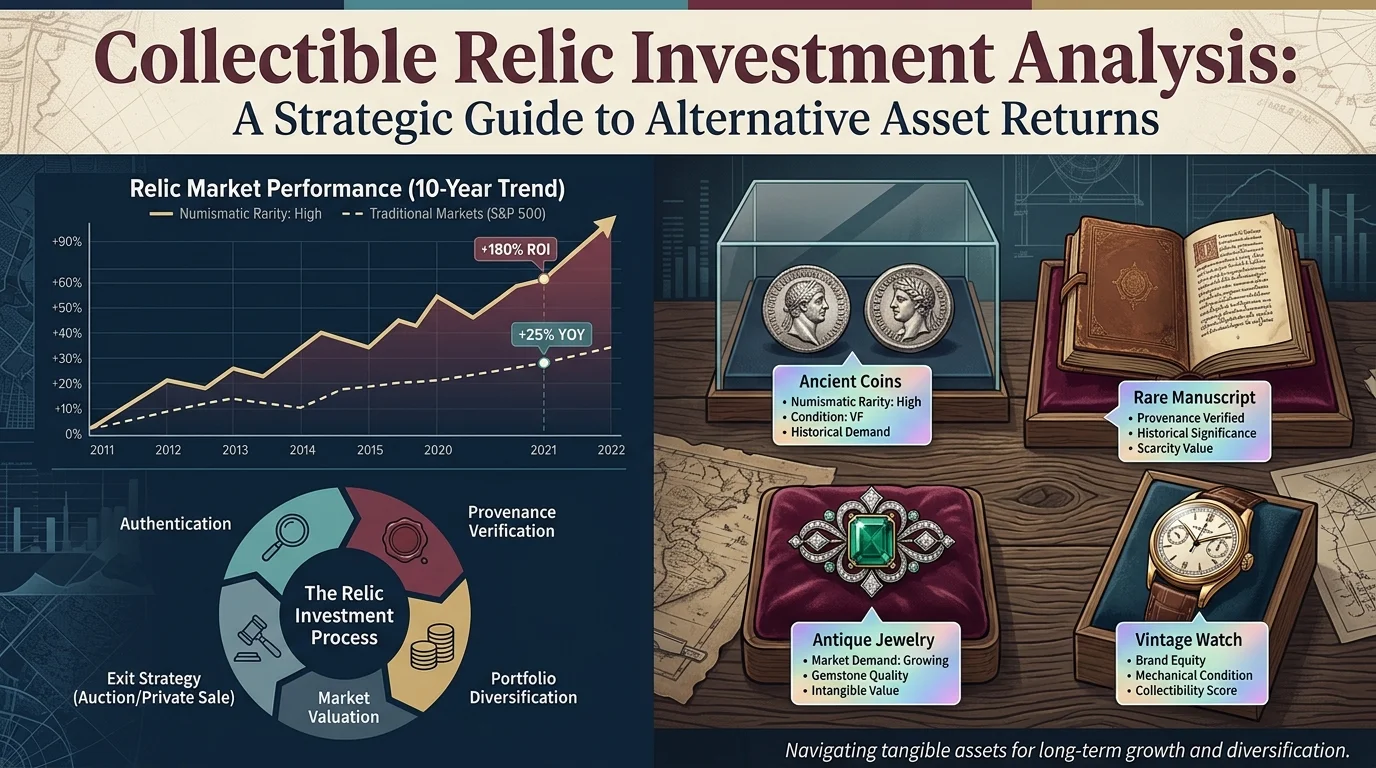
Understanding what drives value in collectible relics is essential for making informed investment decisions. Four primary factors—rarity, condition, provenance, and demand—interact to determine market prices .
Rarity: The Foundation of Exclusivity
Rarity transforms ordinary objects into coveted treasures. The principle is straightforward: the fewer examples that exist, the higher the potential value. However, scarcity must be genuine and verifiable. The “junk wax era” of the 1980s and 1990s serves as a cautionary tale—mass-produced trading cards flooded the market, crushing values for decades . Today, savvy investors seek items with naturally limited production runs or those that have survived in limited quantities due to historical events or natural attrition.
Condition: The Preservation Premium
Mint condition items command substantial premiums over their damaged or worn counterparts. Professional grading services have standardized condition assessment across categories like coins, trading cards, and watches. For numismatic coins, the difference between a Good-4 grade and a Mint State-65 grade can represent a value multiplier of hundreds or even thousands of times. Investors must understand grading standards within their chosen category and prioritize preservation through proper storage and handling.
Provenance: The Ownership Advantage
Provenance—the documented chain of ownership—has become arguably the most critical value driver in the modern collectibles market . Items with clear, unbroken ownership histories sell for significant premiums over identical items with murky backgrounds. The record-breaking $10.1 million sale of Jane Birkin’s personal Hermès Birkin bag exemplifies how famous ownership elevates value . For shipwreck artifacts, “clean” provenance—documented proof of legal salvage through proper government channels—is non-negotiable for legitimate market participation .
Demand and Cultural Relevance
Even the rarest, finest-condition item will not appreciate without collector demand. Cultural trends, generational shifts, and media exposure all influence what collectors seek. The rise of digital fractional ownership platforms has opened collectible markets to younger investors who may not have the capital for full ownership of million-dollar assets . This democratization of access could drive sustained demand growth across multiple categories.
3. Top Performing Categories in 2026
Market data from 2025 and early 2026 reveals clear performance leaders and laggards across the collectible spectrum.
Art: The Undisputed Leader
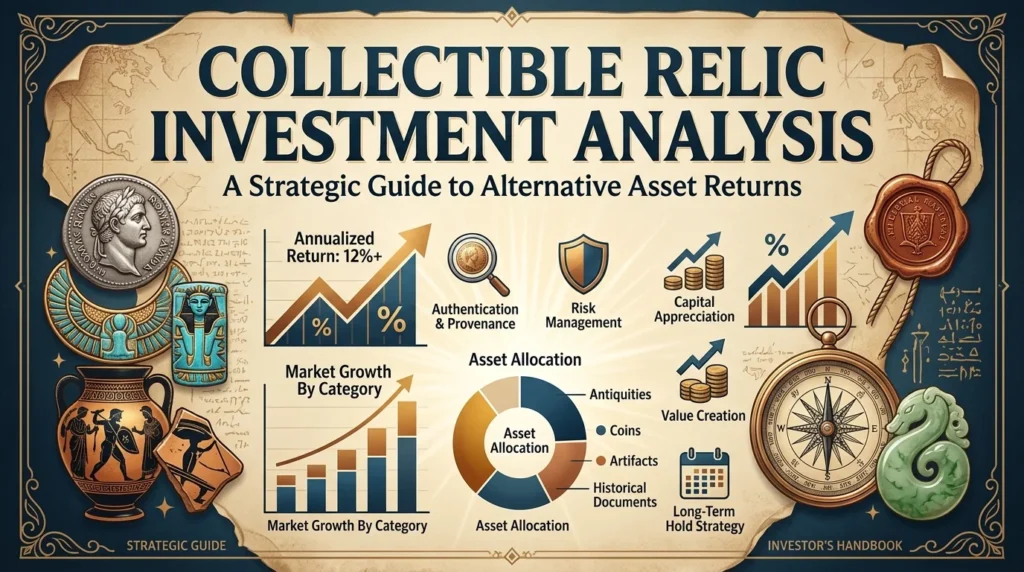
Impressionist art led all categories in 2025 with a 13.6% appreciation, driven by major single-owner sales and extraordinary auction results. Gustav Klimt’s “Portrait of Elisabeth Lederer” achieved $236.4 million, the highest price ever for a modern artwork sold at auction . Modern art rose 7.1%, postwar art gained 5.2%, and European Old Masters posted a 1.7% gain. These results demonstrate that top-tier art continues to attract serious capital even during broader market uncertainty.
Luxury Watches: Resilience Through Scarcity
Watches rose 5.1% in 2025, supported by sustained demand for Patek Philippe’s Aquanaut and Nautilus models, along with continued strength from Rolex . The category has become one of the most closely watched in luxury investing, with buyers focusing on recognizable models, exceptional condition, and long-term collectability. Unlike many collectibles, high-end watches offer the additional benefit of wearability, though investors should be cautious about actually wearing investment-grade pieces.
Rare Coins: A Market Poised for Growth
Multiple factors are converging to drive rare coin prices higher. Streaming auction platforms like Whatnot and eBay Live have created unprecedented demand, with sellers “devouring everything they can find” according to industry experts . The gamification of coin buying through mystery boxes and “breaks” has introduced new participants to the market. Additionally, rising precious metals prices have established a higher floor for gold and silver coins, while dealer inventories remain at historic lows—a classic supply-demand imbalance that typically precedes price increases .
| Category | 2025 Performance | Key Drivers | 2026 Outlook |
|---|---|---|---|
| Impressionist Art | +13.6% | Major single-owner sales, trophy asset demand | Positive |
| Modern Art | +7.1% | Auction records, institutional buying | Stable to Positive |
| Luxury Watches | +5.1% | Brand strength, wearable utility | Positive |
| Rare Coins | Not separately reported | Streaming auctions, gamification, low inventory | Strongly Positive |
| Classic Cars | -3.7% | Market cooling, high maintenance costs | Neutral |
| Handbags | -0.2% | Stable, provenance-driven outliers | Stable |
4. Risks and Considerations for Relic Investors
Despite the compelling upside, investing in collectible relics carries unique risks that distinguish this asset class from traditional securities.
Illiquidity and Transaction Costs
Collectibles are inherently illiquid. Unlike stocks that can be sold in seconds, a rare artifact may take months or years to find a buyer at the desired price. Auction house commissions typically range from 10% to 25% of the hammer price, eating substantially into returns. Investors should approach collectibles with a long-term horizon of at least five to ten years and maintain adequate liquidity elsewhere in their portfolios .
Authentication and Fraud Risk
The collectibles market has historically attracted counterfeiters and fraudsters. While transparency has improved dramatically in the internet era—with bad actors quickly exposed by online communities—risk remains . Investors should only purchase from reputable dealers who provide third-party authentication and clear documentation. For coins, certification from services like Professional Coin Grading Service (PCGS) or Numismatic Guaranty Company (NGC) is essential . Online purchases require particular scrutiny, as authenticity and pricing are harder to verify remotely.
Storage and Insurance Costs
Proper preservation requires investment in climate-controlled storage, security systems, and specialized display cases. Insurance for collectibles typically costs 1% to 2% of value annually, with higher rates for items with exceptional value or vulnerability to theft or damage . These carrying costs erode returns and must be factored into investment calculations.
Market Volatility and Trend Risk
Collector tastes change. Categories that seem invincible today may fall out of favor tomorrow. The classic car market declined 3.7% in 2025 despite strong performance from “halo” models like the Ferrari F50 . Investors who bought at the peak of a trend may face prolonged holding periods or losses if they need to sell during a downturn.
5. Strategic Approaches for the Discerning Investor
Successful collectible relic investment requires a disciplined, research-driven approach rather than emotional purchasing.
The Hybrid Portfolio Strategy
Financial advisors increasingly recommend allocating a small portion of client portfolios—typically 5% to 10%—to collectibles as a diversification tool . This hybrid approach combines the growth potential of tangible assets with the stability and liquidity of traditional stocks and bonds. Within the collectible allocation, further diversification across categories (art, coins, watches) can reduce category-specific risk.
Focus on Blue-Chip Scarcity
In a market where “rare” is overused, true scarcity commands a premium. Investors should prioritize items with documented limited production, significant historical importance, or unique characteristics that cannot be replicated. For coins, this means focusing on proof issues, limited editions, and error coins with documented mint mistakes . For art, established artists with auction records and institutional demand offer more predictable appreciation than emerging names.
The Passion Premium
Perhaps the most counterintuitive investment advice is to collect what you love. Genuine passion drives the research and due diligence that leads to better investment decisions . Curious collectors naturally develop informational advantages in their chosen niches, learning to spot undervalued opportunities before the broader market recognizes them. Moreover, the intrinsic enjoyment of ownership provides value even during periods of flat or declining prices—a psychological benefit that purely financial assets cannot match.
Entry Points for New Investors
For those new to collectible investing, several accessible entry points exist. American Gold Eagles and Silver Eagles offer liquidity and lower markups than exotic rarities . Numismatic coins in the 5,000to50,000 range represent the “sweet spot” for many investors, offering meaningful scarcity without the extreme concentration risk of million-dollar trophies . Fractional ownership platforms provide another avenue, though investors should carefully evaluate fee structures and governance before committing capital.
6. The Future of Collectible Relic Investment
Several structural trends suggest continued growth for collectible relics as an asset class. The rise of digital authentication through blockchain technology could solve longstanding provenance challenges, making the market more accessible to institutional capital . Younger collectors, approaching ownership differently than previous generations, are driving demand for fractional platforms and digital-native collectibles . Meanwhile, persistent inflation concerns and growing US national debt—approaching $2 trillion annually—position tangible assets as hedges against currency debasement .
The market has matured significantly from the “boiler room” operations of the pre-internet era. Transparency has increased, bad actors are quickly identified, and information is more accessible than ever . While this maturity has eliminated some arbitrage opportunities, it has also made the market safer for legitimate investors.
Conclusion
Collectible relic investment represents a compelling frontier for portfolio diversification and wealth preservation. The convergence of institutional recognition, technological innovation, and shifting demographic preferences suggests sustained demand for rare, authenticated items with clear provenance. However, success requires discipline, research, and a long-term orientation. The most successful investors will be those who combine financial rigor with genuine passion—recognizing that the true value of collectibles extends beyond quarterly returns to encompass history, culture, and human connection.
Frequently Asked Questions (FAQs)
Q1: What percentage of my portfolio should be allocated to collectibles?
Most financial advisors recommend limiting collectible exposure to 5-10% of a diversified portfolio . This allocation provides diversification benefits without exposing investors to excessive illiquidity risk. Within this allocation, further diversification across multiple collectible categories is advisable.
Q2: How can I verify the authenticity of a collectible before purchasing?
Always purchase from reputable dealers who provide third-party certification. For coins, look for holders from PCGS or NGC . For art and artifacts, demand a documented provenance chain and consider independent appraisal. Avoid online purchases where authentication is difficult, and be wary of deals that seem too good to be true.
Q3: Are digital collectibles and NFTs a viable investment?
While blockchain-authenticated digital assets have gained attention, the market remains highly speculative. Investors should prioritize platforms with regulatory compliance, clear intellectual property rights, and demonstrated liquidity . Digital collectibles should represent only a small portion of any collectible allocation.
Q4: How do taxes work on collectible investment gains?
In most jurisdictions, collectibles are subject to capital gains tax upon sale. Rates may differ from those applied to stocks or bonds—in the United States, collectibles held for over one year are taxed at a maximum rate of 28%, higher than the 20% rate for most other long-term capital gains. Consult a tax professional for jurisdiction-specific guidance.
Q5: What is the minimum investment needed to start collecting seriously?
Entry points vary by category. Common date silver coins can be acquired for under 100,whilefinearttypicallyrequiresfiveorsixfigures[citation:7].The5,000 to $50,000 range represents a productive entry point for many numismatic and decorative art categories, offering meaningful scarcity without prohibitive concentration . New investors should start small, learn their chosen category thoroughly, and scale up as expertise develops.
Q6: How does fractional ownership work, and is it recommended?
Fractional platforms allow multiple investors to own shares in high-value collectibles. These platforms have gained traction among younger investors seeking access to trophy assets . While they offer lower entry barriers, investors should carefully evaluate fee structures, voting rights, and exit mechanisms. Not all fractional platforms have proven their long-term viability.