Collectible Object Preservation Methods: Museum-Grade Techniques to Protect Your Valuables
Introduction
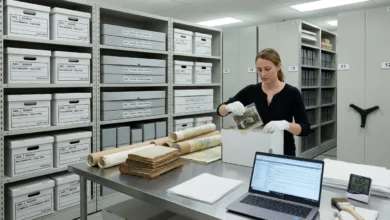
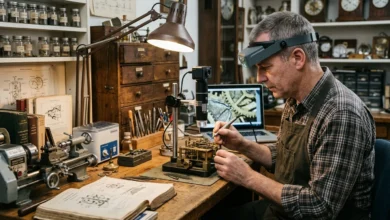
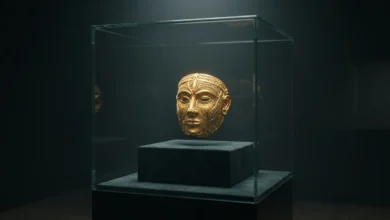
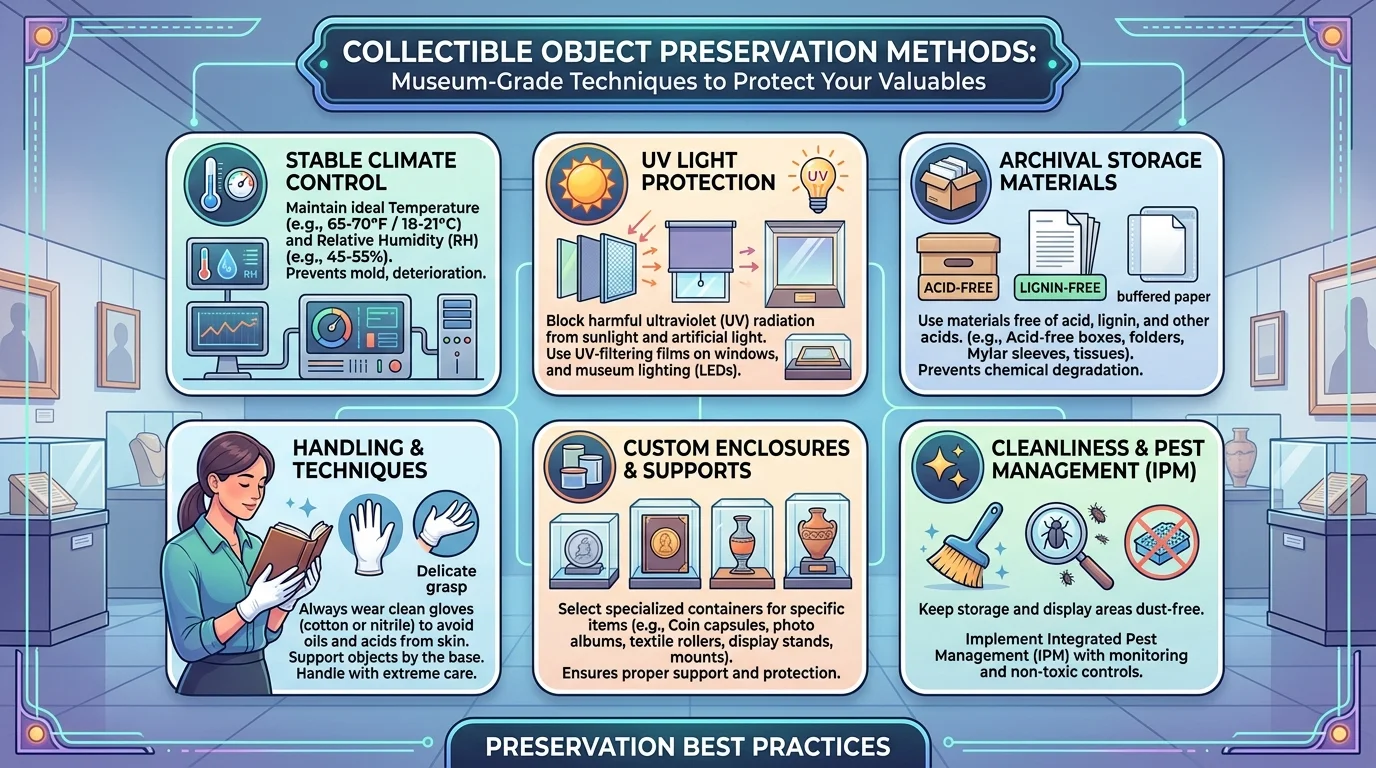
All materials degrade over time. Some deteriorate because of their inherent properties, others as a result of poor storage or display conditions. We cannot stop degradation, but professional collectible object preservation methods allow us to control how fast it happens . Whether you collect vintage textiles, rare coins, antique furniture, or ceramic figurines, understanding how different materials respond to light, humidity, temperature, and handling is essential. This article delivers museum-grade preservation strategies used by the National Archives of Australia, Yale University Library, and the Smithsonian Institution. Implement these techniques to keep your cherished collectibles in optimal condition for generations.
Why Preservation Matters More Than Restoration
Preservation prevents damage before it occurs. Restoration attempts to reverse damage after it happens. The former is always cheaper, more effective, and better for an object’s long-term value. Professional conservators agree: an object with original surface patina and honest wear is more valuable than one that has been aggressively restored. Collectible object preservation methods focus on creating stable environments, using archival-quality storage materials, and minimizing physical handling.
The Five Enemies of Collectible Objects
| Enemy | Effect | At-Risk Materials | Prevention Method |
|---|---|---|---|
| Light (especially UV) | Fading, embrittlement, chemical breakdown | Textiles, paper, photographs, colored plastics | UV-filtering film, low-lux lighting, storage in darkness |
| Humidity (above 65%) | Mold growth, corrosion, swelling | Leather, wood, paper, metals | Dehumidifier, silica gel, maintain below 60% RH |
| Humidity (below 35%) | Cracking, shrinkage, brittleness | Wood, ivory, bone, textiles | Humidifier, microclimate boxes |
| Temperature fluctuations | Physical stress, condensation, accelerated chemical reactions | All materials, especially mixed-media objects | Climate-controlled storage, avoid attics and basements |
| Insects & Rodents | Physical damage, staining, contamination | Textiles, paper, leather, wood furniture | Regular inspection, blunder traps, no food in storage areas |
Material-Specific Preservation Methods
Paper and Photographs
Paper artifacts include books, letters, posters, comic books, prints, and photographs. These are among the most vulnerable collectibles.
- Store flat in acid-free boxes or folders. Never fold large items .
- Use unbuffered tissue for photographs (buffered tissue can damage certain photographic processes).
- Maintain temperature between 18-20°C (65-68°F) and relative humidity between 45-50% .
- Keep away from light. Fluorescent tubes emit high UV levels .
- Handle with clean, dry hands or wear nitrile gloves .
- Never use adhesive tape, rubber cement, or glue sticks on paper items.
Textiles and Costumes
Textiles include clothing, quilts, flags, tapestries, rugs, and stuffed toys. Old textiles can be extremely fragile .
- Lay flat in archival boxes, interleaved with acid-free tissue paper .
- Pad folds with sausage-shaped tissue rolls to prevent crease damage .
- Use padded hangers only for sturdy garments. Most textiles should be stored flat.
- Avoid washing with detergents or bleaches, which weaken fibers .
- Freezing can treat textile infestations without chemicals .
- Never store textiles in plastic dry-cleaning bags, which trap moisture.
Metals (Coins, Medals, Silverware, Tools)
Metal corrosion accelerates as humidity rises . Different metals require different approaches.
- Store in low-humidity environments (below 40% for iron and steel).
- Use archival coin holders or capsules. Avoid PVC flips, which release damaging gasses.
- Wear gloves when handling silver and copper to prevent fingerprints .
- Never polish silver-plated items. Abrasive polishes wear through the thin plating layer.
- Apply microcrystalline wax (Renaissance Wax) to iron and steel tools after cleaning.
- Avoid polishes and harsh cleansers on painted or gilt surfaces .
Ceramics and Glass
Ceramics and glass are brittle but chemically stable if undamaged. However, they present unique challenges.
- Do not stack glass or china pieces directly on top of each other .
- Use padding between stacked items (acid-free tissue or archival foam).
- Handle with gloves to prevent fingerprints and oil transfer.
- Repair only with reversible adhesives (Hxtal NYL-1, not superglue).
- Store heavy items on lower shelves to prevent injury and damage.
Wooden Objects and Furniture
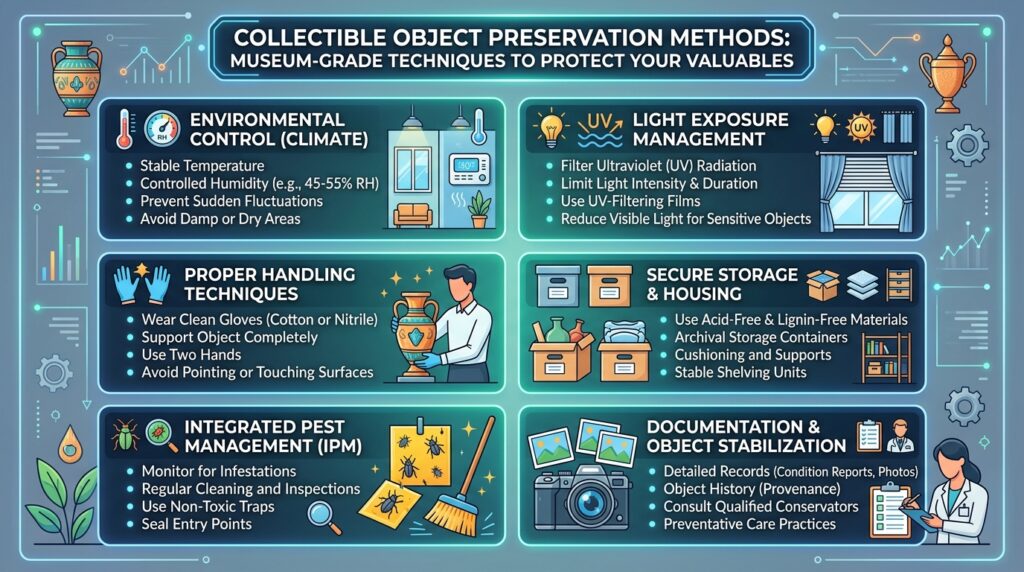
Wood cracks and warps under changing climatic conditions . Wooden storage equipment can also release harmful vapors .
- Maintain stable humidity (40-50% RH) to prevent cracking and warping.
- Avoid direct sunlight, which fades finishes and accelerates oxidation.
- Dust with soft cloths only. Avoid waxes, oils, and polishes containing silicone.
- Store furniture off the floor using plinths or pallets to protect from floods .
- Do not use wooden shelving for storage, as it can harbor insects and release vapors .
Bone, Ivory, and Natural Specimens
Over time, bone and ivory become brittle and discolor . Natural history specimens have additional vulnerabilities.
- Maintain stable, moderate humidity (45-50% RH). Too dry causes cracking, too humid causes swelling.
- Wear gloves when handling old animal skins or taxidermied specimens, as these may have been treated with arsenic or pesticides .
- Store away from light, which accelerates yellowing and embrittlement.
- Isolate specimens from other collections to prevent pest cross-contamination.
Plastics and Modern Synthetics
Plastics gradually become brittle as they lose plasticizers and other additives . Modern toys and collectibles require special attention.
- Isolate unstable early plastics so volatile off-gassing compounds do not affect other objects .
- Store in cool, dark environments. Heat accelerates plastic degradation.
- Avoid airtight enclosures for degrading plastics (gasses need to escape).
- Monitor for signs of deterioration: yellowing, stickiness, cracking, or white bloom.
Environmental Control Specifications
The National Archives of Australia recommends storage temperatures between 18-20°C (64-68°F) and relative humidity between 45-50% for mixed collections . For general home storage:
- Target temperature around 20°C (68°F)
- Keep relative humidity below 60% to prevent mold growth
- Avoid wide fluctuations, which physically stress objects
- Note that office air conditioning often operates only during business hours, leading to wider fluctuations at other times
For light control:
- Turn lights on only when needed
- Storage areas should ideally have no windows
- Where windows exist, use opaque curtains or blinds
- Fluorescent tubes emit high UV levels; replace with LED or add UV filters
Safe Handling Techniques
Proper handling prevents the majority of physical damage to collectibles.
| Handling Rule | Application | Why It Matters |
|---|---|---|
| Wear disposable nitrile gloves | Metals, glass, ceramics, photographs | Prevents oil and sweat transfer |
| Clean, dry bare hands | Textiles, paper (if gloves reduce dexterity) | Reduces risk of tearing delicate items |
| Carry one item at a time | Fragile objects | Prevents collision damage |
| Use trolleys for heavy items | Furniture, large ceramics | Prevents dropping and back injury |
| Support undersides | Ceramics, glass | Prevents stress on handles and rims |
| Open books flat with supports | Rare books, manuscripts | Prevents spine breaking |
Never hold an object by handles, straps, or attachments, which may be weaker than the main body .
Archival Storage Materials: A Buyer’s Guide
Manufacturers’ claims that products are “archival” may not reflect specific preservation standards . Follow these guidelines:
- Acid-free: pH 7.0 or higher. Use for paper, photographs, textiles.
- Lignin-free: Lignin causes paper to yellow and become brittle.
- Buffered vs. unbuffered: Buffered (alkaline reserve) for most paper; unbuffered for photographs, wool, silk, and某些 leathers.
- PVC-free: PVC releases hydrochloric acid as it degrades. Use polyethylene, polypropylene, or polyester (Mylar).
- Passed Photographic Activity Test (PAT): Required for materials in contact with photographs.
Approved archival supply vendors include Gaylord, University Products, and Talas. For small quantities, library supply vendors now offer boxes and storage supplies for personal use .
Packaging Guidelines for Collectible Objects
Objects should be individually wrapped so they do not touch and damage each other .
- Use shock-absorbing materials: acid-free tissue, archival foams, or bubble pack
- Never use newspaper (inks transfer, paper becomes brittle)
- Do not write or stick labels directly onto objects
- Label boxes clearly; tie cotton tape labels onto objects when practical
- Ensure boxes fully enclose objects with padding but are not so large that objects move freely
- For oversized items, drape with cotton dust sheets
For textiles specifically: interleave with archival tissue, pad folds, and never crush .
Storage Equipment Requirements
Storage equipment should be designed to minimize damage.
- Use coated metal shelving. Avoid wooden equipment, which releases harmful vapors, contributes to fire spread, and harbors insects
- Store items off the floor using plinths or plastic pallets for flood protection
- Do not store items on top of cabinets (too close to ceiling lights, risk of water damage from sprinklers)
- Ensure drawers operate smoothly, have stops to prevent full extension, and have front and back lips to prevent items from falling
- Never overfill drawers. Ideally half-full or containing only one flat object per drawer
Pest Prevention and Control
To reduce the risk of insect and rodent infestation :
- Do not eat in storage areas
- Keep surfaces clean (floors, shelf tops)
- Bait regularly for rodents
- Use insect blunder traps as monitors for localized infestation
- Inspect new acquisitions before adding to storage
- Isolate infested items and seek professional advice
Disaster Preparedness for Collectors
Create a disaster response plan for your collection:
- Document everything with photographs and written descriptions
- Store digital copies of documentation off-site
- Know the location of water shut-off valves and electrical panels
- Keep emergency supplies: plastic sheeting, absorbent pads, nitrile gloves, flashlights
- Identify a professional conservator before you need one
After a water event: air dry items if possible. Freeze wet paper and photographs to prevent mold while arranging professional treatment. Do not attempt to separate stuck pages.
When to Hire a Professional Conservator
Professional conservation costs 50−200 per hour but preserves value. Hire a conservator if:
- An item has active mold, insect damage, or corrosion
- A valued piece is broken (ceramics, glass, complex objects)
- You cannot identify the material composition
- The item has historical significance or value over $500
Find accredited conservators through the American Institute for Conservation (AIC) “Find a Conservator” tool. Expect a written treatment proposal before work begins.
Preservation vs. Restoration vs. Conservation: Critical Distinctions
- Preservation: Preventing future damage through environmental control and proper storage (does not alter the object)
- Conservation: Stabilizing an object with minimal visible intervention, using reversible methods
- Restoration: Returning an object to a previous appearance, often involving irreversible changes
For collectible objects, preservation is always the highest priority. Conservation is appropriate for unstable items. Restoration should be the last resort, only for objects where aesthetic appearance overrides historical authenticity.
The 10-Step Weekly Preservation Checklist
- Check temperature and humidity readings
- Inspect for dust accumulation on storage areas and objects
- Look for signs of insect activity (frass, webbing, casings)
- Verify that no direct sunlight is hitting any object
- Ensure storage boxes are properly closed
- Check for any signs of mold (musty smell, fuzzy growth)
- Confirm that no objects are touching each other
- Inspect for any new cracks, discoloration, or damage
- Clean exterior of storage cabinets with microfiber cloth
- Document any changes or concerns
Common Preservation Mistakes to Avoid
| Mistake | Consequence | Correct Action |
|---|---|---|
| Storing in basements or attics | Extreme temperature and humidity fluctuations | Climate-controlled interior closets or rooms |
| Using cardboard boxes | Acid migration, insect harborage | Archival-quality boxes |
| Wrapping in newspaper | Ink transfer, acid damage | Acid-free tissue or unbuffered paper |
| Displaying in direct sunlight | Fading, embrittlement | UV-filtering film, rotate display periods |
| Applying furniture polish to antiques | Silicone residue, surface damage | Dry dusting only |
| Using rubber bands or metal paper clips | Chemical damage, rust stains | Archival corners, plastic clips, cotton ties |
Preserving Born-Digital Collectibles
Digital files (digital art, scanned documents, digital photographs) require their own preservation strategies:
- Follow the 3-2-1 rule: 3 copies, 2 different media types, 1 off-site
- Use archival-grade M-Discs for optical storage (1,000-year rated)
- Migrate files to new formats every 5-10 years
- Store hard drives in cool, dry environments (heat kills drives)
Conclusion
Collectible object preservation methods are not complicated, but they require consistency and attention to detail. Control temperature and humidity. Filter or eliminate UV light. Use only archival-quality storage materials. Handle objects with clean hands or gloves. Inspect regularly for pests and damage. When in doubt, do nothing until you have consulted a professional conservator. The small investment in proper preservation today will keep your collectibles valuable and beautiful for decades to come.
Frequently Asked Questions (FAQs)
Q1: What are the ideal temperature and humidity levels for storing most collectibles?
A: Target 18-20°C (65-68°F) and 45-50% relative humidity. Keep humidity below 60% to prevent mold. Avoid fluctuations, which physically stress objects .
Q2: Can I store different types of collectibles together in the same box?
A: No. Objects should be wrapped individually so they do not touch each other . Different materials may have conflicting environmental needs. Isolate unstable plastics that off-gas harmful vapors .
Q3: Is it safe to wear cotton gloves when handling collectibles?
A: For most items, disposable nitrile gloves are preferred. Cotton gloves can snag on delicate surfaces and transfer dirt. Wear gloves when handling glass, metal, and photographs to prevent fingerprints .
Q4: How often should I clean my collectibles?
A: Gently clean objects only with a dry soft cloth or brush as needed . Over-cleaning causes damage. If objects need extensive cleaning, seek professional advice.
Q5: Can I use my home’s attic or basement for collectible storage?
A: No. Attics experience extreme heat and temperature fluctuations. Basements have high humidity and flood risk. Use climate-controlled interior closets or rooms.
Q6: What should I do if I find mold on a collectible?
A: Isolate the affected item immediately to prevent spread. Do not attempt to clean mold yourself without proper training and respiratory protection. Consult a professional conservator.
Q7: Are plastic storage bins safe for collectibles?
A: Only if they are made of polypropylene (PP #5) or polyethylene (PE #2, #4). Avoid polycarbonate and PVC bins. Even safe plastics should be used with interior archival boxes or tissue, as bins can trap moisture.
Q8: How do I preserve a vintage textile with creases?
A: Do not iron, which sets stains and flattens natural dimensionality. Store flat in an archival box with interleaved acid-free tissue. Pad folds with tissue rolls. This will reduce crease stress over time without causing damage .
Final Recommendation for Action
Examine one collectible in your home today. Is it stored in a cardboard box? Is it near a window? Is dust accumulating on its surface? Make one change this week: move it to an acid-free box, relocate it away from sunlight, or purchase a humidity monitor for your storage area. Small, consistent actions preserve value better than any single expensive intervention. Your grandchildren will thank you for the objects you save today.