Hidden Mechanics of Vintage Tools: Ingenious Engineering Secrets from Pre-Electric Era
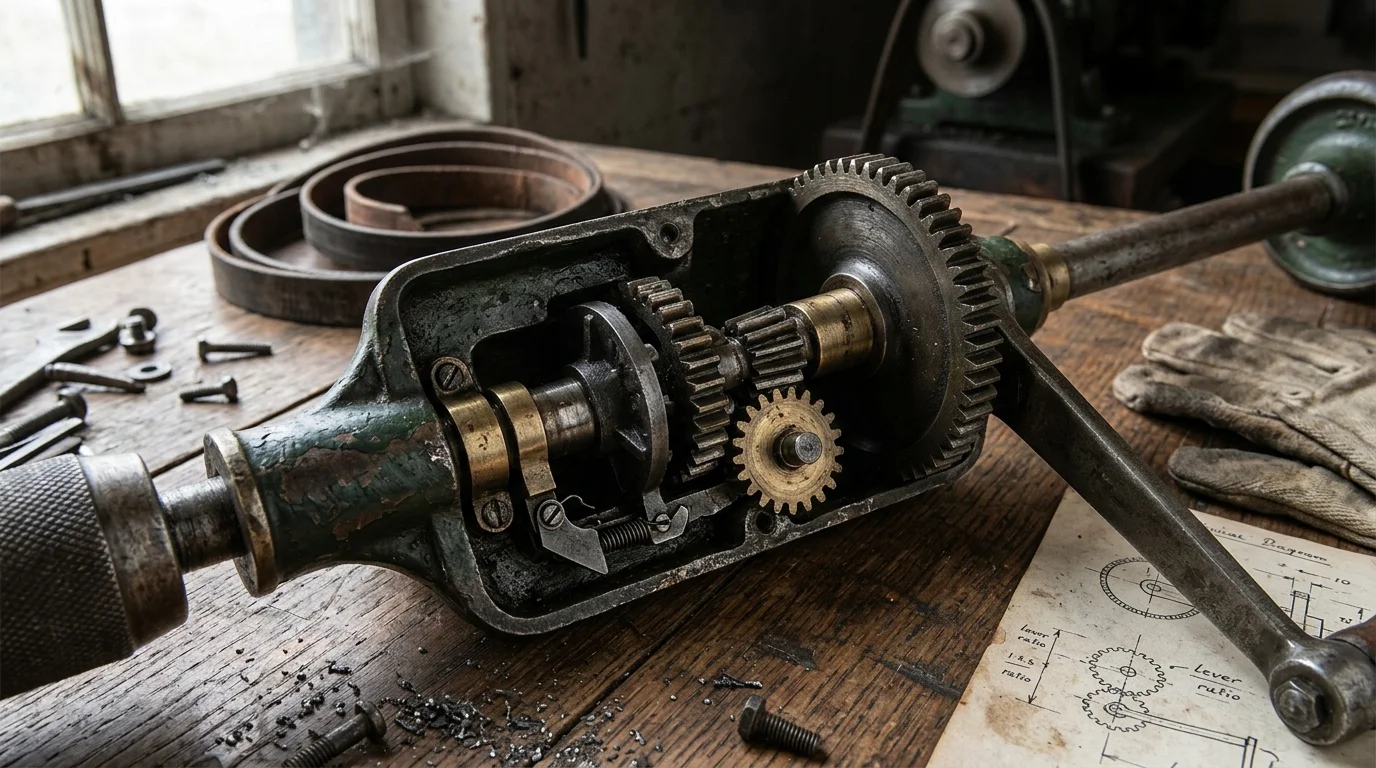
Table of Contents
- What Are Hidden Mechanics in Vintage Tools?
- The Mystery of the Handsaw Nib
- Multi-Function Gearing: The North Bros. 1530 Drill
- Decorative Precision: Rose Engine Lathes
- Mechanical Computing: Antique Adding Machine Internals
- Watchmaking Precision: Wheel Cutting Engines
- The Fusee Engine and Screw-Cutting Innovation
- Hand-Cut Gear Teeth and Slotting Machines
- Ancient Origins: Bow Drills and Early Lathes
- Frequently Asked Questions (FAQs)
- Preserving and Understanding Hidden Mechanisms
1. What Are Hidden Mechanics in Vintage Tools?
Hidden mechanics refer to the internal gearing, ratcheting systems, cam mechanisms, and engineering solutions built into vintage tools that are not visible from the outside. Unlike modern tools that often prioritize disposability, antique tools contained intricate mechanical features designed for specific functions, extended life, and even aesthetic appeal .
Understanding these hidden mechanisms transforms a collector’s perspective from simple ownership to genuine appreciation of pre-industrial and early-industrial engineering genius. Many of these mechanisms have no direct modern equivalent, making them both historically significant and mechanically fascinating.
2. The Mystery of the Handsaw Nib
Perhaps the most debated hidden feature in vintage tool history is the small protuberance near the tip of old handsaw blades, known as the “nib.”
The Mystery: For decades, tool collectors and historians debated the purpose of this tiny bump found on handsaws from the late 19th and early 20th centuries .
Popular but Incorrect Theories:
- A gauge to signal when to stop pulling the saw
- A scribe for starting cuts
- A tool to break through nails in recycled wood (which explains why so many have broken nibs)
The Actual Answer: According to Disston and Sons, a major saw manufacturer, and confirmed by the Disstonian Institute, “The ‘nib’ near the end of a hand saw has no practical use whatever, it merely serves to break the straight line of the back of the blade and is an ornamentation only” .
Hidden History: The nib was a stylistic holdover from 17th-century Dutch saws that featured an actual front knob handle. When steel became rigid enough to eliminate the need for a front handle, manufacturers kept the nib as a decorative tradition.
Collector Insight: Many saws found today have broken nibs, suggesting that users did attempt to use them as nail pullers, despite the manufacturer’s stated ornamental purpose.
3. Multi-Function Gearing: The North Bros. 1530 Drill
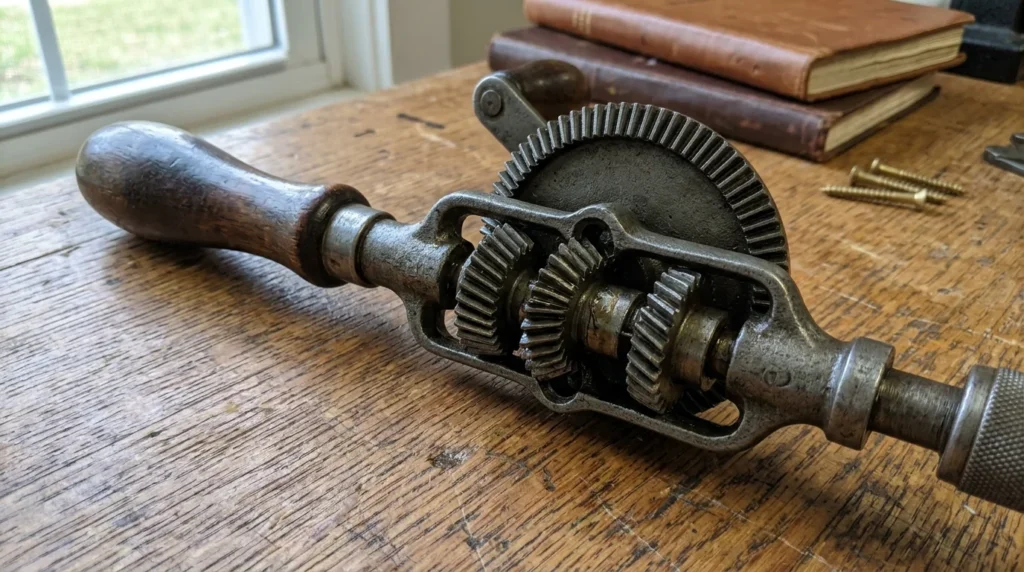
The North Bros. 1530 eggbeater drill represents one of the most complex hidden mechanisms ever mass-produced in a hand tool .
What It Looks Like: A standard 10.5-inch long hand drill with a wheel on the side.
The Hidden Mechanism: A five-position sliding switch on the shaft that completely changes how the chuck operates:
| Position | Mechanism Function |
|---|---|
| 1 | Normal operation: clockwise drills in, counterclockwise drills out |
| 2 | Clockwise does nothing; counterclockwise drills out only |
| 3 | Clockwise drills in; counterclockwise does nothing |
| 4 | No matter which direction you turn, chuck always drills into work |
| 5 | Gears locked completely |
Patent Origin: This mechanism was patented in 1908 by George O. Leopold (Patent 894,673) and represents a pinnacle of mechanical ratchet design .
Why It Matters: No modern hand drill offers this functionality. The mechanism allowed one-handed operation in tight spaces where changing grip was impossible. Collectors consider fully functional 1530 models highly desirable.
4. Decorative Precision: Rose Engine Lathes
The rose engine lathe represents hidden mechanics applied to decorative art rather than pure utility.
Basic Description: A specialized lathe that uses cam-like rosettes to create rhythmic movements in the cutting tool, producing complex decorative patterns on metal objects .
The Hidden Mechanism:
| Component | Function |
|---|---|
| Rosettes (cams) | Mounted on mandrel with edge and side serrations |
| Rubbing pieces | Bear against rosettes, causing mandrel to move rhythmically |
| Plate springs | Hold mandrel in contact with rubbers |
| Backgearing | Belt pulley arrangement for speed control |
Historical Example: The Hulot Fils rose engine lathe of 1768 from France could produce both lateral and longitudinal wavy lines on work surfaces. The mandrel could move freely in its bearings while the headstock moved laterally on fulcrums .
Applications: Used for ornamental turning on watch cases, snuff boxes, and fine jewelry. The patterns created are impossible to replicate with standard lathes because they require the synchronized rhythmic movement that only rosettes can produce.
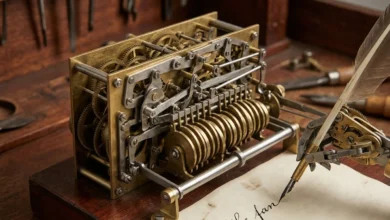
5. Mechanical Computing: Antique Adding Machine Internals
Before electronic calculators, adding machines performed complex calculations using purely mechanical means.
The Hidden Complexity: Banks of gears, levers, springs, and ratchets working in sequence to perform addition, subtraction, multiplication, and division .
Key Mechanical Principles:
- Each key press rotates a gear by a specific number of teeth
- Carry mechanisms use 9-to-10 tooth transitions to advance the next digit
- Tens transfer mechanisms link adjacent columns
- Subtraction often uses complementary digit methods (9s complement)
Why Collectors Value Them: The internal mechanisms are visible when covers are removed, revealing a mesmerizing array of interacting metal parts. Photographer Kevin Twomey describes using hot lights to capture “the intricate and complex inner workings” that “sing” when properly illuminated .
Restoration Note: These mechanisms require careful cleaning without removing original lubrication. Many use specific oil blends no longer manufactured.
6. Watchmaking Precision: Wheel Cutting Engines
Wheel cutting engines represent hidden mechanics at the highest precision level, designed specifically for clock and watch makers.
Purpose: Cutting gear teeth (wheels) for timepieces where tooth accuracy directly affects timekeeping .
Hidden Features:
- Index plates with multiple division rings (typically 21 rings ranging from 60 to 100 teeth)
- X and Y tilt angle adjustment for cutter positioning
- Locking sprung detent for precise index positioning
- Dovetail slides with calibrated degree scales
Rare Capability: Some late 19th-century German engines included “rare X and Y tilt angle adjustment” allowing cutters to approach the work from different angles—a feature not found on most modern gear cutters .
Collector Value: Complete, functional wheel cutting engines from the late 19th century are extremely rare. The example shown at auction featured “gentle age-related oxidation” but remained “in good original working condition” .
7. The Fusee Engine and Screw-Cutting Innovation
The fusee engine represents a specialized adaptation of screw-cutting lathe technology for clockmaking.
What It Cut: Fusees—the conical pulleys used in clock movements to equalize spring tension .
The Hidden Mechanism:
The early 19th-century fusee lathe used a rack and pinion system where:
- A pinion on the mandrel rotated with the workpiece
- The pinion engaged a rack that traveled perpendicular to the lathe axis
- The rack frame carried an adjustable inclined bar
- The cutting tool moved along the bed at a rate determined by the bar’s inclination
- This inclination directly controlled the pitch of the thread being cut
Why Ingenious: This mechanism allowed variable pitch threading on a conical surface—a complex mathematical relationship achieved through purely mechanical means without any calculation by the operator.
8. Hand-Cut Gear Teeth and Slotting Machines
One of the most surprising hidden mechanics is visible only under close inspection: hand-cut gear teeth.
The Practice: Throughout the 19th century, many engineering firms made their own tools rather than purchasing from manufacturers. This included cutting gear teeth by hand .
Identifying Features:
- Irregular tooth spacing
- Variable tooth profiles
- Repair pegs replacing broken teeth (hand-shaped wooden or metal pegs)
Example: The Unknown Slotting Machine (c.1830)
This 10-foot 9-inch tall cast iron machine features gear teeth that “have been replaced by pegs” due to wear. Because gear teeth were hand-cut, they “tended to be irregular and prone to wear and break” .
Collector Significance: Machines without maker’s marks were often shop-built, making them unique examples of vernacular engineering. The slotter “bears no makers name” because “many engineering firms made their own tools” .
9. Ancient Origins: Bow Drills and Early Lathes
The hidden mechanics of vintage tools have roots extending to antiquity, with direct lineage to tools used for constructing the Antikythera Mechanism.
Ancient Bow Drill (c. 490 BC):
Depicted on Greek red figure vases, the bow drill used a thong wrapped around a wooden shaft. The user moved the bow back and forth, spinning the drill at high speed .
Homer described this mechanism in the Odyssey (Line 380):
“They took the stake of olive-wood, sharp at the point, and thrust it into his eye, while I, throwing my weight upon it from above, whirled it round, as when a man bores a ship’s timber with a drill, while those below keep it spinning with the thong” .
Ancient Lathe References:
Pliny credited Theodorus of Samos (c. 500 BC) with inventing the lathe. An inscribed column from Eleusis (c. 400 BC) uses the words “τορνεύσει” (shape via rotating) and “τόρνου” (lathe) in a construction contract for bronze connectors .
Antikythera Connection: Researchers have concluded that the Antikythera Mechanism (circa 100 BCE) required lathe-turned components for its gearing system. The precision of its circular shafts and gear blanks would have been impossible without these ancient machine tools .
10. Frequently Asked Questions (FAQs)
Q1: What defines a “hidden” mechanism in a vintage tool?
A: A hidden mechanism is any internal gearing, ratcheting, cam, or linkage system that is not visible during normal tool use. Examples include multi-position ratchets, internal gear trains, and cam-driven oscillating cutters. These mechanisms typically require partial disassembly to observe.
Q2: How can I identify if a vintage tool has valuable hidden mechanics?
A: Look for patent dates on the tool body (e.g., “PAT. 894,673”). Research the patent online to understand the mechanism. Also look for unusual levers, sliding switches, or knobs whose function is not immediately obvious. These often control hidden internal systems.
Q3: Should I disassemble a vintage tool to see its hidden mechanics?
A: Only if you have proper tools and experience. Many vintage tools use left-hand threads, spring-loaded components that can launch, and fragile pot metal parts. For valuable tools, consult a specialist restoration expert first. The North Bros. 1530’s gearbox is described as making users “never want to open it up” .
Q4: What is the most mechanically complex vintage hand tool ever made?
A: The North Bros. 1530A drill with its five-position ratchet mechanism is widely considered among the most complex. Other contenders include late Victorian combination tools with 20+ functions and early mechanical calculators with hundreds of interacting parts.
Q5: How do I preserve the hidden mechanics of a vintage tool?
A: Do not use modern WD-40 or penetrating oils. Use proper clock or gun oil for metal mechanisms. Store in dry conditions (under 50% RH for steel components). Exercise mechanisms periodically to prevent seizing, but without applying heavy force. Document any disassembly with photographs.
Q6: Are tools with hidden mechanics more valuable than simple tools?
A: Generally yes, but condition is critical. A non-functional complex tool may have parts value only. A functional example with smooth operation commands significant premium. The rose engine lathe by Hulot Fils (1768) is a museum piece of incalculable value .
Q7: What is the oldest evidence of hidden mechanics in tools?
A: The Antikythera Mechanism (circa 100 BCE) contains over 30 bronze gears in a complex arrangement. While a computing device rather than a hand tool, it proves that gearing technology existed at that time. The bow drill described by Homer (c. 8th century BCE) represents the earliest described mechanical tool .
11. Preserving and Understanding Hidden Mechanisms
For Collectors:
- Acquire patent literature for your tools (free via Google Patents)
- Join specialist communities (Early American Industries Association, tool collector forums)
- Learn to operate mechanisms before disassembling
- Document original lubrication points and types
For Researchers:
- X-ray imaging can reveal internal mechanisms without disassembly
- High-resolution macro photography captures gear tooth wear patterns
- 3D scanning enables digital preservation of rare mechanisms
The Value of Understanding:
A tool’s hidden mechanics tell the story of how pre-electric engineers solved problems. The five-position ratchet solved the problem of one-handed drilling in corners. The rose engine rosette solved the problem of repetitive decorative patterns. The fusee engine solved the problem of variable pitch conical threading .
Each mechanism represents a moment of human ingenuity fixed in metal and wood—waiting to be rediscovered by the collector who looks beyond the surface.